
[论文解读] Improving Generative Model-based Unfolding with Schrödinger Bridges
SBUnfold 使用 Schrödinger Bridges 学习基于扩散的映射来展开,结合 OmniFold 与 IcINN 的优点,在合成的 Z+jets 数据集上相对于最先进方法表现改进,尤其是在数据有限时。
Machine learning-based unfolding has enabled unbinned and high-dimensional differential cross section measurements. Two main approaches have emerged in this research area: one based on discriminative models and one based on generative models. The main advantage of discriminative models is that they learn a small correction to a starting simulation while generative models scale better to regions of phase space with little data. We propose to use Schroedinger Bridges and diffusion models to create SBUnfold, an unfolding approach that combines the strengths of both discriminative and generative models. The key feature of SBUnfold is that its generative model maps one set of events into another without having to go through a known probability density as is the case for normalizing flows and standard diffusion models. We show that SBUnfold achieves excellent performance compared to state of the art methods on a synthetic Z+jets dataset.
研究动机与目标
- 通过结合判别模型和生成模型的优势,激励并改进用于差分截面的机器学习展开。
- 使用 Schrödinger Bridges 开发 SBUnfold,在数据集之间建立映射,而无需已知的源分布。
- 在合成的 Z+jets 数据集上,与 OmniFold 和 IcINN(cINN)比较 SBUnfold 的表现。
- 在数据可用性变化下评估性能,以测试鲁棒性和数据效率。
提出的方法
- 描述 Schrödinger Bridges 及其与扩散模型和 SB 理论的关系。
- 通过用基于 Schrödinger Bridge 的传输替代 IcINN 的 E 步,将 SB 集成到展开工作流中。
- 使用扩散过程将探测器层面的观测量去噪,朝向起 generator 层的分布,从重建层输入开始。
- 比较随机采样与确定性(ODE)采样方案,并选择一个简单的确定性变体。
- 在 Pythia 生成的模拟上进行训练,并使用基于 Herwig 的伪数据集评估展开质量,使用如 EMD 和三角鉴别器等度量。
实验结果
研究问题
- RQ1 Schrödinger Bridges 是否能够在展开中提供高数据效率且准确的探测器层与生成器层分布之间的传输?
- RQ2SBUnfold 是否在保留 OmniFold(数据驱动 E 步)和 IcINN(仿真驱动 E 步)的实际优势的同时减轻它们的弱点?
- RQ3在不同的数据可用性(如样本减少)下,SBUnfold 相对于 cINN 和 OmniFold 的表现如何?
主要发现
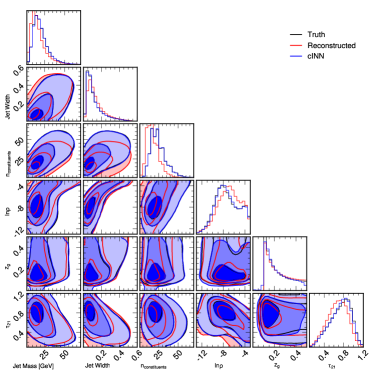
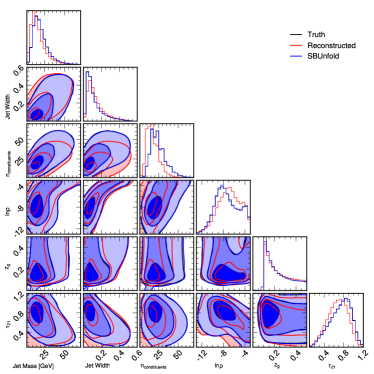
- SBUnfold 在多种喷射观测量上,始终实现较低的未 bin 的地球移动距离(EMD),且通常具有较低的三角鉴别值,相较于 cINN。
- SBUnfold 对具有尖锐特征的分布显示出更高的保真度,并从重建层事件派生的有信息先验中受益。
- 当数据稀缺时,SBUnfold 比 OmniFold 更具鲁棒性,而后者在有限数据情形下性能可能下降。
- 以 Herwig 作为伪数据时,SBUnfold 与生成器层分布更一致,在六个喷射观测量中,在某些情形甚至优于 OmniFold(Step 1)与 cINN 相比。
- 迁移矩阵表明 SBUnfold 对重建事件应用的改动较小,呈现对角线式的矫正特征,符合温和的展开。
更好的研究,从现在开始
从论文设计到论文写作,大幅缩短您的研究时间。
无需绑定信用卡
本解读由 AI 生成,并经人工编辑审核。