
[论文解读] In-situ vs accreted Milky Way globular clusters: a new classification method and implications for cluster formation
本文提出一种新的分类方法,用于区分银河系球状星团(GCs)是否为原位形成或吸积形成,基于总能量与角动量的z分量,并以[Al/Fe]丰度比进行校准。该方法成功区分了原位与吸积GCs,揭示了其在空间分布、运动学特征和化学性质上的显著差异——原位GCs表现出类似盘状的分布,且在[Fe/H] ≈ −1.3至−1.0之间出现旋转速度上升的特征,表明其形成于约117亿至127亿年前银河系盘的形成时期。
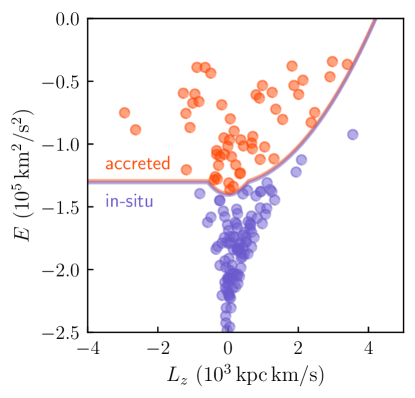
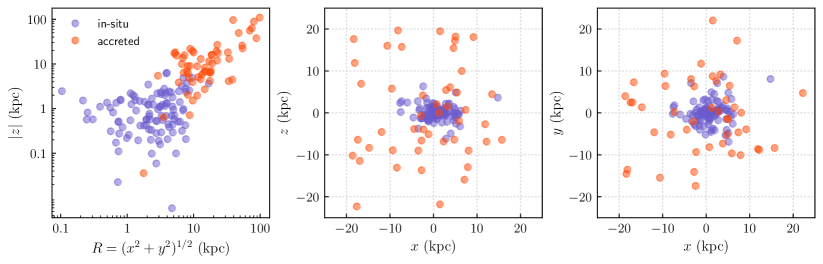
We present a new scheme for the classification of the in-situ and accreted globular clusters (GCs). The scheme uses total energy $E$ and $z$-component of the orbital angular momentum and is calibrated using [Al/Fe] abundance ratio. We demonstrate that such classification results in the GC populations with distinct spatial, kinematic, and chemical abundance distributions. The in-situ GCs are distributed within the central 10 kpc of the Galaxy in a flattened configuration aligned with the MW disc, while the accreted GCs have a wide distribution of distances and a spatial distribution close to spherical. In-situ and accreted GCs have different $ m [Fe/H]$ distributions with the well-known bimodality present only in the metallicity distribution of the in-situ GCs. Furthermore, the accreted and in-situ GCs are well separated in the plane of $ m [Al/Fe]-[Mg/Fe]$ abundance ratios and follow distinct sequences in the age--$ m [Fe/H]$ plane. The in-situ GCs in our classification show a clear disc spin-up signature -- the increase of median $V_ϕ$ at metallicities $ m [Fe/H]\approx -1.3÷-1$ similar to the spin-up in the in-situ field stars. This signature signals the MW's disc formation, which occurred $\approx 11.7-12.7$ Gyrs ago (or at $z\approx 3.1-5.3$) according to GC ages. In-situ GCs with metallicities of $ m [Fe/H]\gtrsim -1.3$ were thus born in the Milky Way disc, while lower metallicity in-situ GCs were born during early, turbulent, pre-disc stages of the evolution of the Galaxy and are part of its Aurora stellar component.
研究动机与目标
- 开发一种基于数据的稳健分类方案,仅使用能量与角动量即可区分银河系中球状星团的原位与吸积来源。
- 利用[Al/Fe]丰度比对分类方法进行校准,该比值可作为形成环境与星团起源的示踪指标。
- 研究原位与吸积球状星团群体在空间、运动学与化学性质上的差异。
- 将原位GCs观测到的运动学趋势与银河系盘的形成时标及其早期演化阶段联系起来。
- 通过宇宙学模拟(FIRE-2)验证分类结果,确保与星系形成模型的一致性。
提出的方法
- 分类基于总能量(E)与轨道角动量的z分量(Lz),这两项参数在盖亚数据中对所有银河系GCs均可用。
- 该方法通过[Al/Fe]丰度比进行校准,该比值可区分原位([Al/Fe]较高)与吸积([Al/Fe]较低)星团。
- 根据星团在E–Lz平面中的位置,结合化学丰度数据提供的决策边界,将其归类为原位或吸积。
- 通过与FIRE-2宇宙学模拟对比,检验该方法:比较原位与吸积GCs的径向与速度分布与观测数据的一致性。
- 利用[镁/铁]与[铝/铁]等额外丰度比对分类进行优化,尤其针对已知异常星团如ω Cen与NGC 6273。
- 统计验证表明,原位星团的误分类率不超过10%,且已知异常值已在星表中特别标注。
实验结果
研究问题
- RQ1能否仅使用能量与角动量可靠地对银河系球状星团进行原位与吸积群体的分类?
- RQ2原位与吸积球状星团在空间、运动学与化学性质上的差异是什么?这些差异是否可量化?
- RQ3原位球状星团是否表现出与盘形成相关的运动学特征,例如在特定金属量下出现旋转速度上升?
- RQ4观测到的原位与吸积球状星团分布是否与星系形成宇宙学模拟的预测一致?
- RQ5像[Al/Fe]与[Mg/Fe]这样的丰度比在区分星团起源与优化分类方面有多大的帮助?
主要发现
- 原位球状星团被限制在银河系中心10 kpc范围内,表现出扁平且与盘面对齐的空间分布,而吸积星团则呈现近乎球对称的分布。
- 原位GC群体在[Fe/H]上表现出双峰金属量分布,主峰位于[Fe/H] ≈ −1.3至−1.0之间,而吸积群体则呈现单峰、低金属量的分布。
- 原位GC群体显示出清晰的自转提升特征:在[Fe/H] ≈ −1.3至−1.0之间,中位Vϕ显著上升,与原位场星的运动学趋势一致。
- 根据原位GCs中自转提升的时间点,推断出银河系盘的形成时间约为117亿至127亿年前(z ≈ 3.1至5.3)。
- 在[Al/Fe]–[Mg/Fe]丰度平面中,原位与吸积GCs被清晰分离,呈现出不同的序列,表明其形成环境存在本质差异。
- 当进行金属量匹配后,银河系中原位与吸积GCs的径向与速度分布与FIRE-2模拟中对应的原位与吸积恒星粒子的分布高度一致,支持了球状星团形成于富含气体、频繁并合的时期这一模型。
更好的研究,从现在开始
从阅读论文到最终审阅,大幅缩短您的研究时间。
无需绑定信用卡
本解读由 AI 生成,并经人工编辑审核。