
[论文解读] Industry-Relevant Implicit Large-Eddy Simulation of a High-Performance Road Car via Spectral/hp Element Methods
本文首次采用谱/$hp$单元方法,实现了对完整高性能跑车的高阶精度隐式大涡模拟(LES)。通过开发鲁棒的高阶网格生成技术与先进数值格式——特别是基于能量稳定分析的CG-SVV算子——作者实现了复杂、高雷诺数流场的稳定、高保真模拟,标志着高阶计算流体动力学(CFD)在工业领域应用的重要进展。
We present a successful deployment of high-fidelity Large-Eddy Simulation (LES) technologies based on spectral/hp element methods to industrial flow problems, which are characterized by high Reynolds numbers and complex geometries. In particular, we describe the numerical methods, software development and steps that were required to perform the implicit LES of a real automotive car, namely the Elemental Rp1 model. To the best of the authors' knowledge, this simulation represents the first fifth-order accurate transient LES of an entire real car geometry. Moreover, this constitutes a key milestone towards considerably expanding the computational design envelope currently allowed in industry, where steady-state modelling remains the standard. To this end, a number of novel developments had to be made in order to overcome obstacles in mesh generation and solver technology to achieve this simulation, which we detail in this paper. The main objective is to present to the industrial and applied mathematics community, a viable pathway to translate academic developments into industrial tools, that can substantially advance the analysis and design capabilities of high-end engineering stakeholders. The novel developments and results were achieved using the academic-driven open-source framework Nektar++.
研究动机与目标
- 弥合学术高阶CFD研究与汽车空气动力学工业应用之间的差距。
- 解决典型真实车辆复杂曲面几何中高阶网格生成的关键挑战。
- 利用谱/$hp$方法实现对整个高性能汽车在高雷ynolds数下的稳定、高保真隐式LES模拟。
- 证明高阶方法在更准确捕捉非定常流动物理特性方面优于传统RANS和DES方法。
- 验证开源学术框架(如Nektar++)集成至工业级CFD工作流的可行性。
提出的方法
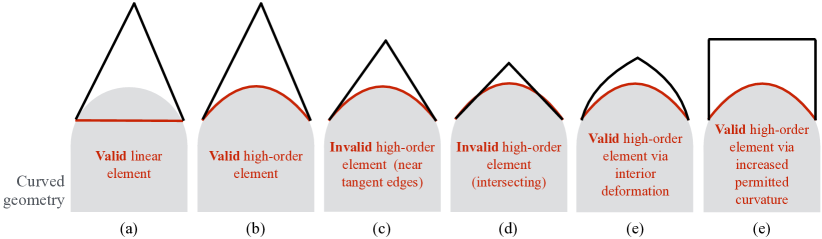
- 采用一种新颖的后处理高阶网格生成工作流程,通过嵌入几何曲率对线性网格进行变形,确保网格有效性的同时保持表面精度。
- 采用谱/$hp$单元方法,空间离散化多项式阶次最高达4,实现几何与解的高阶精度。
- 基于能量稳定分析(ESA)提出一致的稳定策略,以缓解非线性与湍流流场中的混叠驱动不稳定性。
- 基于ESA估计推导出一种新型CG-SVV(连续伽辽金-反对称变分)格式,无需显式建模即可自然正则化欠分辨尺度。
- 通过CADfix中的CFI接口集成CAD数据,实现精确的几何重构与高阶网格生成。
- 利用开源框架Nektar++实现并测试完整的模拟流程,包括网格生成、求解器与后处理。
![Figure 1: Computational resources required to perform the direct numerical simulation (DNS) as a function of the Reynolds number [ 37 ] . Yellow and red lines represent projections on when DNS capabilities are due to become available as computational power increases following two different Moore law](https://ar5iv.labs.arxiv.org/html/2009.10178/assets/x1.png)
实验结果
研究问题
- RQ1高阶谱/$hp$单元方法能否在高雷诺数下对完整复杂汽车几何实现稳定且精确的隐式LES?
- RQ2鲁棒的后处理高阶网格生成流程在保持工业级几何网格有效性的同时,能在多大程度上保持几何精度?
- RQ3基于ESA估计的CG-SVV格式在无需显式湍流建模的情况下,稳定高阶模拟的效能如何?
- RQ4与线性网格相比,高阶离散化在曲面无滑移边界上是否能减少人工耗散,从而提升流动物理保真度?
- RQ5将学术高阶CFD工具集成至工业工作流,能否同时实现物理上忠实且计算上可行的结果?
主要发现
- 本研究首次采用谱/$hp$单元方法,对完整真实汽车几何实现了高阶(多项式阶次4)隐式LES模拟。
- 尽管未采用显式湍流模型,模拟仍实现了稳定且高保真的结果,归功于高阶格式固有的数值耗散。
- 新颖的高阶网格生成流程生成的网格中,直边单元占比不足5%,显著减少人工耗散,同时保持了鲁棒性。
- 基于ESA估计的CG-SVV格式有效抑制了混叠不稳定性,并为欠分辨尺度提供了充分正则化,支持长时间积分。
- 不同离地高度(D1、D2、D3)下的结果表现出良好一致性,表明模拟能稳定捕捉关键非定常流特征。
- 研究表明,高阶方法可通过更精确解析非定常涡结构与气动载荷,显著提升工业CFD的精度,且无需依赖RANS或DES模型。
更好的研究,从现在开始
从阅读论文到最终审阅,大幅缩短您的研究时间。
无需绑定信用卡
本解读由 AI 生成,并经人工编辑审核。