
[论文解读] Inference of CO2 flow patterns -- a feasibility study
本研究提出使用条件正常化流(CNF)融合时序地震与井数据,以推断CO2羽流模式(包括常规与泄漏情况),实现不确定性感知的推断。该方法在高保真度重建羽流的同时,其不确定性估计与实际误差具有强相关性,证明了其在碳捕集与封存系统中早期泄漏检测的可行性。
As the global deployment of carbon capture and sequestration (CCS) technology intensifies in the fight against climate change, it becomes increasingly imperative to establish robust monitoring and detection mechanisms for potential underground CO2 leakage, particularly through pre-existing or induced faults in the storage reservoir's seals. While techniques such as history matching and time-lapse seismic monitoring of CO2 storage have been used successfully in tracking the evolution of CO2 plumes in the subsurface, these methods lack principled approaches to characterize uncertainties related to the CO2 plumes' behavior. Inclusion of systematic assessment of uncertainties is essential for risk mitigation for the following reasons: (i) CO2 plume-induced changes are small and seismic data is noisy; (ii) changes between regular and irregular (e.g., caused by leakage) flow patterns are small; and (iii) the reservoir properties that control the flow are strongly heterogeneous and typically only available as distributions. To arrive at a formulation capable of inferring flow patterns for regular and irregular flow from well and seismic data, the performance of conditional normalizing flow will be analyzed on a series of carefully designed numerical experiments. While the inferences presented are preliminary in the context of an early CO2 leakage detection system, the results do indicate that inferences with conditional normalizing flows can produce high-fidelity estimates for CO2 plumes with or without leakage. We are also confident that the inferred uncertainty is reasonable because it correlates well with the observed errors. This uncertainty stems from noise in the seismic data and from the lack of precise knowledge of the reservoir's fluid flow properties.
研究动机与目标
- 开发一种机器学习框架,对地质碳封存(GCS)中的CO2流动模式进行不确定性量化推断。
- 解决利用多模态时序数据检测常规与泄漏CO2羽流模式之间细微差异的挑战。
- 评估条件正常化流能否从噪声大、接近真实世界观测数据中生成CO2饱和度及其相关不确定性的可靠后验估计。
- 评估在复杂、非均质储层中,推断的不确定性与实际重建误差之间的相关性。
- 为基于数据驱动推断的不确定性感知、实时监测系统在GCS中的应用奠定基础。
提出的方法
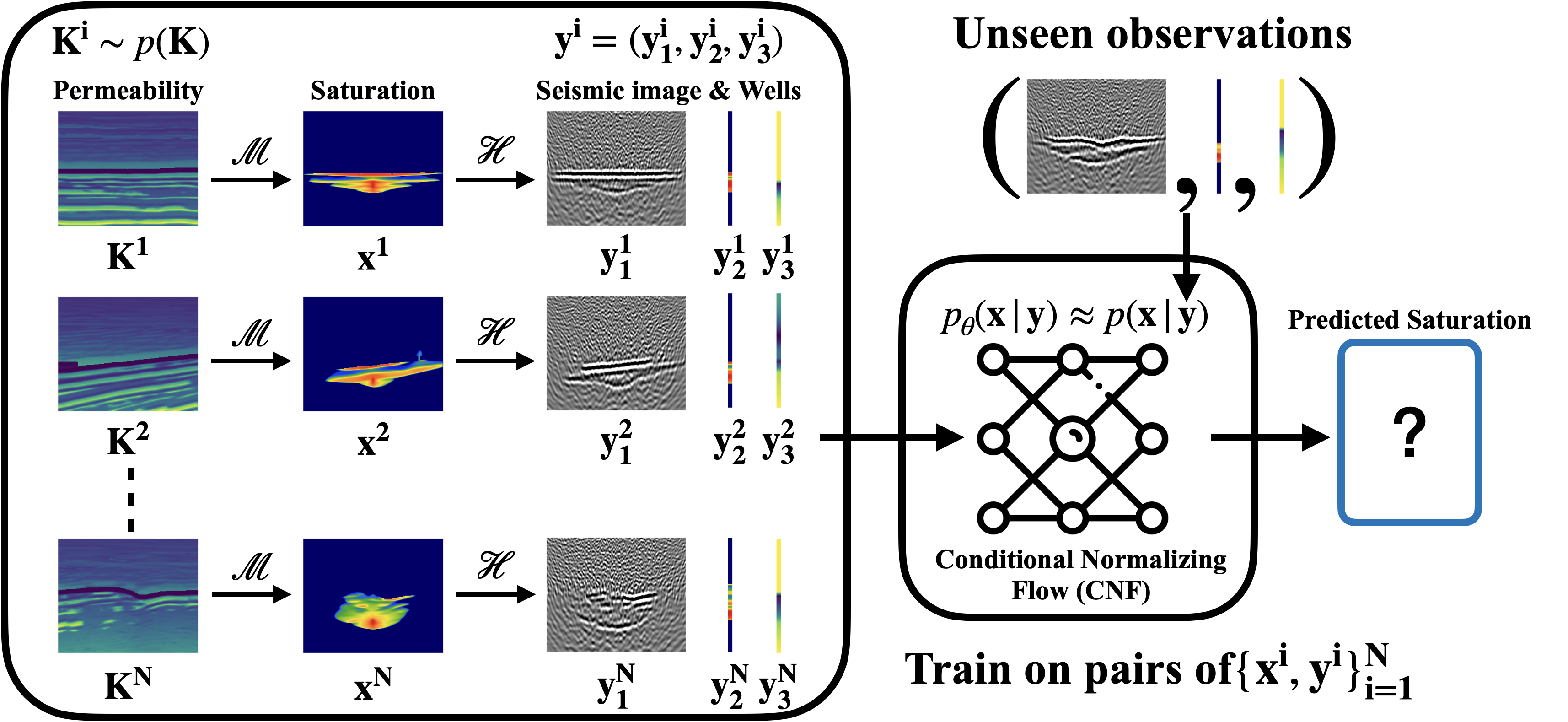
- 通过训练条件正常化流(CNF)来建模后验分布 $ p(\mathbf{x} \mid \mathbf{y}) $,其中 $ \mathbf{x} $ 为CO2饱和度图像,$ \mathbf{y} $ 为多模态观测向量。
- 观测向量 $ \mathbf{y} $ 包含三个部分:地震成像数据、井筒压力与井筒饱和度测量值。
- 训练数据通过储层模拟生成,其中渗透率 $ \mathbf{K}^{(i)} \sim p(\mathbf{K}) $ 为随机实现,生成相应的CO2饱和度 $ \mathbf{x}^{(i)} $ 与时序观测 $ \mathbf{y}^{(i)} $。
- 时序地震图像通过基准与监测调查的逆时偏移法(RTM)生成,信噪比为8.0 dB,使用15 Hz Ricker子波。
- 训练目标通过最小化Kullback-Leibler散度实现,损失函数为 $ \mathcal{L}(\theta) = \mathbb{E}_{\mathbf{x},\mathbf{y}}[ \frac{1}{2}||f_\theta(\mathbf{x};\mathbf{y})||_2^2 - \log|\det(\mathbf{J}_{f_\theta})| ] $。
- 训练完成后,CNF为未见测试案例生成后验样本与不确定性估计(归一化标准差)。
实验结果
研究问题
- RQ1条件正常化流能否从多模态时序数据中准确推断CO2羽流模式,包括常规与泄漏流动情景?
- RQ2在地震噪声与储层非均质性存在的情况下,推断的不确定性估计与实际重建误差的相关性如何?
- RQ3该模型能否在不产生假阳性或假阴性的情况下区分泄漏与非泄漏情形?
- RQ4在复杂地质条件下,后验均值估计与真实饱和度模式的匹配程度如何?
- RQ5CNF在处理因储层属性不确定性而产生的CO2羽流演化非唯一性与非线性问题方面是否有效?
主要发现
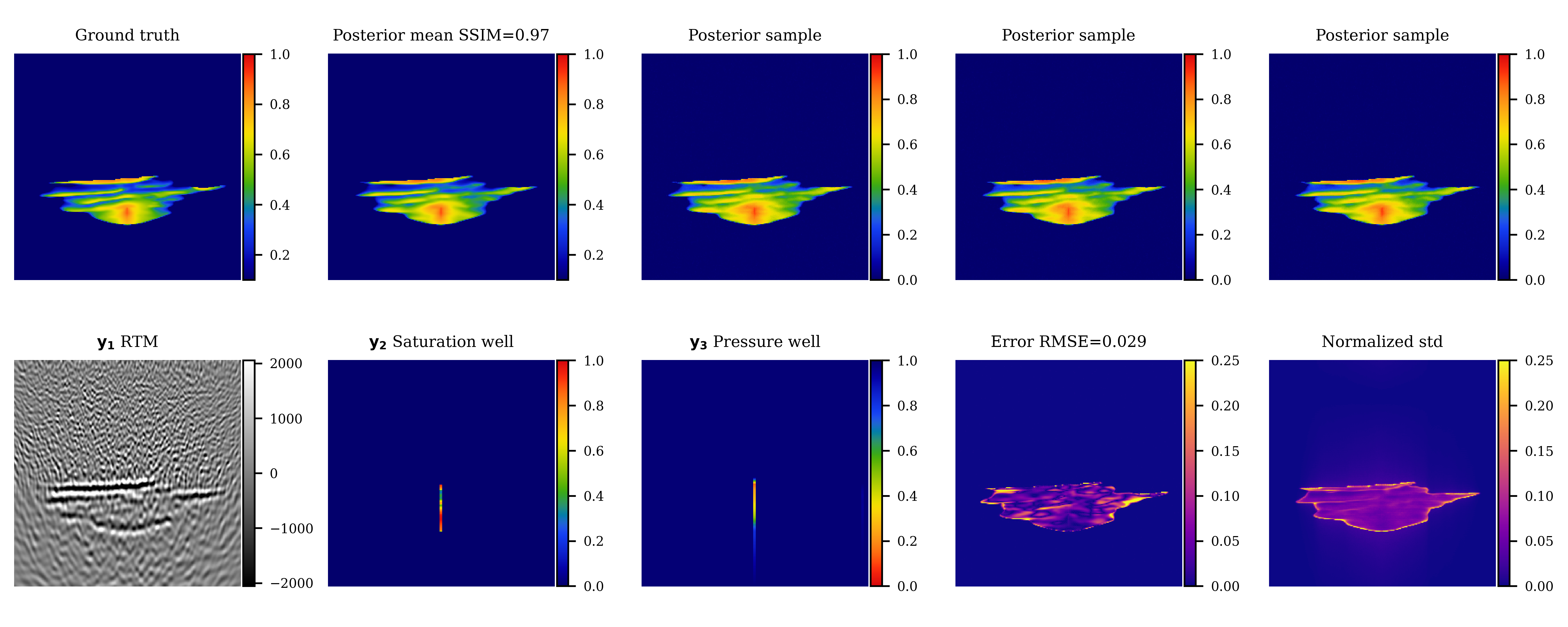
- 后验均值估计在无泄漏情况下SSIM(结构相似性指数)达0.97,在泄漏情况下达0.96,表明与真实值高度一致。
- 推断的不确定性在地质结构复杂区域(特别是羽流顶部与裂缝带附近)最高,这些区域正是泄漏发生位置,且与实际重建误差高度相关。
- 在36个测试样本中,该方法未产生任何假阳性或假阴性,正确识别了所有泄漏与非泄漏情形。
- 不确定性估计与地震数据中的噪声以及对储层属性知识的不精确性一致,验证了其合理性。
- 该方法成功捕捉了常规与异常流动模式之间的细微差异,即使变化微小且被噪声掩盖。
- 结果表明,使用CNF进行CO2监测中不确定性感知推断具有可行性,为构建实时数字孪生系统奠定了基础。
更好的研究,从现在开始
从阅读论文到最终审阅,大幅缩短您的研究时间。
无需绑定信用卡
本解读由 AI 生成,并经人工编辑审核。