
[论文解读] Infomaxformer: Maximum Entropy Transformer for Long Time-Series Forecasting Problem
Infomaxformer 提出了一种基于最大熵的自注意力机制和键值蒸馏方法,将 Transformer 的复杂度从 𝒪(L²) 降低至 𝒪(L),从而在提升准确率的同时实现了长序列时间序列预测。它结合了季节-趋势分解与稀疏注意力机制,以捕捉长程依赖关系,在多个长序列数据集上优于当前最先进模型。
The Transformer architecture yields state-of-the-art results in many tasks such as natural language processing (NLP) and computer vision (CV), since the ability to efficiently capture the precise long-range dependency coupling between input sequences. With this advanced capability, however, the quadratic time complexity and high memory usage prevents the Transformer from dealing with long time-series forecasting problem (LTFP). To address these difficulties: (i) we revisit the learned attention patterns of the vanilla self-attention, redesigned the calculation method of self-attention based the Maximum Entropy Principle. (ii) we propose a new method to sparse the self-attention, which can prevent the loss of more important self-attention scores due to random sampling.(iii) We propose Keys/Values Distilling method motivated that a large amount of feature in the original self-attention map is redundant, which can further reduce the time and spatial complexity and make it possible to input longer time-series. Finally, we propose a method that combines the encoder-decoder architecture with seasonal-trend decomposition, i.e., using the encoder-decoder architecture to capture more specific seasonal parts. A large number of experiments on several large-scale datasets show that our Infomaxformer is obviously superior to the existing methods. We expect this to open up a new solution for Transformer to solve LTFP, and exploring the ability of the Transformer architecture to capture much longer temporal dependencies.
研究动机与目标
- 解决原始 Transformer 在长序列时间序列预测(LTFP)中时间与内存复杂度呈二次方增长的问题。
- 克服稀疏注意力机制中因随机采样导致的性能下降问题。
- 通过一种新颖的键值蒸馏机制,有效去除自注意力图中的冗余特征。
- 通过将时间序列分解与 Transformer 架构结合,提升对复杂时间序列模式的建模能力。
- 在保持高预测准确率的同时,支持有效处理超长输入序列(最长可达 1440 步)。
提出的方法
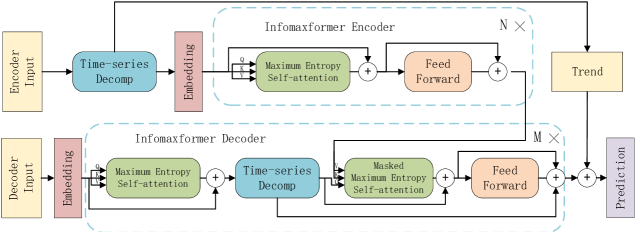
- 基于最大熵原理重新设计自注意力机制,引导稀疏注意力的计算,降低复杂度,同时保留关键依赖关系。
- 提出一种基于熵最大化的稀疏性机制(MEA),通过选择主导查询而非随机采样,最小化特征损失。
- 提出键值蒸馏方法,压缩冗余的注意力表征,将时间和内存复杂度均降低至 𝒪(L)。
- 将时间序列分解(TSD)与编码器-解码器架构结合,显式分离并建模季节性和趋势分量。
- 将 MEA 与 TSD 结合,实现高精度的长序列建模,避免因稀疏性导致的性能下降。
实验结果
研究问题
- RQ1最大熵原理能否用于设计更高效、更有效的稀疏注意力机制,以应对长序列时间序列预测?
- RQ2如何在不牺牲预测性能的前提下,有效去除自注意力图中的冗余特征?
- RQ3将时间序列分解与稀疏注意力结合,是否能提升 Transformer 在长程依赖建模方面的能力?
- RQ4所提出的方法能否在超长输入序列(如 1440 步)上实现扩展,同时保持或提升准确率?
- RQ5在内存和序列长度受限条件下,MEA 的性能与标准注意力及其他稀疏注意力机制相比如何?
主要发现
- Infomaxformer 将时间和内存复杂度从 𝒪(L²) 降低至 𝒪(L),支持处理最长达 1440 步的超长序列。
- 在 ETTh1 数据集上,Infomaxformer 在序列长度为 1440 时,MSE 达到 0.573,MAE 为 0.585,优于基线模型。
- 消融实验表明,若移除 MEA、TSD 或键值蒸馏任一模块,性能均出现显著下降。
- TSD 与 MEA 的结合在长序列预测中(如 192 步预测)优于 Autoformer 中的 SDB 与 AC 组合。
- 当采样因子 U 足够大时,其对性能影响极小,表明 MEA 对方差估计具有鲁棒性。
- 与 Informer 不同,该模型在不同采样因子下均保持稳定性能,归因于更智能的初始采样策略。
更好的研究,从现在开始
从阅读论文到最终审阅,大幅缩短您的研究时间。
无需绑定信用卡
本解读由 AI 生成,并经人工编辑审核。