
[论文解读] Inner-IoU: More Effective Intersection over Union Loss with Auxiliary Bounding Box
Inner-IoU 引入具有可扩展比的辅助边界框以计算 IoU 损失,在与现有 IoU 基损失结合时改善收敛性和泛化。
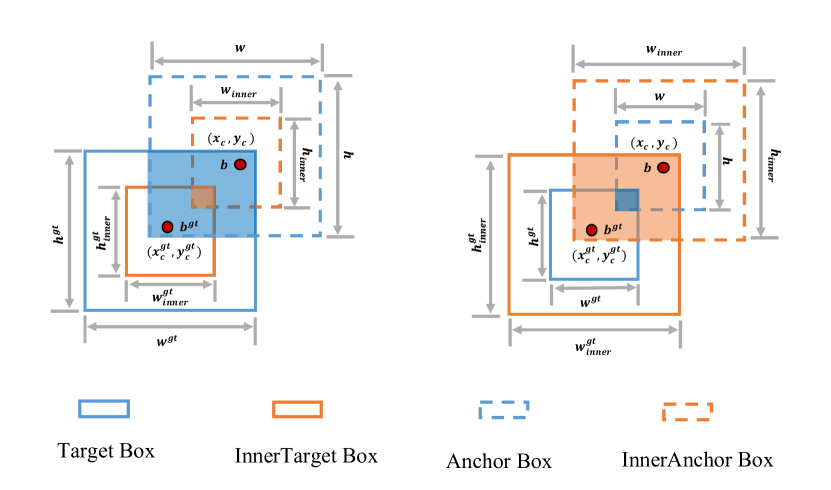
With the rapid development of detectors, Bounding Box Regression (BBR) loss function has constantly updated and optimized. However, the existing IoU-based BBR still focus on accelerating convergence by adding new loss terms, ignoring the limitations of IoU loss term itself. Although theoretically IoU loss can effectively describe the state of bounding box regression,in practical applications, it cannot adjust itself according to different detectors and detection tasks, and does not have strong generalization. Based on the above, we first analyzed the BBR model and concluded that distinguishing different regression samples and using different scales of auxiliary bounding boxes to calculate losses can effectively accelerate the bounding box regression process. For high IoU samples, using smaller auxiliary bounding boxes to calculate losses can accelerate convergence, while larger auxiliary bounding boxes are suitable for low IoU samples. Then, we propose Inner-IoU loss, which calculates IoU loss through auxiliary bounding boxes. For different datasets and detectors, we introduce a scaling factor ratio to control the scale size of the auxiliary bounding boxes for calculating losses. Finally, integrate Inner-IoU into the existing IoU-based loss functions for simulation and comparative experiments. The experiment result demonstrate a further enhancement in detection performance with the utilization of the method proposed in this paper, verifying the effectiveness and generalization ability of Inner-IoU loss. Code is available at https://github.com/malagoutou/Inner-IoU.
研究动机与目标
- 分析边界框回归过程,识别标准 IoU 损失的局限性。
- 提出使用可控尺度比的辅助边界框的 Inner-IoU 损失。
- 通过在不同检测器/数据集上将 Inner-IoU 与现有基于 IoU 的损失结合来展示泛化性。
- 展示相较于现有基于 IoU 的损失具有更快的收敛性和更好的检测指标。
提出的方法
- 分析高 IoU 样本与低 IoU 样本在基于 IoU 的回归动力学与梯度。
- 定义利用按比率参数缩放的辅助边界框来计算的 Inner-IoU 损失。
- 说明 ratio < 1 如何使高 IoU 样本回归受益,ratio > 1 如何使低 IoU 样本受益。
- 将 L_Inner-IoU 与现有损失(L_Inner-GIoU、L_Inner-DIoU、L_Inner-CIoU、L_Inner-EIoU、L_Inner-SIoU)进行整合。
- 在标准检测器/数据集上进行仿真与对比实验以评估性能。
实验结果
研究问题
- RQ1具有尺度比的辅助边界框能否提高基于 IoU 的边界框回归的收敛速度?
- RQ2将 Inner-IoU 与现有 IoU 基损失结合后,是否在不同检测器和数据集上具备泛化性?
- RQ3在实际应用中,哪些比率设置可优化高 IoU 与低 IoU 样本的回归?
- RQ4使用 Inner-IoU 时,实验是否在 AP50 与 mAP50:95 上显示出可检测的提升?
主要发现
- Inner-IoU 通过对高 IoU 样本使用较小的辅助框、对低 IoU 样本使用较大的辅助框实现更快的收敛。
- 在评估的设置中,将 Inner-IoU 与 CIoU 和 SIoU 集成在一起,相较基线可获得更高的 AP50 和 mAP50:95。
- 在 VOC 的 YOLOv7-tiny 上,Inner-CIoU 和 Inner-SIoU 相对于 CIoU 和 SIoU 基线在 AP50 和 mAP50:95 上有提升。
- 在 AI-TOD 的 YOLOv5s 上,Inner-SIoU(ratio > 1)相对于 SIoU 提升 AP50 与 mAP50:95,显示对小目标的鲁棒性。
- 仿真结果表明,高 IoU 样本(ratio < 1)收敛更快,低 IoU 样本回归更好(ratio > 1)。
- 该方法在检测器和像素尺寸上的泛化性强,在所报告的实验中展现出近似 SOTA 的性能。

更好的研究,从现在开始
从阅读论文到最终审阅,大幅缩短您的研究时间。
无需绑定信用卡
本解读由 AI 生成,并经人工编辑审核。