
[论文解读] Integrated Sensing, Communication, and Powering (ISCAP): Towards Multi-functional 6G Wireless Networks
本文提出集成感知、通信与供电(ISCAP)的6G无线网络,该网络通过同一无线信号统一实现感知、通信与无线能量传输。通过支持同时传输、感知辅助的能量传输以及可持续ISAC的能量采集,ISCAP提升了频谱与能量效率,降低了成本,并开启了近场波束成形和智能反射面等新能力。
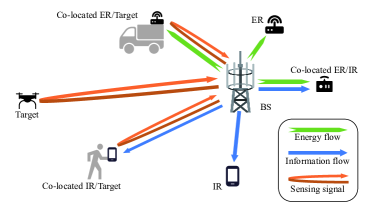
This article presents a novel multi-functional system for a sixth-generation (6G) wireless network with integrated sensing, communication, and powering (ISCAP), which unifies integrated sensing and communication (ISAC) and wireless information and power transfer (WIPT) techniques. The multi-functional ISCAP network promises to enhance resource utilization efficiency, reduce network costs, and improve overall performance through versatile operational modes. Specifically, a multi-functional base station (BS) can enable multi-functional transmission, by exploiting the same radio signals to perform target/environment sensing, wireless communication, and wireless power transfer (WPT), simultaneously. Besides, the three functions can be intelligently coordinated to pursue mutual benefits,i.e., wireless sensing can be leveraged to enable light-training or even training-free WIPT by providing side-channel information, and the BS can utilize WPT to wirelessly charge low-power devices for ensuring sustainable ISAC. Furthermore, multiple multi-functional BSs can cooperate in both transmission and reception phases for efficient interference management, multi-static sensing, and distributed energy beamforming. For these operational modes, we discuss the technical challenges and potential solutions, particularly focusing on the fundamental performance tradeoff limits, transmission protocol design, as well as waveform and beamforming optimization. Finally, interesting research directions are identified.
研究动机与目标
- 应对支持海量物联网设备且具备长续航电池的6G网络日益增长的可持续、高容量需求。
- 通过统一感知、通信与能量传输,克服传统单功能无线网络的局限性。
- 通过多功能基站实现频谱与能量效率的提升,同时降低基础设施与运营成本。
- 通过智能协调与资源共享,实现感知、通信与供电功能之间的互利共赢。
- 开发新型传输协议、波束成形与波形设计,以支持6G中同时进行的多功能操作。
提出的方法
- 提出一种同时多功能传输模式,即单一无线信号可并行完成感知、通信与无线能量传输。
- 引入感知辅助的无线信息与能量传输(WIPT),利用感知获得的信道状态信息(CSI)与散射体位置,实现低训练或无训练的无线能量传输。
- 采用无线供电的ISAC,即从WPT中采集的能量为低功耗物联网设备供电,以维持其ISAC操作的长期运行。
- 构想网络化多功能传输,通过多基站协作实现分布式波束成形、干扰管理与多站式感知。
- 基于球面波前的近场信道模型,适用于极大规模阵列,以支持三维定位与聚焦能量波束。
- 探索毫米波/太赫兹频段的混合数字-模拟波束成形,以在保持性能的同时降低多功能系统中的硬件成本。
实验结果
研究问题
- RQ1如何在单一无线信号中联合优化感知、通信与能量传输,以最大化系统效率?
- RQ2ISCAP系统中,感知精度、通信速率与能量传输效率之间的基本性能权衡是什么?
- RQ3如何利用感知信息降低无线能量传输中的CSI训练开销?
- RQ4针对具有极大规模阵列的近场多功能传输,最优的波束成形与波形设计是什么?
- RQ5如何联合优化智能反射面(IRS)与基站波束成形,以提升C-R-E(通信、感知、能量)性能?
主要发现
- 同时多功能传输实现了频谱、硬件与信号的三重利用,显著提升了资源利用率并降低了网络成本。
- 感知辅助的WIPT通过利用环境散射体信息估计CSI,减少了训练开销,支持低训练或无训练的能量传输。
- 无线供电的ISAC使低功耗物联网设备能够通过采集同一信号的能量,长期维持感知与通信操作。
- 采用极大规模天线的近场多功能传输可实现高精度三维定位与聚焦能量波束,提升信噪比与能量效率。
- 毫米波/太赫兹频段的混合波束成形架构在支持高速率数据传输与精确感知的同时,降低了硬件复杂度。
- 智能反射面(IRS)可增强信号强度并实现虚拟视 Line-of-Sight(LoS)链路,提升ISAC与WIPT性能,尤其在结合感知用于CSI获取时效果更显著。
![Figure 2: The Pareto boundary of a C-R-E region example [ 8 ] .](https://ar5iv.labs.arxiv.org/html/2401.03516/assets/x2.png)
更好的研究,从现在开始
从阅读论文到最终审阅,大幅缩短您的研究时间。
无需绑定信用卡
本解读由 AI 生成,并经人工编辑审核。