
[论文解读] Interlayer link prediction in multiplex social networks: an iterative degree penalty algorithm
该论文提出了一种用于多层社交网络中层间链路预测的迭代度惩罚(IDP)算法,通过利用网络结构和度惩罚原则,提升了匹配准确性。通过迭代地利用邻接矩阵乘法和优先考虑连接较少的共同邻居来优化预测,IDP 显著优于现有方法,尤其在低平均度和低重叠节点场景下,召回率最高提升 36.6%,F1 分数最高提升 25.0%。
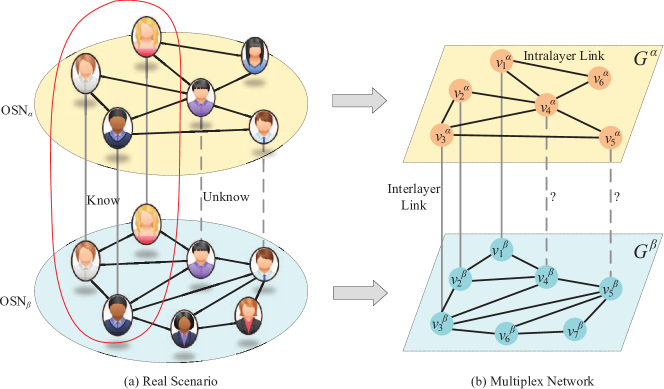
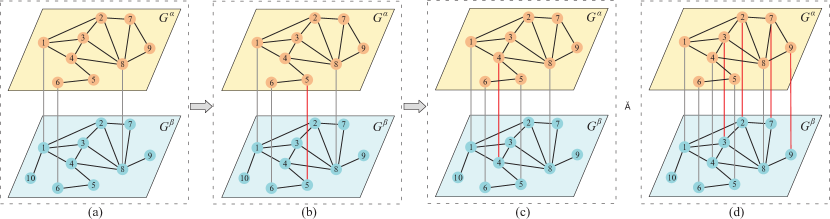
Online social network (OSN) applications provide different experiences; for example, posting a short text on Twitter and sharing photographs on Instagram. Multiple OSNs constitute a multiplex network. For privacy protection and usage purposes, accounts belonging to the same user in different OSNs may have different usernames, photographs, and introductions. Interlayer link prediction in multiplex network aims at identifying whether the accounts in different OSNs belong to the same person, which can aid in tasks including cybercriminal behavior modeling and customer interest analysis. Many real-world OSNs exhibit a scale-free degree distribution; thus, neighbors with different degrees may exert different influences on the node matching degrees across different OSNs. We developed an iterative degree penalty (IDP) algorithm for interlayer link prediction in the multiplex network. First, we proposed a degree penalty principle that assigns a greater weight to a common matched neighbor with fewer connections. Second, we applied node adjacency matrix multiplication for efficiently obtaining the matching degree of all unmatched node pairs. Thereafter, we used the approved maximum value method to obtain the interlayer link prediction results from the matching degree matrix. Finally, the prediction results were inserted into the priori interlayer node pair set and the above processes were performed iteratively until all unmatched nodes in one layer were matched or all matching degrees of the unmatched node pairs were equal to 0. Experiments demonstrated that our advanced IDP algorithm significantly outperforms current network structure-based methods when the multiplex network average degree and node overlapping rate are low.
研究动机与目标
- 为解决在不同在线社交网络(OSNs)中,用户账号是否属于同一人这一挑战,尤其在用户名称和属性因隐私或匿名性而不同的情况下。
- 在以网络结构为主要信息来源的多层网络中,提升层间链路预测的准确性,特别是在低平均度和低节点重叠条件下。
- 开发一种高效、可扩展的方法,利用结构相似性和基于度的加权策略,增强跨层节点的匹配能力。
- 通过逐轮计算匹配度和最大值选择,迭代发现隐藏的层间链路。
提出的方法
- 提出一种度惩罚原则,为连接较少的共同匹配邻居分配更高权重,反映其在无标度网络中更强的预测能力。
- 使用节点邻接矩阵乘法,在单次操作中高效计算所有跨层未匹配节点对之间的匹配度。
- 应用经批准的最大值选取方法,从匹配度矩阵中提取得分最高的层间链路预测结果。
- 采用迭代过程,将预测的链路插入先验集合,并重新运行匹配度计算,直至所有未匹配节点均被匹配或所有度数变为零。
- 将度惩罚整合到匹配度计算中,以反映共同匹配邻居数量及其连通性水平的综合影响。
- 采用基于真实世界网络的自匹配多层网络构建策略,在受控条件下评估性能。
实验结果
研究问题
- RQ1当平均度和节点重叠率较低时,如何提升多层社交网络中层间链路预测的性能?
- RQ2邻居度分布对共同匹配邻居在层间节点匹配中的可靠性有何影响?
- RQ3通过逐步将高置信度预测结果融入匹配过程,迭代优化是否能提升预测准确性?
- RQ4基于度感知的共同邻居加权与均匀加权相比,在预测层间链路方面表现如何?
- RQ5邻接矩阵乘法在可扩展方式下,能否高效计算所有未匹配节点对之间的匹配度?
主要发现
- IDP 算法在所有测试的真实世界网络中均优于 FRUI 基线,召回率最高提升 36.6%,平均提升 7.0%。
- 精确率最高提升 19.0%,平均提升 3.8%,表明对预测链路的置信度更强。
- F1 分数最高提升 25.0%,平均提升 5.0%,表明整体性能持续提升。
- IDP 的性能增益在平均度低和节点重叠率低的网络中最为显著,传统方法在这些场景下表现困难。
- 随着 $ p $ 的增加,召回率、精确率和 F1 的提升百分比先增加后减少,表明与噪声水平存在非单调关系。
- 该算法能有效处理无标度网络结构,通过在匹配分值中惩罚高阶节点,降低其作为匹配指标的不可靠性。
更好的研究,从现在开始
从阅读论文到最终审阅,大幅缩短您的研究时间。
无需绑定信用卡
本解读由 AI 生成,并经人工编辑审核。