
[论文解读] Internal tide generation from non-uniform barotropic body forcing
本文提出一种耦合模态系统(CMS),用于建模非均匀地转潮汐在变化地形上生成内波的过程,采用局部本征函数展开的体源项公式。该方法在小斜率情况下解析地恢复了弱地形近似(WTA),并数值求解了任意地形下的CMS,结果表明非均匀潮汐会局部影响层结场,且在强超临界区域,能量转换率趋近于刀刃形或阶跃形地形的极限值。
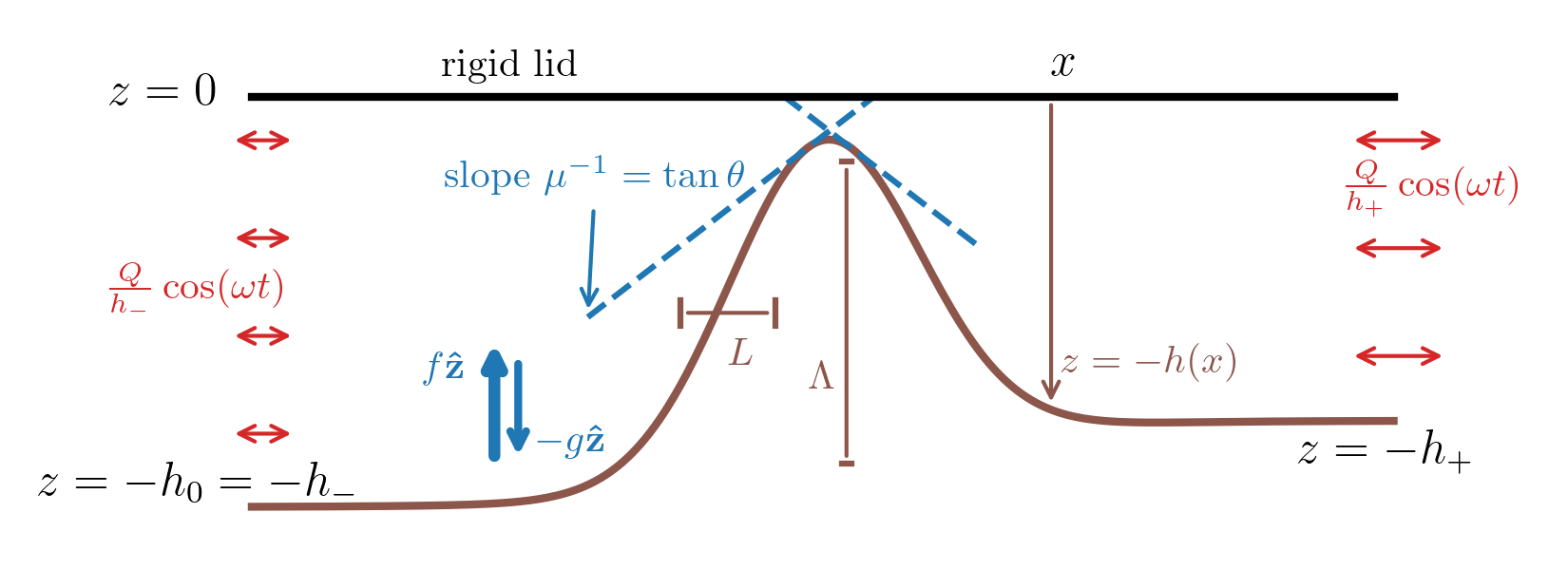
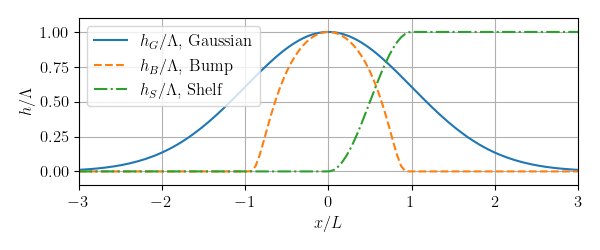
We model linear, inviscid, internal tides generated by the interaction of a barotropic tide with one-dimensional topography. Starting from the body-forcing formulation of the hydrodynamic problem, we derive a Coupled-Mode System (CMS) using a local eigenfunction expansion of the stream function. For infinitesimal topography, we solve this CMS analytically, recovering the classical Weak Topography Approximation (WTA) formula for the barotropic-to-baroclinic energy conversion rate. For arbitrary topographies, we solve this CMS numerically. The CMS enjoys faster convergence with respect to existing modal solutions and can be applied in the subcritical and supercritical regimes for both ridges and shelf profiles. We show that the non-uniform barotropic tide affects the baroclinic field locally over topographies with large slopes and we study the dependence of the radiated energy conversion rate on the criticality. We show that non-radiating or weakly radiating topographies are common in the subcritical regime. We also assess the region of validity of the WTA approximation for the commonly used Gaussian ridge and a compactly supported bump ridge studied here for the first time. Finally, we provide numerical evidence showing that in the strongly supercritical regime the energy conversion rate for a ridge (resp. shelf) approaches the value obtained by the knife-edge (resp. step) topography.
研究动机与目标
- 开发一种更精确且高效的模型方法,用于在复杂地形上模拟非均匀地转潮汐生成内波的过程。
- 将弱地形近似(WTA)扩展至非均匀强迫情形,并评估其在真实地形剖面中的有效性。
- 研究地转-层结能量转换率对地形临界性及空间结构的依赖关系。
- 提供一个数值稳健的框架,适用于亚临界与超临界地形,包括海脊与大陆架。
- 确定在强超临界区域能量转换率的渐近行为,并与理想化的阶跃形与刀刃形地形进行比较。
提出的方法
- 基于Garrett & Gerkema(2007)推导的体源项方法建立内波问题模型,确保与非静力动力学的一致性。
- 采用流函数的局部本征函数展开,推导出耦合模态系统(CMS),将偏微分方程转化为常微分方程组。
- 对无穷小地形解析求解CMS,恢复经典WTA公式中的能量转换率表达式。
- 对任意地形剖面(包括高斯海脊与紧支撑凸起海脊)进行CMS的数值求解。
- 利用傅里叶变换与渐近分析,从模态振幅计算远场能量通量与转换率。
- 通过表面边界值问题,基于刚性盖近似,由层结压力场重构自由表面位移。
实验结果
研究问题
- RQ1非均匀地转强迫如何影响在变化地形上内波的局部结构与辐射能量?
- RQ2弱地形近似(WTA)在真实地形剖面(如高斯海脊与紧支撑凸起)中的适用范围是什么?
- RQ3能量转换率如何依赖于地形临界性,特别是在亚临界与超临界区域?
- RQ4在强超临界区域,能量转换率的渐近极限为何?是否趋近于理想化的阶跃形或刀刃形地形的极限?
- RQ5耦合模态系统(CMS)在复杂地形下是否能实现比传统模态解更快的收敛速度?
主要发现
- 耦合模态系统(CMS)在海脊与大陆架的亚临界与超临界区域均表现出比现有模态解更快的收敛速度。
- 非均匀地转潮汐会局部调制层结场,尤其在大斜率地形上表现显著,表明强迫的空间变化不可忽略。
- 在亚临界区域,非辐射或弱辐射地形普遍存在,表明小斜率地形下能量转换受到抑制。
- 对于具有显著空间变化的地形,WTA近似失效;其有效性通过数值方法在高斯海脊与新研究的紧支撑凸起海脊上进行了评估。
- 在强超临界区域,海脊的能量转换率渐近趋近于刀刃形地形的极限值,而大陆架则趋近于阶跃形地形的极限值。
- CMS对WTA公式的解析恢复,验证了其与经典理论的一致性,并证实了该框架在小斜率情况下的准确性。
更好的研究,从现在开始
从阅读论文到最终审阅,大幅缩短您的研究时间。
无需绑定信用卡
本解读由 AI 生成,并经人工编辑审核。