
[论文解读] Interplay of two $E_g$ orbitals in Superconducting La$_3$Ni$_2$O$_7$ Under Pressure
本研究提出了一种双轨道双层 $t$-$J$ 模型,以解释高压下 La$_3$Ni$_2$O$_7$ 中的高温超导现象,表明 $3d_{x^2-y^2}$ 轨道通过强层间超交换作用驱动 $s$-波超导,而 $3d_{z^2}$ 轨道由于能带极度平坦化而贡献微弱。该模型再现了实验测得的能带结构,并预测电子掺杂可增强 $T_c$,空穴掺杂下则出现 BCS-BEC 跨越行为。
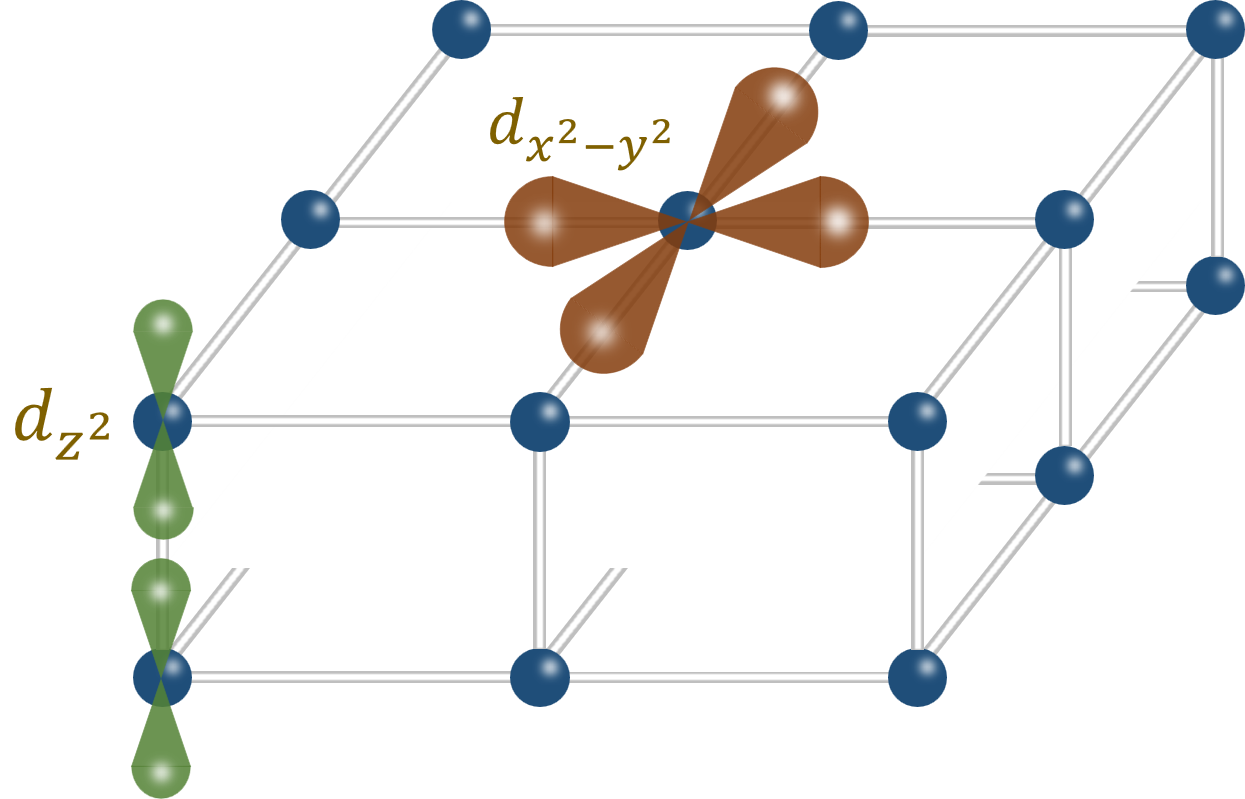
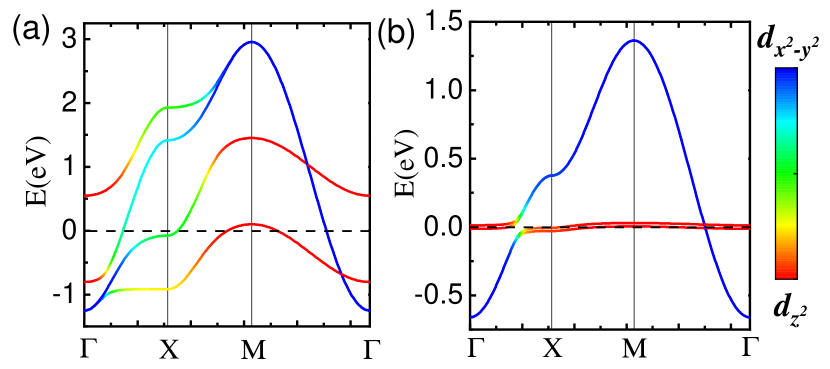
The discovery of high-$T_c$ superconductivity (SC) in La$_3$Ni$_2$O$_7$ (LNO) has aroused a great deal of interests. Previously, it was proposed that the Ni-$3d_{z^2}$ orbital is crucial to realize the high-$T_c$ SC in LNO: The preformed Cooper pairs therein acquire coherence via hybridization with the $3d_{x^2-y^2}$ orbital to form the SC. However, we held a different viewpoint that the interlayer pairing $s$-wave SC is induced by the $3d_{x^2-y^2}$ orbital, driven by the strong interlayer superexchange interaction. To include effects from both $E_g$-orbitals , we establish a two-orbital bilayer $t$-$J$ model. Our calculations reveal that due to the no-double-occupancy constraint, the $3d_{x^2-y^2}$ band and the $3d_{z^2}$ bonding band are flattened by a factor of about 2 and 10, respectively, which is consistent with recent angle-resolved-photo-emission-spectroscopy measurements. Consequently, a high temperature SC can be hardly induced in the $3d_{z^2}$-orbital due to the difficulty to develop phase coherence. However, it can be easily achieved by the $3d_{x^2-y^2}$ orbital under realistic interaction strength. With electron doping, the $3d_{z^2}$-band gradually dives below the Fermi level, but $T_c$ continues to enhance, suggesting that it is not necessary for the high-$T_c$ SC in LNO. With hole doping, $T_c$ initially drops and then rises, accompanied by the crossover from the BCS to BEC-type superconducting transitions.
研究动机与目标
- 解决关于在高压 La$_3$Ni$_2$O$_7$ 中主导高温超导的 $E_g$ 轨道是 $3d_{z^2}$ 还是 $3d_{x^2-y^2}$ 的争议。
- 在统一的理论框架中纳入双 $E_g$ 轨道与双层结构之间的相互作用。
- 解释观测到的高 $T_c \approx 80$ K 以及压力诱导的结构相变至 $Fmmm$ 对称性的成因。
- 解释角分辨光电子能谱(ARPES)数据中显示的两个轨道均存在强烈能带平坦化的现象。
- 研究掺杂对 $T_c$ 的依赖关系以及超导转变的性质(从 BCS 到 BEC 跨越)。
提出的方法
- 构建了一个包含层内与层间跃迁、自旋交换及轨道杂化的双轨道双层 $t$-$J$ 模型。
- 对 $t$-$J$ 哈密顿量应用平均场分解,通过 $\sigma$-键合与 $\pi$-键合通道分离空穴与自旋子部分。
- 利用无双占据约束推导出有效能带平坦化因子:$3d_{x^2-y^2}$ 约为 2,$3d_{z^2}$ 约为 10。
- 引入杂化项 $\chi^{xz}_{\parallel}$ 与层间配对 $\Delta^{x}_{\perp}$,以模拟轨道混合与层间配对。
- 通过数值求解平均场哈密顿量计算 $T_c$ 并分析掺杂演化行为。
- 引入化学势偏移 $\mu_f$、$\mu_b$ 与 $\delta\mu$,以满足总电子密度约束。
实验结果
研究问题
- RQ1在高压 La$_3$Ni$_2$O$_7$ 中,主导高温超导的 $E_g$ 轨道是 $3d_{z^2}$ 还是 $3d_{x^2-y^2}$?
- RQ2两个 $E_g$ 轨道之间的相互作用如何影响超导配对机制?
- RQ3尽管 $3d_{z^2}$ 轨道具有强层间耦合,为何仍无法支持高-$T_c$ 超导?
- RQ4电子与空穴掺杂如何影响超导转变温度 $T_c$?
- RQ5在空穴掺杂下,超导转变是否从 BCS 行为演化为 BEC 特性?
主要发现
- $3d_{x^2-y^2}$ 轨道通过强层间超交换作用驱动高-$T_c$ $s$-波超导,与实验测得的 $T_c \approx 80$ K 一致。
- $3d_{z^2}$ 轨道由于无双占据约束导致能带平坦化因子达 ~10,抑制了相位相干性,从而无法支持高-$T_c$ 配对。
- 该模型成功再现了 ARPES 测得的能带平坦化:$3d_{x^2-y^2}$ 约为 2,$3d_{z^2}$ 约为 10,验证了理论框架的合理性。
- 电子掺杂可增强 $T_c$,即使 $3d_{z^2}$ 能带已下移至费米能级以下,表明其并非高-$T_c$ 超导所必需。
- 空穴掺杂诱导了从 BCS 到 BEC 的跨越,$T_c$ 初期下降后上升,与实验中非单调的 $T_c$ 趋势一致。
更好的研究,从现在开始
从阅读论文到最终审阅,大幅缩短您的研究时间。
无需绑定信用卡
本解读由 AI 生成,并经人工编辑审核。