
[论文解读] Introducing the Perturbative Solution of the Inter-Channel Stimulated Raman Scattering in Single-Mode Optical Fibers
本文提出了一种单模光纤中跨信道受激拉曼散射(SRS)方程的微扰解法,实现了对多波段波分复用(WDM)系统中功率传输的精确且计算高效的建模。该方法在C+L+S波段达到二阶展开时误差低于0.1 dB,在U至E波段达到三阶展开时同样保持0.1 dB精度,与数值积分相比计算时间至少减少一个数量级。
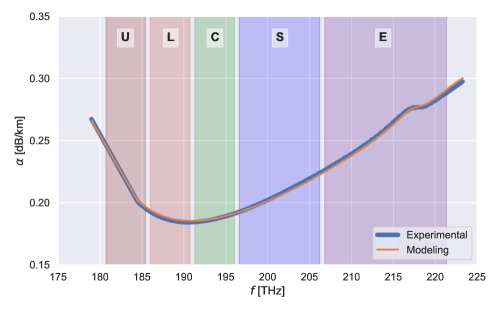
The continuously increasing IP data traffic demand, with geometrical growth rate exceeding 26%, requires a large transmission capacity increment from the fiber optical infrastructure. As the deploy of new fiber cables requires extensive investments, the development of multi-band amplifiers and transceivers, already available as prototypes, is progressively considered towards the entire low-loss single-mode bandwidth beyond the 5 THz C-band. In this perspective, an adequate handling of the variations along the frequency of the fiber physical features becomes crucial for the fiber propagation modeling in multi-band wavelength division multiplexing (WDM) channel comb transmission scenarios. In particular, the inter-channel stimulated Raman scattering (SRS) is the fundamental inter-band effect in this context. The SRS effect on the WDM comb propagated through a single-mode optical fiber is described by a set of ordinary differential equations (ODEs). To date, an exact solution of the SRS ODEs has not been proposed, and in the literature numerical solutions or approximations have been considered in order to take into account this effect. In this work, a perturbative solution of the SRS ODEs is presented enabling an efficient trade-off between the target accuracy and the computational time. Considering a C+L+S transmission scenario, the perturbative expansion up to the 2nd order ensures an excellent accuracy. Whereas, in an U-to-E transmission scenario, the 3rd order is required in order to reach an equivalent accuracy.
研究动机与目标
- 解决在单模光纤中多波段WDM系统内跨信道SRS缺乏精确解析解的问题。
- 开发一种计算高效的方法,在宽频带光传输中实现SRS建模的精度与速度之间的平衡。
- 提供一种系统化程序,用于确定实现SRS功率传输估计目标容差所需的微扰阶数。
- 在不同带宽和入射功率条件下,通过真实传输场景(包括C+L+S波段和U至E波段)验证微扰方法的有效性。
提出的方法
- 本文通过一组描述由于拉曼增益导致信道间功率传输的耦合常微分方程(ODE),建立了跨信道SRS效应的数学模型。
- 对SRS ODE应用微扰展开,将解按拉曼增益系数和信道功率的幂级数展开,高精度场景下最高展开至三阶。
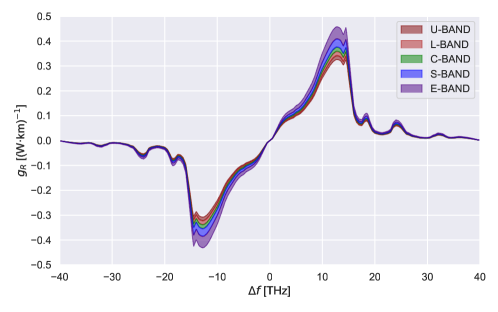
- 基于拉曼增益谱的最大绝对值与阶乘缩放的启发式准则被推导出来,用于估计在给定容差(如0.1 dB)下所需的微扰阶数。
- 该方法允许在较粗的步长(数十公里)下进行空间积分,而数值ODE求解器通常需要0.1–1公里的步长,显著降低了计算负载。
- 通过将微扰解与使用真实光纤参数和信道配置的数值参考解进行对比,验证了该方法的有效性。
- 当需要极高计算效率时,该方法支持通过将信道分组为宏信道实现可扩展建模,假设每个宏信道内光纤和谱参数缓慢变化。
实验结果
研究问题
- RQ1在宽频带WDM系统中,为实现目标精度(如0.1 dB)建模跨信道SRS,所需的最优微扰阶数是什么?
- RQ2随着传输带宽增加,该微扰解法与标准SRS ODE数值积分相比,其计算效率如何?
- RQ3能否推导出一种保守且有效的程序,用于估计所需微扰阶数,而无需依赖迭代数值计算?
- RQ4在C+L+S波段和U至E波段传输等真实场景中,当每信道入射功率平坦时,微扰解法的性能如何?
- RQ5该微扰解法在多大程度上可扩展以支持宽频带光系统中广义非线性噪声建模?
主要发现
- 在C+L+S波段传输场景中,二阶微扰解法的相对误差低于0.1 dB,与数值参考解的精度相当。
- 在U至E波段传输中,需采用三阶微扰解法以维持同等精度,误差被控制在0.1 dB容差范围内。
- 与数值ODE积分相比,该微扰方法在带宽从2.5至40 THz增加时,计算时间至少减少一个数量级。
- 微扰解法的空间积分步长可增至数十公里,同时保持0.1 dB精度,而数值方法则需0.1–1 km的步长。
- 基于拉曼增益谱和阶乘缩放的启发式准则,可可靠估计任意给定容差下所需的微扰阶数。
- 通过允许宏信道分组,该方法支持可扩展建模,在每个组内谱参数缓慢变化时,可显著降低计算成本而不损失精度。
更好的研究,从现在开始
从阅读论文到最终审阅,大幅缩短您的研究时间。
无需绑定信用卡
本解读由 AI 生成,并经人工编辑审核。