
[论文解读] IRS-Aided WPCNs: A New Optimization Framework for Dynamic IRS Beamforming
本文提出了一种新型动态智能反射面(IRS)波束成形框架,用于无线能量传输通信网络(WPCNs),通过联合优化时变的IRS相位偏移与资源分配以最大化总吞吐量。证明了上行链路自适应(UL-adaptive)与静态IRS波束成形性能相同,从而显著降低信令开销,并提出一种利用最优解结构的低复杂度算法,适用于实际部署。
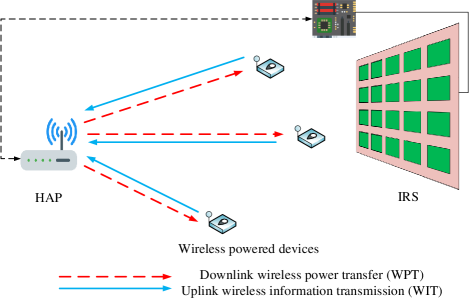
In this paper, we propose a new dynamic IRS beamforming framework to boost the sum throughput of an intelligent reflecting surface (IRS) aided wireless powered communication network (WPCN). Specifically, the IRS phase-shift vectors across time and resource allocation are jointly optimized to enhance the efficiencies of both downlink wireless power transfer (DL WPT) and uplink wireless information transmission (UL WIT) between a hybrid access point (HAP) and multiple wirelessly powered devices. To this end, we first study three special cases of the dynamic IRS beamforming,namely user-adaptive IRS beamforming, UL-adaptive IRS beamforming, and static IRS beamforming,by characterizing their optimal performance relationships and proposing corresponding algorithms. Interestingly, it is rigorously proved that the latter two cases achieve the same throughput, thus helping halve the number of IRS phase shifts to be optimized and signalling overhead practically required for UL-adaptive IRS beamforming. Then, we propose a general optimization framework for dynamic IRS beamforming, which is applicable for any given number of IRS phase-shift vectors available. Despite of the non-convexity of the general problem with highly coupled optimization variables, we propose two algorithms to solve it and particularly, the low-complexity algorithm exploits the intrinsic structure of the optimal solution as well as the solutions to the cases with user-adaptive and static IRS beamforming. Simulation results validate our theoretical findings, illustrate the practical significance of IRS with dynamic beamforming for spectral and energy efficient WPCNs, and demonstrate the effectiveness of our proposed designs over various benchmark schemes.
研究动机与目标
- 为解决因长距离信号衰减导致的无线供能物联网网络中能量与频谱效率低下的问题。
- 设计一种动态IRS波束成形策略,联合优化时变的相位偏移与资源分配,以提升系统吞吐量。
- 通过证明上行链路自适应与静态波束成形策略性能等价,降低IRS辅助WPCNs中的信令开销。
- 开发一种通用且可扩展的优化框架,适用于任意数量的IRS相位偏移矢量。
提出的方法
- 提出一种新型动态IRS波束成形在WPCNs中的优化框架,联合优化时隙中的IRS相位偏移矢量与时间/功率分配。
- 分析三种特殊情况:用户自适应、上行链路自适应与静态IRS波束成形,推导其最优性能关系。
- 数学上证明上行链路自适应与静态IRS波束成形可实现相同的总吞吐量,从而减少需优化的相位偏移数量。
- 提出两种算法求解非凸优化问题:一种高精度方法与一种利用特殊情况结构洞察的低复杂度算法。
- 利用引理2(涉及乘积与平方根的不等式)界定总吞吐量表达式并推导最优性条件。
- 通过反证法证明:对同一用户使用多个IRS相位偏移矢量会降低性能,从而证明每个用户仅使用单一矢量的合理性。
实验结果
研究问题
- RQ1与静态或自适应基准相比,动态IRS波束成形是否能显著提升IRS辅助WPCNs中的总吞吐量?
- RQ2在可实现的总吞吐量方面,上行链路自适应与静态IRS波束成形是否存在理论等价性?
- RQ3是否可以减少IRS相位偏移矢量的数量而不造成性能损失?若可以,其条件是什么?
- RQ4如何在实际中高效求解动态IRS波束成形的非凸、高度耦合优化问题?
- RQ5为最大化WPCNs中的频谱与能量效率,时变IRS相位偏移矢量的最优结构是什么?
主要发现
- 上行链路自适应与静态IRS波束成形实现相同的总吞吐量,证明可将不同IRS相位偏移矢量的数量减半而性能不下降。
- 动态IRS波束成形的最优解要求每个用户仅使用一个IRS相位偏移矢量,因为对同一用户使用多个矢量会导致性能次优。
- 所提出的低复杂度算法通过利用静态与用户自适应波束成形情况的结构洞察,实现了接近最优的性能。
- 仿真结果证实,所提框架在总吞吐量与能量效率方面显著优于基准方案。
- 上行链路自适应与静态波束成形之间等价性的理论证明,降低了信令开销,简化了WPCNs中实际IRS部署。

更好的研究,从现在开始
从阅读论文到最终审阅,大幅缩短您的研究时间。
无需绑定信用卡
本解读由 AI 生成,并经人工编辑审核。