
[论文解读] IRS-Assisted Wireless Powered NOMA: Do We Really Need Different Phase Shifts in DL and UL?
本文提出在IRS辅助的无线能量供应用于NOMA网络中,联合优化时隙分配与智能反射面(IRS)相位偏移,证明了动态波束成形——即下行链路能量传输与上行链路信息传输使用不同相位偏移——是不必要的。关键贡献在于,对两个阶段采用相同的相位偏移可简化设计并降低开销,且不损失性能,从而通过联合与交替优化算法实现高效的总吞吐量最大化,显著优于基准方案。
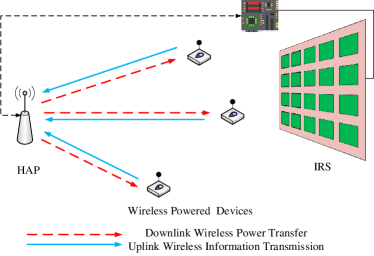
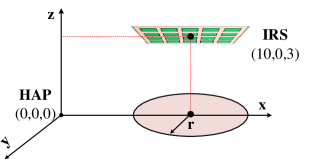
Intelligent reflecting surface (IRS) is a promising technology to improve the performance of wireless powered communication networks (WPCNs) due to its capability to reconfigure signal propagation environments via smart reflection. In particular, the high passive beamforming gain promised by IRS can significantly enhance the efficiency of both downlink wireless power transfer (DL WPT) and uplink wireless information transmission (UL WIT) in WPCNs. Although adopting different IRS phase shifts for DL WPT and UL WIT, i.e., dynamic IRS beamforming, is in principle possible but incurs additional signaling overhead and computational complexity, it is an open problem whether it is actually beneficial. To answer this question, we consider an IRS-assisted WPCN where multiple devices employ a hybrid access point (HAP) to first harvest energy and then transmit information using non-orthogonal multiple access (NOMA). Specifically, we aim to maximize the sum throughput of all devices by jointly optimizing the IRS phase shifts and the resource allocation. To this end, we first prove that dynamic IRS beamforming is not needed for the considered system, which helps reduce the number of IRS phase shifts to be optimized. Then, we propose both joint and alternating optimization based algorithms to solve the resulting problem. Simulation results demonstrate the effectiveness of our proposed designs over benchmark schemes and also provide useful insights into the importance of IRS for realizing spectrally and energy efficient WPCNs.
研究动机与目标
- 解决IRS辅助的无线供能NOMA网络中,动态IRS波束成形是否能提升性能的开放问题。
- 通过联合优化时隙分配与IRS无源波束成形,最大化多个设备的总吞吐量。
- 通过消除下行链路与上行链路中不同相位偏移的需求,降低信令开销与计算复杂度。
- 开发低复杂度、实用的算法——联合优化与交替优化算法,用于系统设计。
- 为IRS在提升WPCN中频谱与能量效率方面的作用提供深入见解。
提出的方法
- 证明在下行链路与上行链路中使用相同的IRS相位偏移为最优,从而消除对动态波束成形的需求。
- 建立一个非凸优化问题,以在服务质量与能量采集约束下最大化总吞吐量。
- 提出一种联合优化算法,采用半定松弛(SDR)与高斯随机化方法处理秩一约束。
- 设计一种交替优化算法,对时隙分配与相位偏移提供闭式解,降低复杂度。
- 在优化框架中使用惩罚方法处理秩约束。
- 通过仿真验证设计,将所提方案与固定相位偏移、固定时隙分配及无IRS的基准方案进行对比。
实验结果
研究问题
- RQ1在IRS辅助的无线供能NOMA网络中,使用不同相位偏移的动态IRS波束成形是否真的有益?
- RQ2是否可以对下行链路无线能量传输与上行链路信息传输使用相同的IRS相位偏移而不造成性能下降?
- RQ3IRS部署对NOMA网络中WPCN的系统吞吐量与能耗有何影响?
- RQ4IRS单元数量如何影响最优时隙分配与设备的采集能量?
- RQ5与联合优化相比,低复杂度的交替优化能否实现近似最优性能?
主要发现
- 在所考虑的IRS辅助WPCN-NOMA系统中,动态IRS波束成形无法提升系统性能,对下行链路与上行链路采用相同相位偏移为最优。
- 所提出的交替优化算法实现的吞吐量几乎与联合优化基准相当,使其成为一种实用的低复杂度解决方案。
- 随着IRS单元数量增加,最优下行链路WPT时隙τ₀减小,从而降低HAP能量消耗,同时保持或提升设备的能量采集性能。
- 当同时优化时隙分配与相位偏移时,总吞吐量相对于基准方案的增益随IRS单元数量增加而提升,尤其显著。
- 尽管WPT时隙缩短,但IRS尺寸增大可提升有效信道增益,从而提高设备的采集能量。
- 随着IRS尺寸增大,系统实现‘双重增益’,即同时提升频谱效率与能量效率。
更好的研究,从现在开始
从阅读论文到最终审阅,大幅缩短您的研究时间。
无需绑定信用卡
本解读由 AI 生成,并经人工编辑审核。