
[论文解读] Is RIS-Aided Massive MIMO Promising with ZF Detectors and Imperfect CSI?
该论文提出了一种低开销的MMSE信道估计器,并在导频开销减少的前提下,推导了在导频信道状态信息(CSI)不完美且使用迫零(ZF)检测器时,智能反射面(RIS)辅助大规模MIMO系统的上行链路可实现速率的闭式表达式。理论分析表明,用户速率至少以 $\mathcal{O}(\log_2(MN))$ 的速度增长,当RIS相位偏移对准单个用户时,速率可达到 $\mathcal{O}(\log_2(MN^2))$,从而实现与 $N$ 成比例的功率或天线数减少,同时保持速率不变。提出的两种基于MM的低复杂度算法,分别用于优化和最大化总速率与最小用户速率,每轮迭代均具有闭式解。
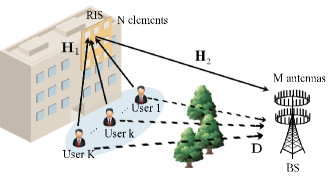
This paper provides a theoretical framework for understanding the performance of reconfigurable intelligent surface (RIS)-aided massive multiple-input multiple-output (MIMO) with zero-forcing (ZF) detectors under imperfect channel state information (CSI). We first propose a low-overhead minimum mean square error (MMSE) channel estimator, and then derive and analyze closed-form expressions for the uplink achievable rate. Our analytical results demonstrate that: $1)$ regardless of the RIS phase shift design, the rate of all users scales at least on the order of $\mathcal{O}\left(\log_2\left(MN ight) ight)$, where $M$ and $N$ are the numbers of antennas and reflecting elements, respectively; $2)$ by aligning the RIS phase shifts to one user, the rate of this user can at most scale on the order of $\mathcal{O}\left(\log_2\left(MN^2 ight) ight)$; $3)$ either $M$ or the transmit power can be reduced inversely proportional to $N$, while maintaining a given rate. Furthermore, we propose two low-complexity majorization-minimization (MM)-based algorithms to optimize the sum user rate and the minimum user rate, respectively, where closed-form solutions are obtained in each iteration. Finally, simulation results validate all derived analytical results. Our simulation results also show that the maximum sum rate can be closely approached by simply aligning the RIS phase shifts to an arbitrary user.
研究动机与目标
- 建立在导频信道状态信息不完美条件下,使用迫零(ZF)检测的RIS辅助大规模MIMO系统的理论框架。
- 推导多用户RIS辅助系统中上行链路可实现速率的闭式表达式。
- 研究用户速率相对于基站天线数 $M$ 和反射单元数 $N$ 的标度行为。
- 提出用于总速率和最小用户速率最大化的低复杂度优化算法。
- 通过仿真验证理论分析结果,并展示简单相位偏移对齐策略可实现近似最优性能。
提出的方法
- 提出一种低开销的最小均方误差(MMSE)信道估计器,以减少导频开销。
- 在导频信道状态信息不完美和迫零(ZF)检测条件下,推导上行链路可实现速率的闭式表达式。
- 采用主要化-最小化(MM)框架,设计两种用于总速率和最小速率最大化的低复杂度算法。
- MM算法的每轮迭代均计算相位偏移和波束成形器的闭式解,确保收敛性。
- 理论分析利用矩阵扰动和二次型表示方法,推导出速率标度律。
- 通过仿真结果验证理论推导,并展示所提算法的性能增益。
实验结果
研究问题
- RQ1在导频信道状态信息不完美且使用迫零(ZF)检测器的RIS辅助大规模MIMO系统中,可实现速率的根本标度律是什么?
- RQ2速率相对于基站天线数 $M$ 和RIS单元数 $N$ 如何变化?
- RQ3通过将RIS相位偏移对准某个特定用户,能否提升其速率?若能,提升幅度如何?
- RQ4当 $N$ 增加时,为维持目标速率,所需最少的天线数或发射功率是多少?
- RQ5简单的相位偏移对齐策略能否实现接近最优的总速率性能?
主要发现
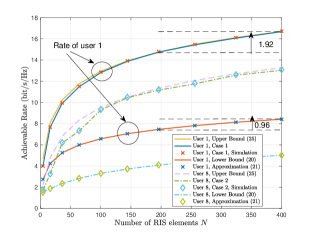
- 无论RIS相位偏移如何设计,所有用户的可实现速率至少以 $\mathcal{O}(\log_2(MN))$ 的速度增长。
- 当RIS相位偏移对准单个用户时,其速率可达到 $\mathcal{O}(\log_2(MN^2))$ 的增长速度,带来显著的性能增益。
- 为维持给定速率,可将天线数 $M$ 或发射功率与 $N$ 成反比减少,从而实现硬件和能耗节省。
- 所提出的基于MM的算法在每轮迭代中均获得闭式解,确保计算复杂度低且收敛。
- 仿真结果证实,将RIS相位偏移对准任意单个用户,可非常接近达到最大总速率,表明该策略具有鲁棒性和简洁性。
- 理论推导通过仿真得到验证,证明了所推导的速率表达式和标度律具有高准确性。
更好的研究,从现在开始
从阅读论文到最终审阅,大幅缩短您的研究时间。
无需绑定信用卡
本解读由 AI 生成,并经人工编辑审核。