
[论文解读] Iterative assembly of $^{171}$Yb atom arrays with cavity-enhanced optical lattices
展示了一种迭代协议,使用原子储库、光镊以及腔增强光晶格,将1225位点目标阵列以约99%占用确定性填充到171Yb原子,实现可扩展、可重新加载的中性原子量子系统。
Assembling and maintaining large arrays of individually addressable atoms is a key requirement for continued scaling of neutral-atom-based quantum computers and simulators. In this work, we demonstrate a new paradigm for assembly of atomic arrays, based on a synergistic combination of optical tweezers and cavity-enhanced optical lattices, and the incremental filling of a target array from a repetitively filled reservoir. In this protocol, the tweezers provide microscopic rearrangement of atoms, while the cavity-enhanced lattices enable the creation of large numbers of optical traps with sufficient depth for rapid low-loss imaging of atoms. We apply this protocol to demonstrate near-deterministic filling (99% per-site occupancy) of 1225-site arrays of optical traps. Because the reservoir is repeatedly filled with fresh atoms, the array can be maintained in a filled state indefinitely. We anticipate that this protocol will be compatible with mid-circuit reloading of atoms into a quantum processor, which will be a key capability for running large-scale error-corrected quantum computations whose durations exceed the lifetime of a single atom in the system.
研究动机与目标
- 促进可扩展地组装大规模、确定性填充的中性原子阵列,用于量子计算和模拟。
- 将光镊与腔增强光晶格结合,以实现快速、高保真成像和确定性填充。
- 通过重复填充的储库和中段重排,将最终阵列大小与单次加载原子供应解耦。
- 通过储库重新加载在时间上维持已填充阵列,支持误差纠正方案的潜在中断电路再加载。
提出的方法
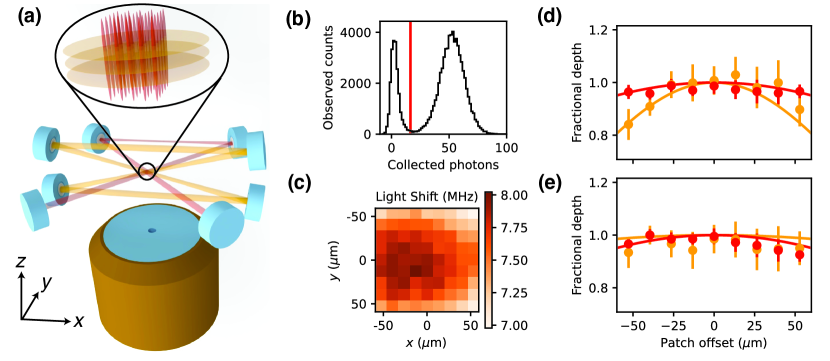
- 使用两个相交的腔(XY 和 Z)来创建三维、深度晶格,以实现原子快速、低损耗成像。
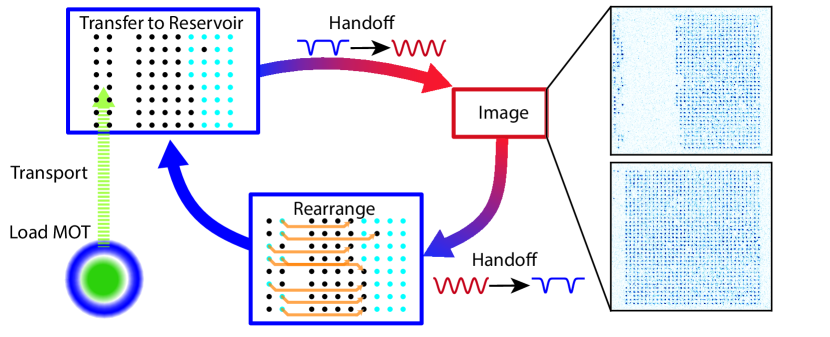
- 在光镊中实现原子储库,以及一个独立的目标镊阵列;将原子转移到腔晶格中以实现位点分辨成像。
- 执行位点分辨荧光成像,以约99.95% 的保真度和约2e-3 的成像损失来确定占用情况。
- 通过重排镊子在储库与目标阵列之间循环,将基于成像结果的空目标位点移入目标阵列。
- 重复加载循环,以在1225位点目标阵列中实现约99%占用率,同时在每个循环中从新 MOT 重新加载储库。
实验结果
研究问题
- RQ1迭代式、基于储库的加载方案是否能够实现非常大原子阵列的近似确定性填充?
- RQ2在储库到目标的移交过程中,最主要的每循环损耗机制是什么,如何减轻它们?
- RQ3在持续重新加载和成像的情况下,是否可在时间上维持一个完全填充的大阵列?
- RQ4腔增强光晶格是否能提供大阵列所需的深度、均匀陷阱,以实现快速、高保真成像?
- RQ5该方法与中电路重加载在可扩展量子计算中的兼容性如何?
主要发现
- 在多次加载循环中,已实现对1225位点目标阵列的确定性填充,约99%占用的171Yb原子。
- 储库最多可达105个位点,循环加载自新 MOT 并紧邻目标阵列,以实现持续补充。
- 通过腔增强晶格成像,在每个位点约7 ms 内获得约50 光子的成像信号,具备99.95% 的占用判别与约2e-3 的原子损失。
- 每循环的加载性能在早期阶段显示每循环向目标阵列转移约45 个原子,最终的空位分数处于百分比级别的损耗,主要由真空寿命(约30 s)主导。
- 该协议允许通过重复的储库重载无限期维持填充阵列,与大规模量子计算的中电路重加载概念兼容。
更好的研究,从现在开始
从论文设计到论文写作,大幅缩短您的研究时间。
无需绑定信用卡
本解读由 AI 生成,并经人工编辑审核。