
[论文解读] JADES: Carbon enrichment 350 Myr after the Big Bang in a gas-rich galaxy
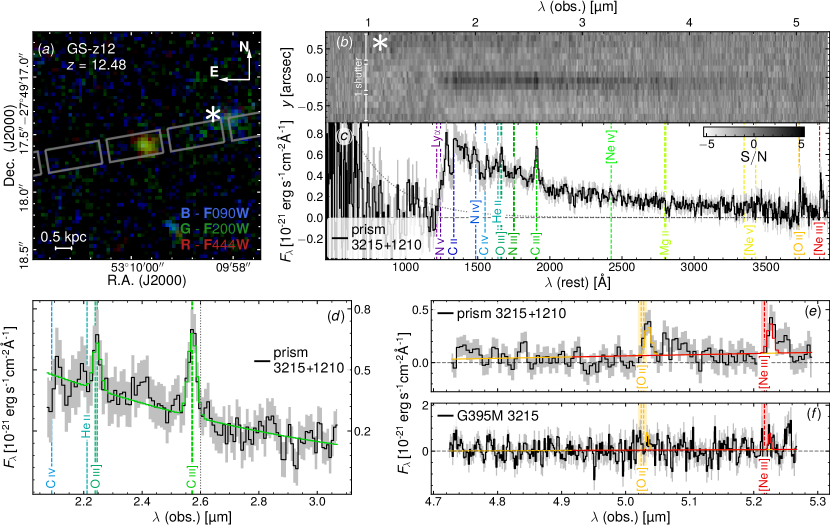
本文报告了一项对 z=12.5 星系(目标)的深度 JWST/NIRSpec 分析,揭示了一个稳健的 C iii] 发射线,暗示 C/O 为太阳或超太阳且存在相当的气体储量,挑战宇宙黎明时期的标准化学富集情景。
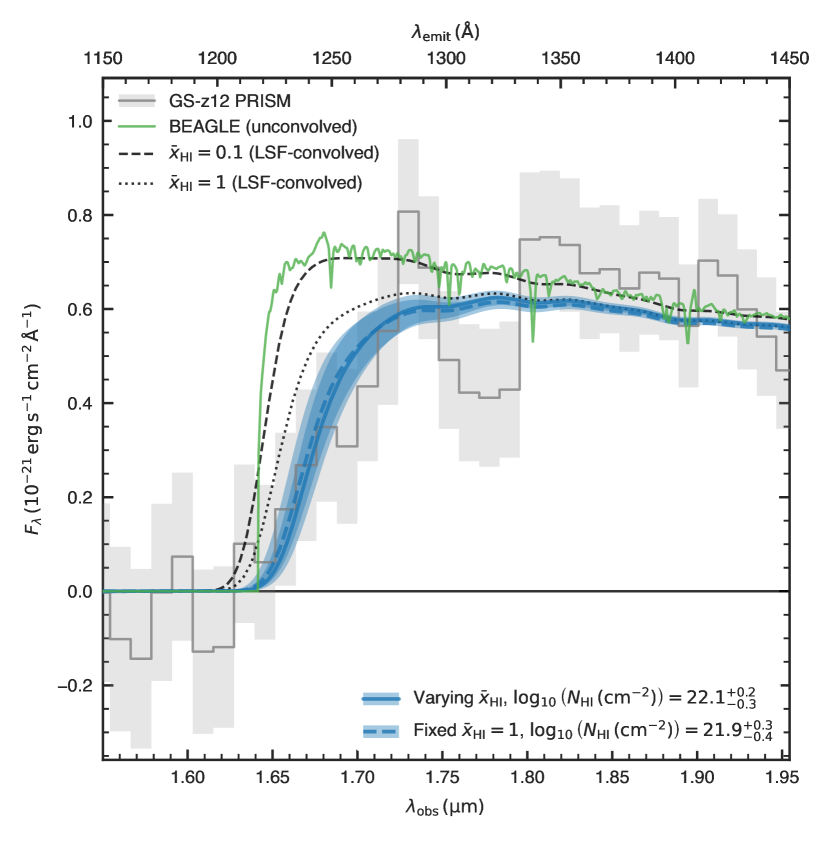
Finding the emergence of the first generation of metals in the early Universe, and identifying their origin, are some of the most important goals of modern astrophysics. We present deep JWST/NIRSpec spectroscopy of GS-z12, a galaxy at z=12.5, in which we report the detection of C III]$λλ$1907,1909 nebular emission. This is the most distant detection of a metal transition and the most distant redshift determination via emission lines. In addition, we report tentative detections of [O II]$λλ$3726,3729 and [Ne III]$λ$3869, and possibly O III]$λλ$1661,1666. By using the accurate redshift from C III], we can model the Ly$α$ drop to reliably measure an absorbing column density of hydrogen of $N_{HI} \approx 10^{22}$ cm$^{-2}$ - too high for an IGM origin and implying abundant ISM in GS-z12 or CGM around it. We infer a lower limit for the neutral gas mass of about $10^7$ MSun which, compared with a stellar mass of $\approx4 imes 10^7$ MSun inferred from the continuum fitting, implies a gas fraction higher than about 0.1-0.5. We derive a solar or even super-solar carbon-to-oxygen ratio, tentatively [C/O]>0.15. This is higher than the C/O measured in galaxies discovered by JWST at z=6-9, and higher than the C/O arising from Type-II supernovae enrichment, while AGB stars cannot contribute to carbon enrichment at these early epochs and low metallicities. Such a high C/O in a galaxy observed 350 Myr after the Big Bang may be explained by the yields of extremely metal poor stars, and may even be the heritage of the first generation of supernovae from Population III progenitors.
研究动机与目标
- 使用深度 JWST/NIRSpec 光谱学识别并表征 z=12.5 星系中的金属线。
- 通过星云发射线和连续性建模约束红移、气体含量和金属丰度。
- 推断早期宇宙中的碳/氧丰度以及可能的富集途径。
提出的方法
- 获得总计约 100 小时积分的带棱镜和 G140M/G395M 架的深度 NIRSpec 光谱。
- 使用局部像素积分高斯模型进行发射线拟合,采用 5-sigma 探测阈值以确保线的可靠性。
- 使用 BEAGLE 建模恒星连续光谱、星云发射、尘埃衰减和以延迟指数型为形的星形成历史,并将 IMF 的上限质量设为 300 M_sun。
- 通过将内在 BEAGLE 光谱与 DLA 和 IGM 吸收模型相结合,约束 Ly-α 阻尼翼吸收以推导 N_HI。
- 从基于 τ_V 的衰减和类 DLA 的金属丰度估计推导气体量和金属丰度,承认在消光与衰减处理中的系统误差。
实验结果
研究问题
- RQ1在大爆炸后 350 Myr 观测到的星系中,其化学组成和 C/O 比是多少?
- RQ2星系的 ISM/CGM 中是否存在大量冷且金属贫乏气体的证据?
- RQ3C iii] 等其他星云线是否能约束 z>12 的气体质量、金属丰度和恒星形成特性?
- RQ4观测到的丰度是否指向 Population III/早期恒星产额的增强作为富集来源?
主要发现
- 以 5-sigma 检出 C iii] 1907,1909,是迄今为止最遥远的金属线探测。
- 红移约束为 z = 12.482 ± 0.012(仅 C iii] 给出 z = 12.479 ± 0.014)。
- 气相氧丰度为 log O/H = 7.9 ± 0.2,C/O 为对数大于 0.15 的太阳或超太阳比(在 BEAGLE 拟合中 C/O ≳ 1.4 倍太阳)。
- 在 ISM/CGM 的中性氢柱密度推断为 log10 N_HI(cm^-2) = 22.1^{+0.2}_{-0.3}(基准值),表明比 IGM 贡献更密集的中性气体。
- 估计的原子气体质量 log(M_gas/M_sun) = 7.0 ± 0.25,意味着一个可观的气体储量,占恒星质量的 10–50%,这取决于气相假设。
- 证据表明高 C/O 与金属贫乏气体与极端金属贫乏恒星的产额一致,可能与 Population III 前体星相关。
更好的研究,从现在开始
从论文设计到论文写作,大幅缩短您的研究时间。
无需绑定信用卡
本解读由 AI 生成,并经人工编辑审核。