
[论文解读] JADES Imaging of GN-z11: Revealing the Morphology and Environment of a Luminous Galaxy 430 Myr After the Big Bang
JWST/NIRCam 在 z=10.60 的 GN-z11 的九波段成像显示紧凑的两成分形态,具有蓝色连续谱 SED,以及一个邻近的星系丰富环境,暗示一个巨大的宿主晕。
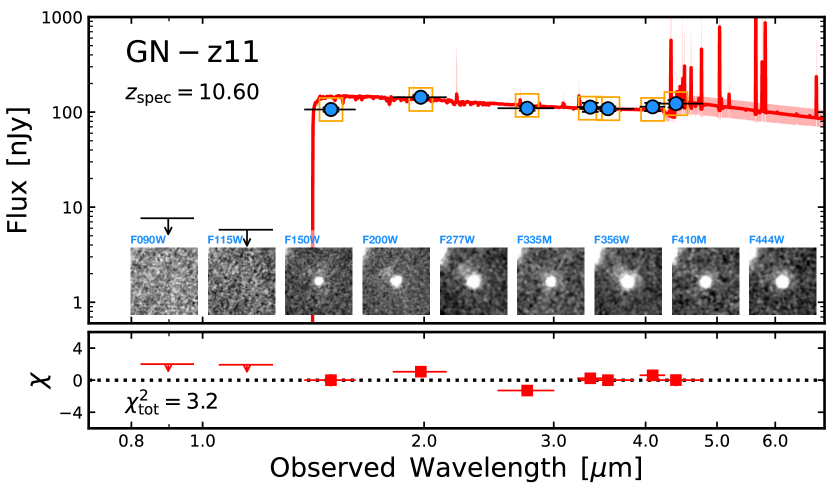
We present JWST NIRCam 9-band near-infrared imaging of the luminous $z=10.6$ galaxy GN-z11 from the JWST Advanced Deep Extragalactic Survey (JADES) of the GOODS-N field. We find a spectral energy distribution (SED) entirely consistent with the expected form of a high-redshift galaxy: a clear blue continuum from 1.5 to 4 microns with a complete dropout in F115W. The core of GN-z11 is extremely compact in JWST imaging. We analyze the image with a two-component model, using a point source and a Sérsic profile that fits to a half-light radius of 200 pc and an index $n=0.9$. We find a low-surface brightness haze about $0.4''$ to the northeast of the galaxy, which is most likely a foreground object but might be a more extended component of GN-z11. At a spectroscopic redshift of 10.60 (Bunker et al. 2023), the comparison of the NIRCam F410M and F444W images spans the Balmer jump. From population synthesis modeling, here assuming no light from an active galactic nucleus, we reproduce the SED of GN-z11, finding a stellar mass of $\sim$$10^{9}~M_{\odot}$, a star-formation rate of $\sim$$20~M_{\odot}~\mathrm{yr}^{-1}$ and a young stellar age of $\sim$$20~\mathrm{Myr}$. As massive galaxies at high redshift are likely to be highly clustered, we search for faint neighbors of GN-z11, finding 9 galaxies out to $\sim$5 comoving Mpc transverse with photometric redshifts consistent with $z=10.6$, and a 10$^{ m th}$ more tentative dropout only $3''$ away. This is consistent with GN-z11 being hosted by a massive dark-matter halo ($\approx8 imes10^{10}~M_{\odot}$), though lower halo masses cannot be ruled out.
研究动机与目标
- 使用高分辨率的 JWST 成像来研究 GN-z11 的形态,以理解其在 z=10.6 时的结构。
- 表征光谱能量分布(SED),在不考虑AGN贡献的情况下推断恒星质量、恒星形成率和年龄。
- 进行光谱测定红移,并将其与星系环境及晕 hosting 属性联系起来。
提出的方法
- 从 GOODS-N 的 JADES 调查获取 9 波段 JWST/NIRCam 成像。
- 使用两成分拟合(点源 + Sérsic轮廓)对形态进行建模,以推导结构参数(半光半径、Sérsic 指数)。
- 使用 Prospector 进行 SED 建模,假设无AGN贡献以估算恒星质量、SFR 和恒星年龄。
- 比较 NIRCam 的 F410M 与 F444W 成像以探测 Balmer 跃迁并约束恒星群体。
- 通过搜索具有一致光度学红移的微弱邻居来识别并分析星系环境。
- 校准天区测量并构建自定义天空平场,以实现准确的背景减法和光测量。
实验结果
研究问题
- RQ1在 z=10.6 时 GN-z11 的本征形态是什么,并且它与其他高红移星系相比如何?
- RQ2在无AGN假设下,根据其SED推断的 GN-z11 的恒星质量、恒星形成率、年龄和尘埃含量是多少?
- RQ3从其环境和邻近星系的聚类推断,GN-z11 是否居于一个巨大的暗物质晕中?
- RQ4F410M 与 F444W 之间的 Balmer 跃迁揭示了关于恒星群体的什么信息?
主要发现
- GN-z11 的核心极为紧凑,使用两成分模型拟合的半光半径为 200 pc,Sérsic 指数 n = 0.9。
- 从 1.5 到 4 微米的 SED 为蓝色,在 F115W 处有掉落,与高红移星系一致;光谱红移为 z_spec = 10.60。
- 总体合成建模(无AGN)给出恒星质量约为 ~1×10^9 太阳质量,SFR 约为 ~20 太阳质量/年,恒星年龄约为 ~20 Myr。
- GN-z11 在东北方向有低表面亮度的薄雾状物,可能是前景物体,尽管也可能是 GN-z11 的扩展分量。
- 在 ~5 共迁移Mpc 内有 9 个光度学红移与 z=10.6 一致的邻近星系,加上在 3 arcseconds 的一个初步的第 10 个 dropout,支持一个质量巨大的晕 hosting 情景(~8×10^10 太阳质量)。
更好的研究,从现在开始
从论文设计到论文写作,大幅缩短您的研究时间。
无需绑定信用卡
本解读由 AI 生成,并经人工编辑审核。