
[论文解读] JADES NIRSpec Initial Data Release for the Hubble Ultra Deep Field: Redshifts and Line Fluxes of Distant Galaxies from the Deepest JWST Cycle 1 NIRSpec Multi-Object Spectroscopy
本文呈现了在 HUDF 中最深的 JWST/NIRSpec MOS 光谱,提供了 178 颗星系的红移(最高到 z=13.2)以及来自 253 个目标的发射线目录,伴随公开数据发布。
We describe the NIRSpec component of the JWST Deep Extragalactic Survey (JADES), and provide deep spectroscopy of 253 sources targeted with the NIRSpec micro-shutter assembly in the Hubble Ultra Deep Field and surrounding GOODS-South. The multi-object spectra presented here are the deepest so far obtained with JWST, amounting to up to 28 hours in the low-dispersion ($R\sim 30-300$) prism, and up to 7 hours in each of the three medium-resolution $R\approx 1000$ gratings and one high-dispersion grating, G395H ($R\approx2700$). Our low-dispersion and medium-dispersion spectra cover the wavelength range $0.6-5.3μ$m. We describe the selection of the spectroscopic targets, the strategy for the allocation of targets to micro-shutters, and the design of the observations. We present the public release of the reduced 2D and 1D spectra, and a description of the reduction and calibration process. We measure spectroscopic redshifts for 178 of the objects targeted extending up to $z=13.2$. We present a catalog of all emission lines detected at $S/N>5$, and our redshift determinations for the targets. Combined with the first JADES NIRCam data release, these public JADES spectroscopic and imaging datasets provide a new foundation for discoveries of the infrared universe by the worldwide scientific community.
研究动机与目标
- 描述在 HUDF 及其周围 GOODS-South 区域的 NIRSpec MOS 观测。
- 提供深层光谱数据以及已处理的 2D/1D 光谱的公开发布。
- 为目标对象测量光谱红移并汇总发射线通量。
- 概述目标选择、MSA 分配以及数据降低/校准过程。
提出的方法
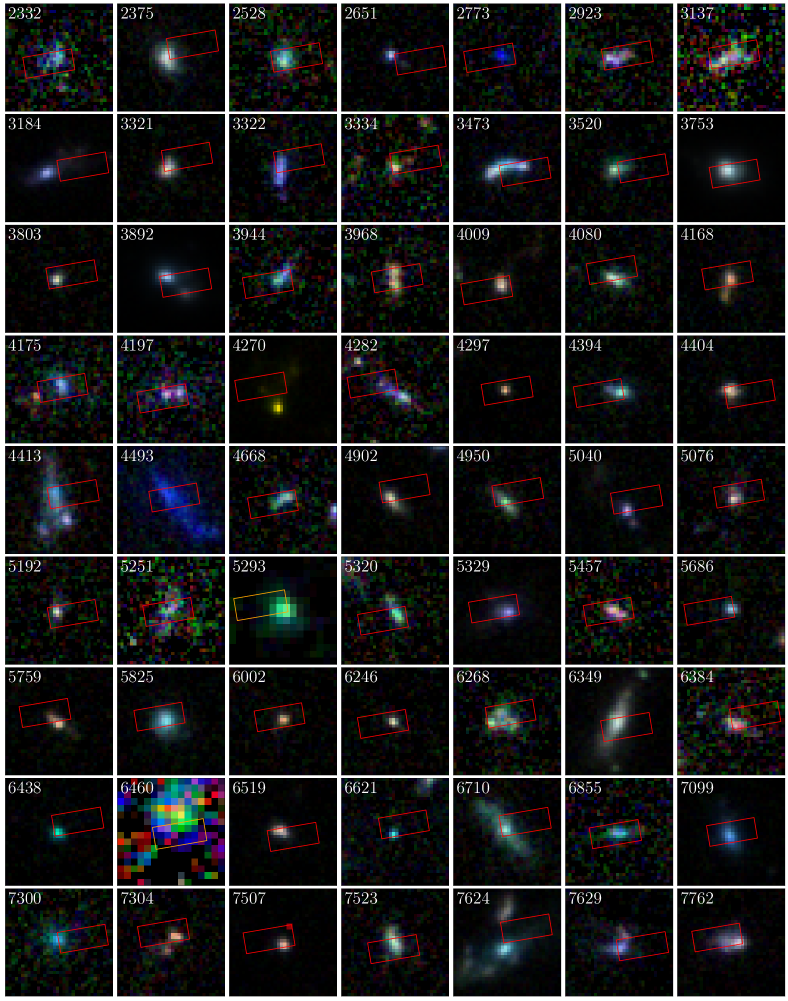
- 使用 NIRSpec MOS,采用棱镜(R~30-300)及中/高分辨率光栅(R~1000,~2700),覆盖 0.6–5.3 μm。
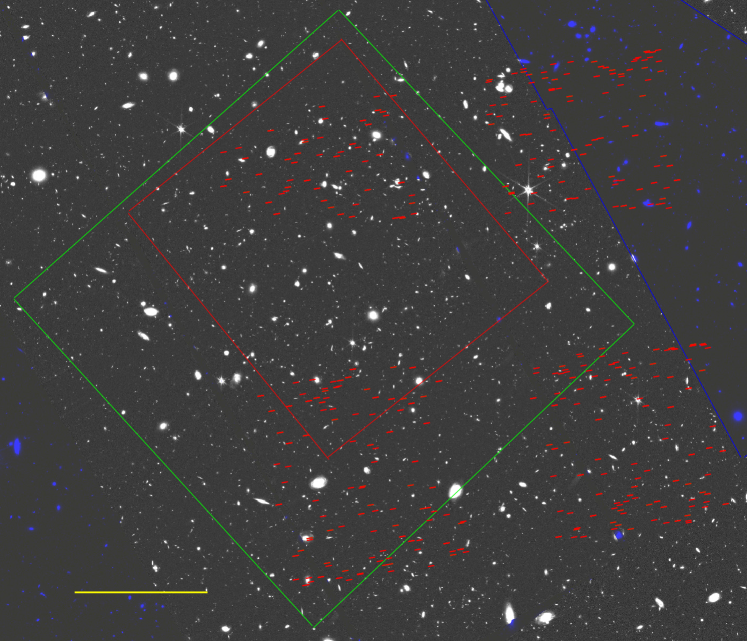
- 通过 eMPT 软件分配目标,以在 MSA 快门内最大化高优先级覆盖。
- 计划三个抖动指向,以最大化曝光时间并降低探测器缺陷。
- 对光谱进行降噪和标定,生成公开可用的 2D 和 1D 数据产品。
- 从低/中色散数据中推导显著发射线的红移和通量。
实验结果
研究问题
- RQ1JADES NIRSpec MOS 在 HUDF/GOODS-South 的光谱红移范围是多少?
- RQ2在目标星系中检测到的发射线通量中,S/N > 5 的有哪些?
- RQ3目标选择与 MSA 分配策略在最大化高红移与稀有对象覆盖方面的效果如何?
- RQ4Cycle 1 获得的最深 NIRSpec 光谱的特征(曝光时间、分辨率)及其科学潜力如何?
- RQ5如何将处理后的数据及红移/线目录与 JWST/NIRCam 成像结合用于未来研究?
主要发现
- 公开发布了使用 NIRSpec MSA 观测的 253 个对象的 reduced 2D 和 1D 光谱。
- 已为 178 个目标测得红移,最高达到 z = 13.2。
- 发射线目录包含观测源中所有检测到的 S/N > 5 的线。
- 光谱数据在低色散棱镜下达到 28 小时,在中/高色散光栅下达到每个约 7 小时。
- 三-pronged 的 MSA 观测策略与三个抖动指向最大化曝光并最小化光谱重叠与缺陷。
- 目标优先级设定为从 z>8.5 的样本到 1.5<z<5.7 的样本,以便从再电离 era 到 Cosmic Noon 的探索。
更好的研究,从现在开始
从阅读论文到最终审阅,大幅缩短您的研究时间。
无需绑定信用卡
本解读由 AI 生成,并经人工编辑审核。