
[论文解读] JADES: The production and escape of ionizing photons from faint Lyman-alpha emitters in the epoch of reionization
本研究分析了 JWST/JADES 数据中 16 个 z>5.8 的微弱 Lyman-α 发射体,测量 Lyα 与 LyC 的产生/逃逸、离子化状态,以及对宇宙再电离的意义。
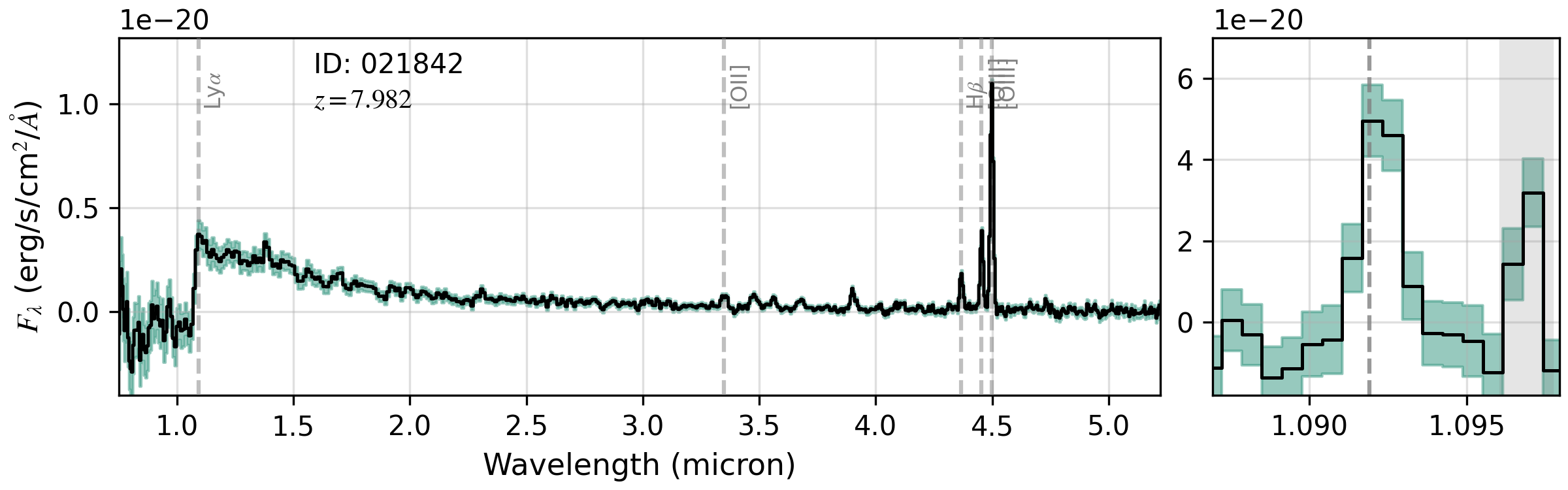
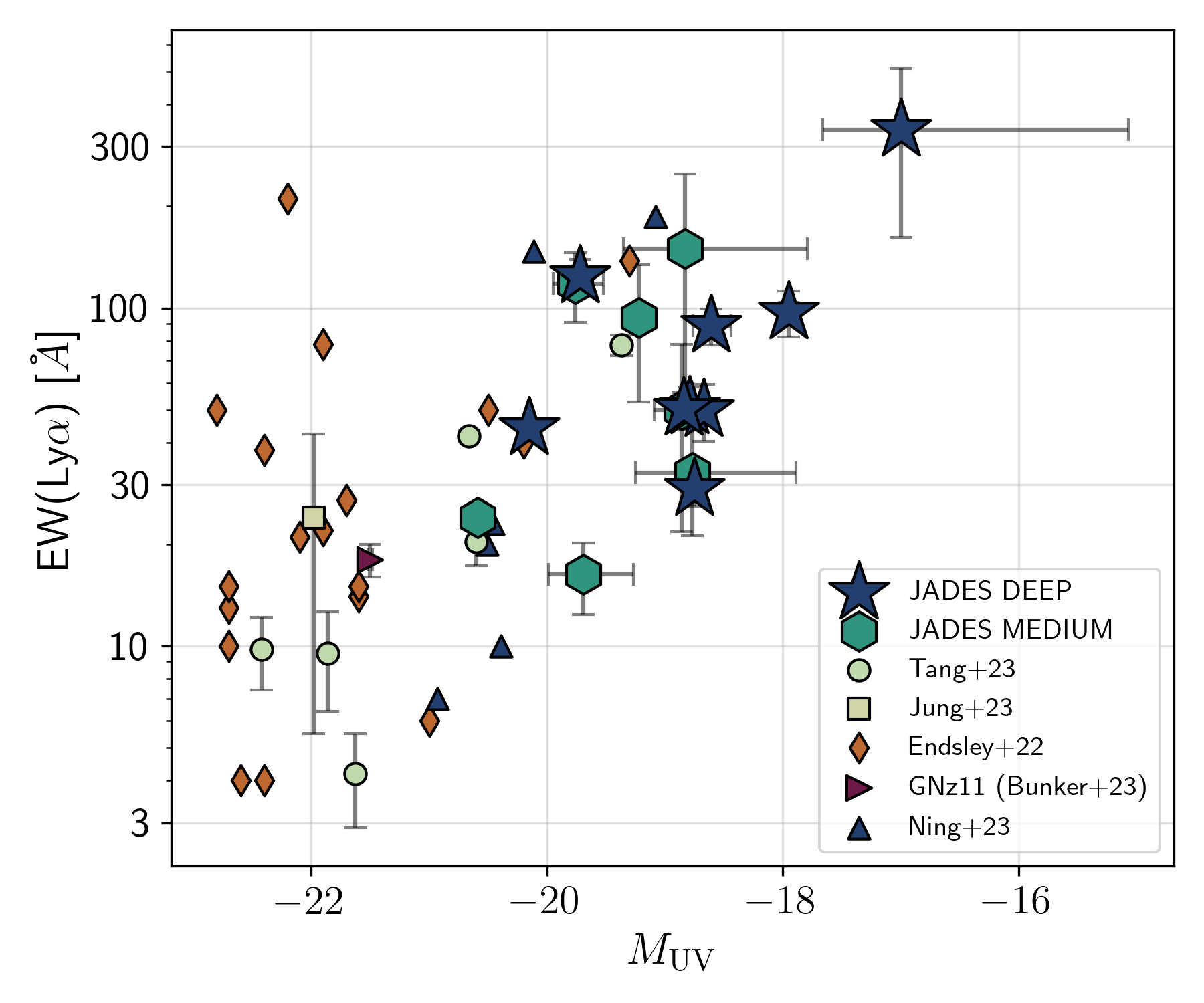
We present the properties of 17 faint Ly$α$ emitting galaxies (LAEs) at $z>5.8$ from the JWST Advanced Deep Extragalactic Survey (JADES) in the Hubble Ultra Deep Field/GOODS-S. These LAEs span a redshift range $z\approx5.8-8.0$ and a UV magnitude range $M_{UV}\approx-17$ to $-20.6$, with the Ly$α$ equivalent width (EW) in the range $\approx 25-350$ Å. The detection of other rest-optical emission lines in the spectra of these LAEs enables the determination of accurate systemic redshifts and Lyα velocity offsets, as well as the physical and chemical composition of their stars and interstellar media. These faint LAEs are consistent with metal-poor systems with high ionization parameters, similar to the general galaxy population at $z>6$. We measured an average ionizing photon production efficiency, log($ξ_ m{ion}$/erg$^{-1}$ Hz) $\approx25.57$ across our LAEs, which does not evolve strongly with redshift. We report an anti-correlation between the Ly$α$ escape fraction (f_ m{esc}) and the velocity offset from systemic redshift, consistent with model expectations. We further find that the strength and velocity offset of Ly$α$ are neither correlated with galaxy spectroscopic properties nor with $ξ_ m{ion}$. We find a decrease in $f_ m{esc}$(Ly$α$) with redshift, indicative of decreasing sizes of ionized bubbles around LAEs at high redshifts. We used a range of galaxy properties to predict Lyman continuum $f_ m{esc}$ for our LAEs, finding that the ionizing photon output into the intergalactic medium remains roughly constant across the observed Ly$α$ EW, showing a mild increase at fainter M$_{UV}$ and at higher redshifts. We derived correlations between the ionizing photon output from LAEs and $M_{UV}$, Ly$α$ EW and redshifts, which can be used to constrain the ionizing photon contribution of LAEs at $z > 6$ towards cosmic reionization.
研究动机与目标
- 研究在再电离时代(z ≈ 5.8–8.0)对微弱 Lyman-α 发射体(LAEs)的物理属性进行分析。
- 从就地系红移、Lyα 速度偏移、化学丰度、离子化参数和尘埃含量等方面利用原始光学线索来推断。
- 估算离子化光子产出效率及对 LyC 逃逸的影响,以更新再电离预算。
- 探讨 Lyα 属性如何与星系属性及不断演化的星系际介质(IGM)相关联。
- 提供观测驱动的相关性以改进再电离建模。
提出的方法
- 使用 JWST NIRSpec 光谱来自 JADES Deep 与 Medium 版层,以识别 z>5.8 的 16 个 LAEs。
- 从 R100 及更高分辨率的 R1000 数据中测量 Lyα 通量,优先使用 G140M 光栅以获取 Lyα 属性。
- 在 G395M/G235M 光栅中利用强的原始光学线(Hβ、[O iii]、Hα)推导系统性红移。
- 从 R100 光谱中推导原始 UV 亮度(MUV),并通过在 1340–2600 Å 区间拟合连续性来得到 UV 斜率 β。
- 估算 Balmer 减退(Hα/Hβ,或 Hβ/Hγ)以在 SMC 曲线下推导尘埃衰减。
- 从内在 L1500 与 Balmer 线(Case-B,Te=10^4 K,ne=100 cm^-3)推断离子化光子产出效率 ξion。
- 在考虑 Case-B 再降解的前提下,利用 dust-corrected Lyα/Hα 比值确定 Lyα 逃逸分数。
实验结果
研究问题
- RQ1在 z>5.8 的微弱 LAEs 中,通过原始光学线揭示的离子化状态、金属丰度与尘埃含量是怎样的?
- RQ2Lyα 属性(强度、速度偏移)如何与系统性属性及 LyC 逃逸潜力相关?
- RQ3这些微弱 LAEs 的离子化光子产出效率(ξion)是多少,是否随 redshift 变化?
- RQ4Lyα 逃逸如何随 redshift 演变,这对 IGM 中离子气泡的大小有何含义?
- RQ5是否可以利用观测得到的 LAE 属性构建现实且以观测为驱动的再电离模型?
主要发现
- LAEs 显示金属贫乏、类似高离子化参数的条件,与普遍的 z>6 星系群体一致。
- 平均离子化光子产出效率在整个样本中为 log(ξion/erg^-1 Hz) ≈ 25.56,随 redshift 的演化不显著。
- 在系统性红移与速度偏移之间发现 Lyα 逃逸分数的反相关,与理论预期一致。
- Lyα 强度与速度偏移与其他光谱学属性或 ξion 未显示出强相关性。
- Lyα 逃逸分数随红移下降,提示早期时期 LAEs 周围的离子化气泡较小。
- 利用多种星系属性,LyC 逃逸预测表明来自这些 LAEs 的对 IGM 的离子化输出在 UV 等级和 Lyα EW 上大致保持不变,带有轻微的红shift 增长。
- 将 LAEs 的离子化光子输出与 UV 等级、Lyα 强度和红shift 之间的相关性用于为再电离模型提供信息。
更好的研究,从现在开始
从论文设计到论文写作,大幅缩短您的研究时间。
无需绑定信用卡
本解读由 AI 生成,并经人工编辑审核。