
[论文解读] Joint-Diagonalizability-Constrained Multichannel Nonnegative Matrix Factorization Based on Multivariate Complex Sub-Gaussian Distribution
本文提出了一种新型多通道非负矩阵分解方法——子高斯MNMF,通过使用多变量复数广义高斯分布(GGD)对观测信号进行建模,以更好地捕捉子高斯源信号的特性。通过在空间协方差矩阵上引入联合对角化约束,作者推导出一种基于辅助函数的收敛优化算法,在混响环境中相较于传统MNMF和FastMNMF表现出更优的源信号分离精度,尤其在音乐信号处理中优势显著。
In this paper, we address a statistical model extension of multichannel nonnegative matrix factorization (MNMF) for blind source separation, and we propose a new parameter update algorithm used in the sub-Gaussian model. MNMF employs full-rank spatial covariance matrices and can simulate situations in which the reverberation is strong and the sources are not point sources. In conventional MNMF, spectrograms of observed signals are assumed to follow a multivariate Gaussian distribution. In this paper, first, to extend the MNMF model, we introduce the multivariate generalized Gaussian distribution as the multivariate sub-Gaussian distribution. Since the cost function of MNMF based on this multivariate sub-Gaussian model is difficult to minimize, we additionally introduce the joint-diagonalizability constraint in spatial covariance matrices to MNMF similarly to FastMNMF, and transform the cost function to the form to which we can apply the auxiliary functions to derive the valid parameter update rules. Finally, from blind source separation experiments, we show that the proposed method outperforms the conventional methods in source-separation accuracy.
研究动机与目标
- 将多通道NMF(MNMF)扩展为使用多变量复数子高斯分布对观测信号进行建模,而非传统的高斯模型。
- 解决子高斯MNMF中成本函数优化的挑战,该问题因缺乏已知的辅助函数而难以实现单调收敛。
- 在空间协方差矩阵上引入联合对角化约束,以推导出有效的辅助函数并实现稳定的参数更新。
- 在强混响条件下评估所提方法在盲源分离中的性能表现,尤其针对具有子高斯特性的音乐信号。
提出的方法
- 采用时变多变量复数广义高斯分布(GGD),其形状参数为β,对子高斯源统计特性进行建模,以表示观测的多通道信号。
- 在空间协方差矩阵上引入联合对角化约束,将成本函数转化为适合使用辅助函数优化的形式。
- 利用辅助函数技术推导出一种新型参数更新算法,确保优化过程中成本函数单调下降。
- 通过闭式表达式迭代更新参数:源功率谱图(σ_ijn)、基矩阵(t_ik, v_kj, z_kn)、空间协方差矩阵(G_in)以及波束成形向量(Q_i)。
- 采用辅助函数方法处理子高斯模型的非凸成本函数,实现稳定且收敛的优化。
- 实验中采用多变量GGD且β=4,该参数能有效反映音乐乐器信号中观测到的子高斯行为。

实验结果
研究问题
- RQ1使用多变量复数子高斯分布对多通道信号进行建模,是否能提升在混响环境中的源信号分离性能?
- RQ2当成本函数难以直接最小化时,能否为子高斯MNMF推导出一种收敛的优化算法?
- RQ3在空间协方差矩阵上施加联合对角化约束,是否能为子高斯MNMF推导出有效的辅助函数?
- RQ4在强混响条件下,所提出的子高斯MNMF与传统MNMF、FastMNMF和ILRMA相比,其源信号分离精度如何?
主要发现
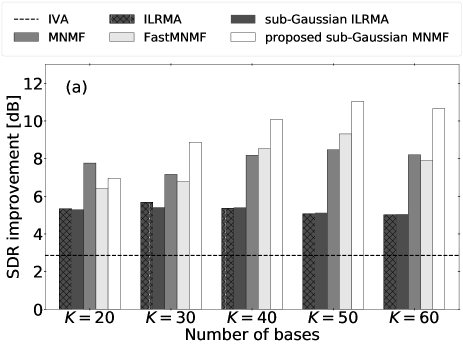
- 在强混响条件下,所提出的子高斯MNMF在源信号分离精度方面显著优于传统MNMF和FastMNMF,表现为信噪比提升(SDR improvement)更优。
- 该方法在SDR提升方面明显优于IVA、ILRMA和子高斯ILRMA,尤其在秩-1空间模型因空间扩展源或长混响而失效的情况下表现更优。
- 联合对角化约束使得有效辅助函数的推导成为可能,从而导出的参数更新算法可保证成本函数单调下降。
- 所提算法具有稳定的收敛性,即使在随机初始化下也能实现优于传统方法的分离性能,表明对初始条件具有鲁棒性。
- 采用β=4的多变量复数GGD能有效建模具有子高斯特性的音乐信号,从而提升建模保真度与分离质量。
更好的研究,从现在开始
从阅读论文到最终审阅,大幅缩短您的研究时间。
无需绑定信用卡
本解读由 AI 生成,并经人工编辑审核。