
[论文解读] JointAI: Joint Analysis and Imputation of Incomplete Data in R
JointAI 是一个 R 包,通过完全兼容的联合建模框架,支持使用贝叶斯方法对不完整数据进行联合贝叶斯分析和多重插补。它通过同时建模结果变量和协变量,克服了标准插补方法中存在的不相容性问题,支持复杂模型(如非线性效应、交互作用、生存分析和多层数据),实现一致的推断。
Missing data occur in many types of studies and typically complicate the analysis. Multiple imputation, either using joint modelling or the more flexible fully conditional specification approach, are popular and work well in standard settings. In settings involving non-linear associations or interactions, however, incompatibility of the imputation model with the analysis model is an issue often resulting in bias. Similarly, complex outcomes such as longitudinal or survival outcomes cannot be adequately handled by standard implementations. In this paper, we introduce the R package JointAI, which utilizes the Bayesian framework to perform simultaneous analysis and imputation in regression models with incomplete covariates. Using a fully Bayesian joint modelling approach it overcomes the issue of uncongeniality while retaining the attractive flexibility of fully conditional specification multiple imputation by specifying the joint distribution of analysis and imputation models as a sequence of univariate models that can be adapted to the type of variable. JointAI provides functions for Bayesian inference with generalized linear and generalized linear mixed models and extensions thereof as well as survival models and joint models for longitudinal and survival data, that take arguments analogous to corresponding well known functions for the analysis of complete data from base R and other packages. Usage and features of JointAI are described and illustrated using various examples and the theoretical background is outlined.
研究动机与目标
- 解决多重插补中的不相容性问题,即插补模型与分析模型不兼容,尤其是在存在非线性效应或交互作用的复杂模型中。
- 为处理复杂结果模型(如纵向数据、生存分析和多层数据)中的不完整协变量,提供统一的框架。
- 克服标准多重插补方法(如 FCS 和联合建模)的局限性,这些方法假设线性关系,难以处理非线性关联或复杂结果。
- 通过在单一联合模型中整合插补与分析,实现一致的贝叶斯推断,确保插补模型与分析模型之间的兼容性。
- 通过模仿熟悉的 R 基础语法和 lme4 风格的回归模型语法,促进在 R 中对不完整数据的用户友好实现。
提出的方法
- 采用完全贝叶斯联合建模方法,将所有变量(结果变量和协变量)的联合分布建模为一系列单变量条件模型。
- 通过从联合模型中推导出的完整条件分布对缺失值进行抽样,确保与分析模型的兼容性。
- 支持多种结果类型,包括高斯分布、二项分布、泊松分布、威布尔分布、Cox 比例风险模型,以及纵向与生存数据的联合模型。
- 通过直接在联合模型中建模变换后的变量,支持使用样条、多项式及变换(如对数、指数)来处理非线性效应。
- 通过 'models' 参数支持使用正态分布、对数正态分布、伽马分布等分布灵活指定插补模型。
- 通过 'trunc' 参数支持对分布进行截断(例如对对数变换变量),以尊重数学约束(例如 log(x) 仅在 x > 0 时有定义),确保数值稳定性。
实验结果
研究问题
- RQ1在存在非线性效应和交互作用的情况下,贝叶斯联合建模如何提升插补模型与分析模型之间的兼容性?
- RQ2在包含生存分析或纵向数据等复杂结果的场景中,JointAI 相较于标准多重插补方法(如 MICE 或假设多元正态性的联合建模)的性能优势有多大?
- RQ3当分析模型包含变换、样条或交互作用时,JointAI 是否能有效处理协变量中的缺失数据而不引入偏倚?
- RQ4在复杂模型中,使用辅助变量(如观测变量的函数)如何提升插补的准确性?
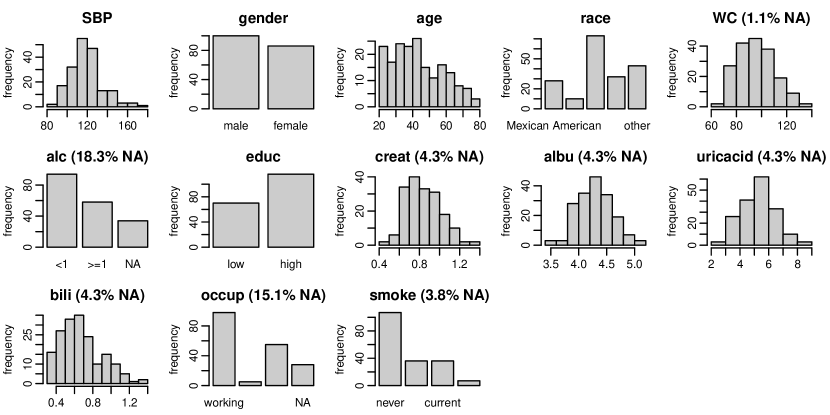
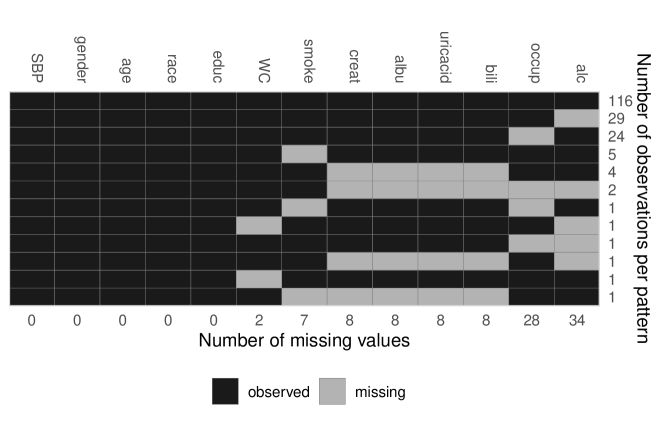
- RQ5在高维或非正态分布的协变量(如 NHANES 数据)的真实数据集中,JointAI 的表现如何?
主要发现
- JointAI 在复杂模型中成功处理了缺失数据,包括非线性效应、交互作用和多层结构,且无需模型不相容性问题。
- 该包通过一致的接口支持广泛的模型类型——线性模型、广义线性模型、混合效应模型、生存模型,以及纵向与生存数据的联合模型。
- 插补模型能自动适应变量类型和约束条件,例如对对数变换变量截断分布,避免无效的数学运算。
- 使用辅助变量(如二次项 I(WC^2))可提升插补精度,通过将相关信息整合到插补过程中。
- 用户可在 R 中定义如 ilogit 等函数以匹配 JAGS 语法,实现非标准变换在模型公式的无缝使用。
- 当分析模型中使用变量的函数(如 log(uricacid))时,主效应(如 uricacid)会自动作为预测变量包含在插补模型中,从而保持模型兼容性。
更好的研究,从现在开始
从阅读论文到最终审阅,大幅缩短您的研究时间。
无需绑定信用卡
本解读由 AI 生成,并经人工编辑审核。