
[论文解读] JWST, ALMA, and Keck Spectroscopic Constraints on the UV Luminosity Functions at z~7-14: Clumpiness and Compactness of the Brightest Galaxies in the Early Universe
本文汇集了在 z~7–14 的经光谱确认的53个明亮星系,以约束紫外光度函数并研究形态,发现 z~7 时呈簇状、并合驱动的结构,且在 z>10 时出现两类截然不同的群体(扩展型,伴随弱高离子线;紧凑型,伴随强线)。
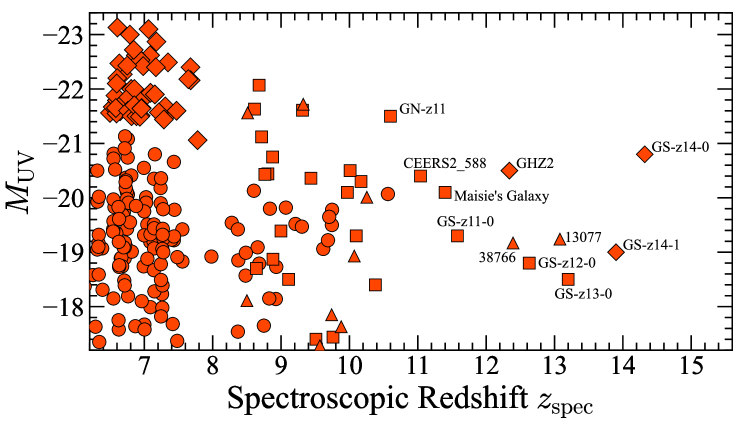
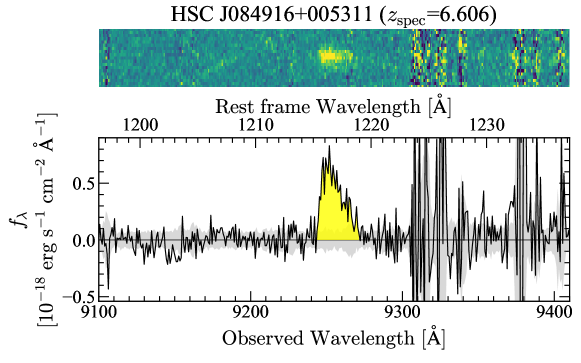
We present the number densities and physical properties of the bright galaxies spectroscopically confirmed at $z\sim7-14$. Our sample is composed of 60 galaxies at $z_\mathrm{spec}\sim7-14$, including recently-confirmed galaxies at $z_\mathrm{spec}=12.34-14.32$ with JWST, as well as new confirmations at $z_\mathrm{spec}=6.583-7.643$ with $-24< M_\mathrm{UV}< -21$ mag using ALMA and Keck. Our JWST/NIRSpec observations have also revealed that very bright galaxy candidates at $z\sim10-13$ identified from ground-based telescope images before JWST are passive galaxies at $z\sim3-4$, emphasizing the necessity of strict screening and spectroscopy in the selection of the brightest galaxies at $z>10$. The UV luminosity functions derived from these spectroscopic results are consistent with a double power-law function, showing tensions with theoretical models at the bright end. To understand the origin of the overabundance of bright galaxies, we investigate their morphologies using JWST/NIRCam high-resolution images obtained in various surveys including PRIMER and COSMOS-Web. We find that $\sim70\%$ of the bright galaxies at $z\sim7$ exhibit clumpy morphologies with multiple sub-components, suggesting merger-induced starburst activity, which is consistent with SED fitting results showing bursty star formation histories. At $z\gtrsim10$, bright galaxies are classified into two types of galaxies; extended ones with weak high-ionization emission lines, and compact ones with strong high-ionization lines including NIV]$λ$1486, indicating that at least two different processes (e.g., merger-induced starburst and compact star formation/AGN) are shaping the physical properties of the brightest galaxies at $z\gtrsim10$ and are responsible for their overabundance.
研究动机与目标
- 使用经光谱确认为的星系量化 z~7–14 亮端紫外光度函数(UVLF)。
- 利用高分辨率的JWST成像评估 z>7 最亮星系的形态,以理解它们的形成通道。
- 研究在 z>10 观测到的明亮星系过剩是否能由不同物理过程解释( merger 引发的星爆 vs. 紧凑的星形成/AGN)。
- 评估高-z 选择中的污染和错位对象,以及对未来大面积 survey 的影响。
提出的方法
- Assemble a sample of 53 spectroscopically confirmed galaxies spanning zspec ~ 6.54–14.32 from JWST, ALMA, and Keck, including new confirmations and literature compilations.
- Compute UV luminosity functions in four redshift bins (z~6.5–7.5, 7.5–8.5, 11.0–13.5, 13.5–15.0) by estimating effective survey volumes for the bright end.
- Use JWST/NIRCam imaging to analyze morphologies and identify clumpy, multi-component structures suggesting merger-driven activity.
- Perform SED fitting with Prospector to infer star-formation histories and structural types (extended vs. compact) for bright z>10 galaxies.
- Cross-check high-z candidates with spectroscopic confirmations to assess interloper contamination from low-z passive galaxies.
实验结果
研究问题
- RQ1在 z ~ 7–14 时,UV 光度函数明亮端的形状是什么,它是否与双幂律(double power-law)或其他形式一致?
- RQ2在 z ~ 7–14 的最亮星系的形态和恒星形成历史是什么,它们是否指示合并驱动的星爆或紧凑的形成机制?
- RQ3明亮的 z>10 星系如何分为互不相同的物理族群,驱动其观测特性和丰度的过程是什么?
- RQ4低红移错位对象在高端亮度星系样本中的影响程度,以及光谱学如何缓解这一问题?
- RQ5这些发现对未来针对 z>10 的非常 Bright 星系的大面积调查有何意义?
主要发现
- 经光谱确认的明亮星系(N=53)覆盖 z~6.54–14.32,能够对 z~7–14 的UV光度函数进行约束。
- 推导出的UV光度函数与双幂律形式一致,并在亮端与理论模型存在张力。
- 大约70% 的 z~7 明亮星系呈现簇状形态,具多重亚分量,暗示合并驱动的星暴活动。
- 在 z>10 时,明亮星系分成两种类型:带有弱高离子线的扩展系统,以及带有强高离子线(如 N IV] 1486)的紧凑型系统,暗示多种形成通道(并合驱动的星暴 vs. 紧凑型星形成/AGN)。
- JWST/NIRSpec 光谱学揭示,一些来自地面观测的非常亮的 z~10–13 候选星系其实是 z~3–4 的被动星系,强调需要严格的光谱确认以及对亮度高的高-z 样本进行仔细筛选。
更好的研究,从现在开始
从论文设计到论文写作,大幅缩短您的研究时间。
无需绑定信用卡
本解读由 AI 生成,并经人工编辑审核。