
[论文解读] Kilonovae of binary neutron star mergers leading to short-lived remnant neutron star formation
本研究调查了双中子星并合后形成短暂存在的大质量中子星(MNS),并在20毫秒内坍缩为黑洞时产生的千新星辐射。通过一致的数值相对论与核合成模拟,发现这类千新星比长寿命MNS产生的千新星显著更暗、持续时间更短,尤其在光学波段,与GW170817事件中AT2017gfo的辐射不一致。结果表明,GW170817残余物很可能未如此迅速坍缩,而早期的光学/近红外观测对探测此类事件至关重要,否则可能被伽马射线暴余晖掩盖。
We study kilonova emission from binary neutron star (BNS) mergers for the case that a remnant massive neutron star (MNS) forms and collapses to a black hole within $20$ ms after the onset of the merger (which we refer to as "a short-lived case") by consistently employing numerical-relativity and nucleosynthesis results. We find that such kilonovae are fainter and last shorter than those for BNSs resulting in the formation of long-lived ($\gg 1\,{ m s}$) MNSs, in particular in the optical band. The resulting light curves are too faint and last for a too short duration to explain the kilonova observation for the BNS associated with GW170817, indicating that the merger remnant formed in GW170817 is unlikely to have collapsed to a black hole within a short period of time ($\sim 20$ ms) after the onset of the merger. Our present result implies that early observation is necessary to detect kilonovae associated with BNSs leading to short-lived MNS formation in particular for the optical blue band as well as that kilonovae could be hidden by the gamma-ray burst afterglow for nearly face-on observation. We provide a possible approximate scaling law for near-infrared light curves with the given reference time and magnitude when the decline power of the ${\it z}$-band magnitude, $d M_{\it z}/d{ m log}_{10}t$, reaches $2.5$. This scaling law suggests that the ${\it HK}$-band follow-up observation should be at least $1$ mag deeper than that for the ${\it z}$-band reference magnitude and earlier than 4 times the reference time.
研究动机与目标
- 确定双中子星并合中形成短暂存在的大质量中子星(MNS)并在其坍缩为黑洞前产生的千新星的电磁辐射特征。
- 评估此类短暂MNS千新星是否能解释与GW170817相关的观测到的千新星AT2017gfo。
- 识别观测挑战,如被伽马射线暴余晖掩盖,并为未来的多信使观测提供指导。
- 推导近红外光曲线的标度律,以指导最优后续观测策略。
提出的方法
- 本研究采用一致的数值相对论模拟,对具有不同方程状态的双中子星系统的并合动力学和质量抛射进行建模。
- 利用模拟得到的核合成产物,确定喷射物的成分和放射性加热速率。
- 基于模拟获得的光学厚度表和加热分布,执行辐射转移模拟,计算光学与近红外波段的光曲线。
- 将光曲线与AT2017gfo(GW170817)和GRB130603B的观测结果进行比较,以检验短暂MNS情景的一致性。
- 基于参考时刻的z波段星等衰减速率,推导出近红外光曲线的标度律。
- 模型中考虑了非局部热动平衡光谱特征和非球对称喷射物形态的影响,以评估其对观测解释的影响。
实验结果
研究问题
- RQ1能否通过形成短暂MNS(在约20毫秒内坍缩)的双中子星并合产生的千新星重现AT2017gfo的观测特性?
- RQ2为何短暂MNS并合产生的千新星辐射比长寿命MNS更暗、持续时间更短,尤其在光学波段?
- RQ3在多波段观测中,短暂MNS千新星在多大程度上被伽马射线暴余晖所掩盖?
- RQ4何种观测策略——特别是近红外波段——能最大化对这类短暂MNS千新星的探测概率?
- RQ5非球对称喷射物形态和光谱特征(如Sr p-Cygni轮廓)如何影响千新星光曲线的解释?
主要发现
- 由于质量抛射减少和放射性加热 timescale 缩短,短暂MNS形成产生的千新星比长寿命MNS产生的显著更暗、持续时间更短,尤其在光学波段。
- 观测到的千新星AT2017gfo与短暂MNS情景不一致,表明GW170817残余物很可能存活超过20毫秒。
- 短暂MNS千新星的光学与近红外辐射常被伽马射线暴余晖掩盖,尤其在面朝观测几何中。
- 推导出近红外光曲线的标度律,表明HK波段的后续观测应至少比z波段参考星等更深1个星等,并在参考时间的四倍之前进行。
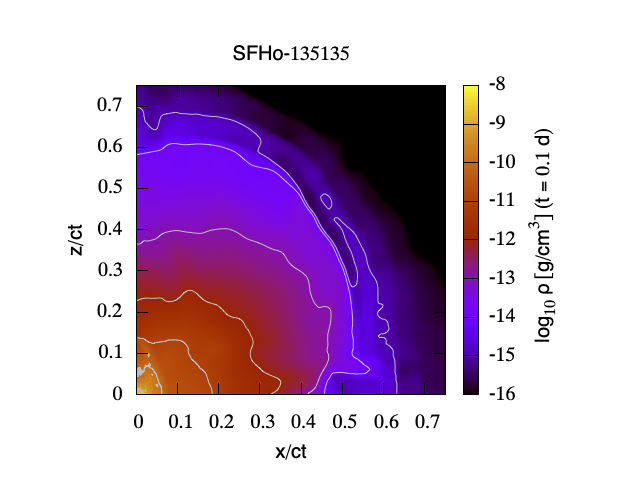
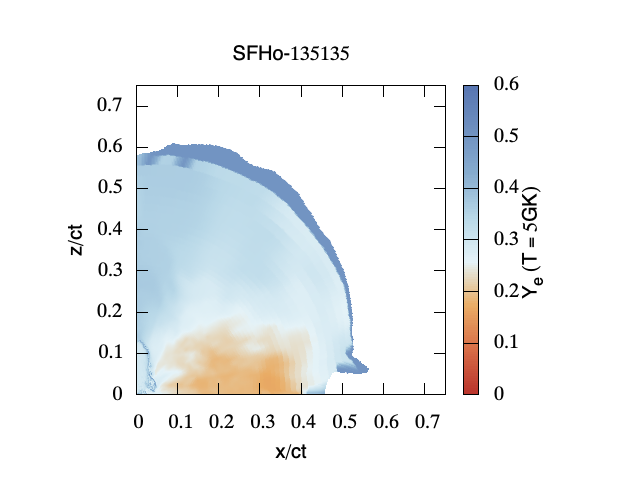
- 短暂MNS模型的Sr质量密度分布显示,合并后1天时呈近乎球对称形态,这与近期对AT2017gfo光谱分析所暗示的非球对称喷射物形态不一致。
- 本研究强调,早期、深度的光学与近红外观测对探测短暂MNS并合产生的千新星至关重要,因为它们在后期阶段几乎不可能被观测到。
更好的研究,从现在开始
从阅读论文到最终审阅,大幅缩短您的研究时间。
无需绑定信用卡
本解读由 AI 生成,并经人工编辑审核。