
[论文解读] Knowledge Editing for Large Language Models: A Survey
本综述全面概述了大语言模型(LLM)的知识编辑(KME),提出将KME统一建模为约束优化问题,以实现精确、高效且知识保留的更新。该工作基于知识注入机制提出了一种新颖的KME技术分类法,分析了关键方法,评估了度量标准与数据集,并指出了在LLM中实现稳健、持续且公平编辑的关键挑战与未来方向。
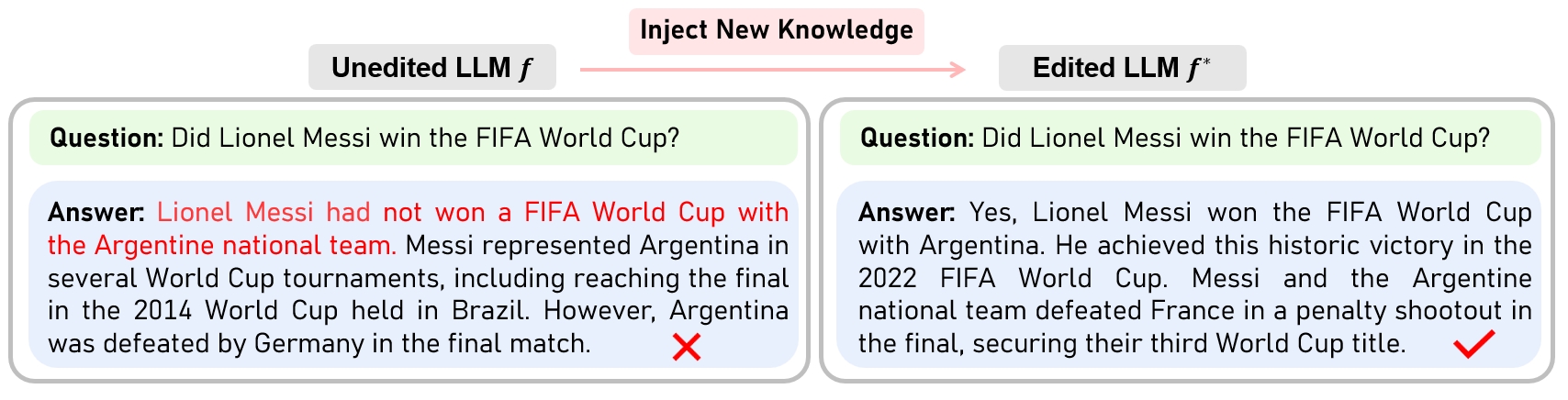
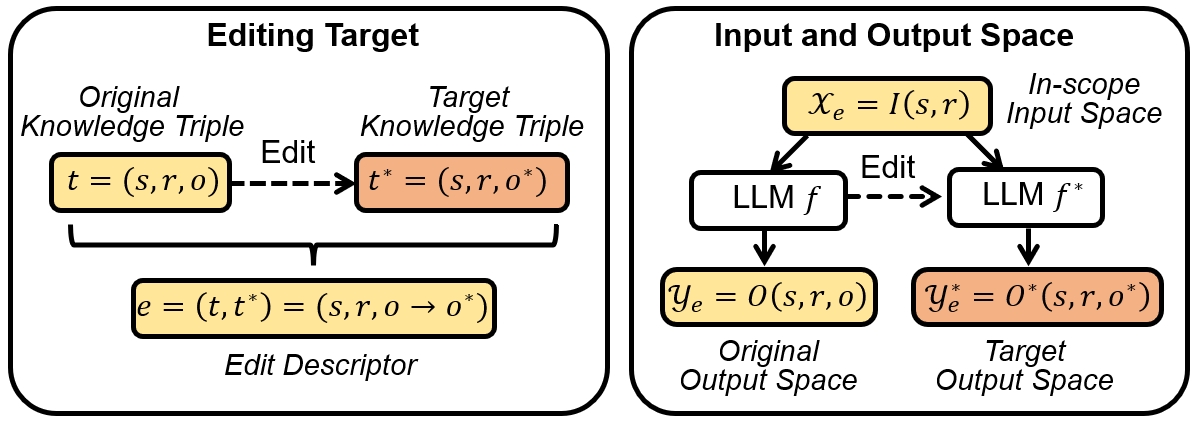
Large language models (LLMs) have recently transformed both the academic and industrial landscapes due to their remarkable capacity to understand, analyze, and generate texts based on their vast knowledge and reasoning ability. Nevertheless, one major drawback of LLMs is their substantial computational cost for pre-training due to their unprecedented amounts of parameters. The disadvantage is exacerbated when new knowledge frequently needs to be introduced into the pre-trained model. Therefore, it is imperative to develop effective and efficient techniques to update pre-trained LLMs. Traditional methods encode new knowledge in pre-trained LLMs through direct fine-tuning. However, naively re-training LLMs can be computationally intensive and risks degenerating valuable pre-trained knowledge irrelevant to the update in the model. Recently, Knowledge-based Model Editing (KME) has attracted increasing attention, which aims to precisely modify the LLMs to incorporate specific knowledge, without negatively influencing other irrelevant knowledge. In this survey, we aim to provide a comprehensive and in-depth overview of recent advances in the field of KME. We first introduce a general formulation of KME to encompass different KME strategies. Afterward, we provide an innovative taxonomy of KME techniques based on how the new knowledge is introduced into pre-trained LLMs, and investigate existing KME strategies while analyzing key insights, advantages, and limitations of methods from each category. Moreover, representative metrics, datasets, and applications of KME are introduced accordingly. Finally, we provide an in-depth analysis regarding the practicality and remaining challenges of KME and suggest promising research directions for further advancement in this field.
研究动机与目标
- 为解决在更新新知识时微调大语言模型所带来的高计算成本与知识退化风险。
- 识别传统微调方法的局限性,包括参数覆盖、灾难性遗忘以及高资源需求。
- 基于新知识注入方式,提出一种系统化的KME技术分类法。
- 利用标准化的度量标准、数据集与真实应用场景,评估现有KME方法。
- 识别持续编辑、对抗鲁棒性与公平性方面的开放挑战,并提出未来研究方向。
提出的方法
- 将KME建模为约束优化问题,以在新知识准确性与原有知识保留之间取得平衡。
- 将KME方法分为两类:(1) 基于参数更新的编辑(例如,更新注意力头或MLP层);(2) 基于辅助网络的编辑(例如,使用检索增强或适配器模块)。
- 提出一种基于知识注入机制的结构化分类法:基于参数的编辑、检索增强的编辑与基于适配器的编辑。
- 提出编辑成功率、知识保留率与编辑特异性等评估度量标准,以衡量KME性能。
- 强调使用专用数据集(如HELM、MMLU以及自定义知识注入基准)进行训练与评估。
- 集成损失函数,对在未修改事实上偏离原始模型行为的偏差进行惩罚,以确保知识保留。
实验结果
研究问题
- RQ1KME技术能否基于其知识注入机制实现系统性分类?
- RQ2在不同KME方法中,编辑准确性、知识保留与计算效率之间的关键权衡是什么?
- RQ3在多个编辑按顺序连续应用的持续编辑场景下,现有KME技术表现如何?
- RQ4KME技术在多大程度上可增强模型对对抗性编辑与错误信息的鲁棒性?
- RQ5KME能否有效用于缓解预训练大语言模型中的偏见并提升公平性?
主要发现
- 与完整微调相比,KME技术通过仅修改模型参数的子集或注入轻量级模块,显著降低了计算成本。
- 基于参数的编辑方法(如修改注意力头或MLP层)表现出较高的编辑成功率,但若未谨慎正则化,存在知识遗忘风险。
- 基于辅助网络的方法(如检索增强或适配器)在知识保留方面表现更优,且更具模块化,但可能引入推理延迟。
- 编辑成功率与保留准确率等评估度量标准对量化KME性能至关重要,最先进方法在标准基准上已实现超过90%的成功率。
- 持续编辑仍是主要挑战,因连续编辑可能导致干扰与先前编辑内容的遗忘,尤其在非正交编辑空间中更为显著。
- 鲁棒性与公平性正成为关键关注点,当结合约束优化与验证机制时,KME在缓解偏见与抵抗对抗性编辑方面展现出潜力。
更好的研究,从现在开始
从阅读论文到最终审阅,大幅缩短您的研究时间。
无需绑定信用卡
本解读由 AI 生成,并经人工编辑审核。