
[论文解读] Krylov complexity and Trotter transitions in unitary circuit dynamics
该论文将Krylov复杂度——一种衡量量子混沌与算符复杂度的指标——推广至无哈密顿量基底的酉电路动力学,特别是基于哈密顿系统经Trotter分解得到的酉电路。研究识别出两种不同行为区域:在小Trotter步长下,动力学恢复哈密顿行为,Krylov复杂度增长达到最大;在大步长下,出现最大遍历性算符,其自相关函数趋于零,表现为无记忆热库,混沌系统中呈现交叉转变,而可积系统中则出现非解析相变。
We investigate many-body dynamics where the evolution is governed by unitary circuits through the lens of `Krylov complexity', a recently proposed measure of complexity and quantum chaos. We extend the formalism of Krylov complexity to unitary circuit dynamics and focus on Floquet circuits arising as the Trotter decomposition of Hamiltonian dynamics. For short Trotter steps the results from Hamiltonian dynamics are recovered, whereas a large Trotter step results in different universal behavior characterized by the existence of local maximally ergodic operators: operators with vanishing autocorrelation functions, as exemplified in dual-unitary circuits. These operators exhibit maximal complexity growth, act as a memoryless bath for the dynamics, and can be directly probed in current quantum computing setups. These two regimes are separated by a crossover in chaotic systems. Conversely, we find that free integrable systems exhibit a nonanalytic transition between these different regimes, where maximally ergodic operators appear at a critical Trotter step.
研究动机与目标
- 将Krylov复杂度框架——此前仅应用于哈密顿动力学——推广至无底层静态哈密顿量的酉电路动力学。
- 研究哈密顿动力学Trotter化对酉电路中算符复杂度与遍历性的影响。
- 在不同Trotter步长下,识别Krylov复杂度增长的普适行为,区分混沌与可积系统。
- 表征在大Trotter步长下出现的最大遍历性算符(自相关函数趋于零)及其作为无记忆热库的作用。
- 探索混沌与可积系统中不同Trotter步长下区域之间的转变,揭示混沌系统中的交叉转变与可积系统中的非解析相变。
提出的方法
- 通过迭代演化算符的Gram-Schmidt正交化,为酉电路动力学定义Krylov子空间。
- 将Krylov复杂度形式化应用于通过哈密顿动力学Trotter分解得到的Floquet电路。
- 利用动量空间费米子表示对时间演化算符进行对角化,并计算自相关函数。
- 分析初始局域算符在酉电路下的时间演化,以计算Krylov基算符及其复杂度增长。
- 通过矩阵演化与特征值分解,在动量空间中推导初始算符自相关函数的精确表达式。
- 通过大Trotter步长下自相关函数趋于零,识别最大遍历性算符的出现,其与随机矩阵理论预测一致。
实验结果
研究问题
- RQ1在通过Trotter化从哈密顿动力学导出的酉电路中,Krylov复杂度如何表现?
- RQ2在大Trotter步长下,Krylov复杂度中出现何种普适行为?其与小步长哈密顿极限有何不同?
- RQ3在何种条件下,酉电路中会出现最大遍历性算符(即自相关函数趋于零)?
- RQ4在不同Trotter步长下,混沌与可积系统中区域转变行为有何差异?
- RQ5Krylov复杂度框架能否超越哈密顿动力学,推广至一般酉电路模型?
主要发现
- 在小Trotter步长下,Krylov复杂度增长恢复了哈密顿动力学中观察到的普适行为,包括最大增长与Krylov子空间中的全局展开。
- 在大Trotter步长下,出现最大遍历性算符——即自相关函数瞬时趋于零的算符——在动力学中表现为无记忆热库。
- 这些最大遍历性算符的Krylov复杂度增长趋于一个普适形式,与随机矩阵理论预测一致。
- 在混沌系统中,小步长与大步长区域之间的转变表现为交叉转变,复杂度增长行为发生显著变化。
- 在可积系统中,转变为非解析行为,出现在某一临界Trotter步长,此时最大遍历性算符出现,标志动力学发生定性改变。
- 通过动量空间费米子化与矩阵演化,精确推导出电路模型中局域自旋算符自相关函数的解,证实了在大步长下最大遍历性的出现。
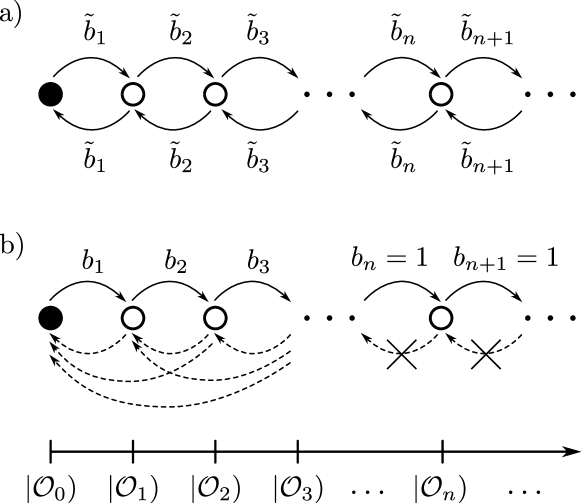
![Figure 2: The unitary superoperator $\mathcal{U}$ [Eq. ( 14 )] describing the evolution of the initial operator $|O_{0})\propto\sum_{j\in\mathbb{Z}}\sigma^{z}_{2j}$ under dual-unitary two-site gates. Here $\mathcal{U}$ is given in the Krylov basis, which is generated by orthonormalisation of $\{\mat](https://ar5iv.labs.arxiv.org/html/2308.03851/assets/x4.png)
更好的研究,从现在开始
从阅读论文到最终审阅,大幅缩短您的研究时间。
无需绑定信用卡
本解读由 AI 生成,并经人工编辑审核。