
[论文解读] Large Knowledge Model: Perspectives and Challenges
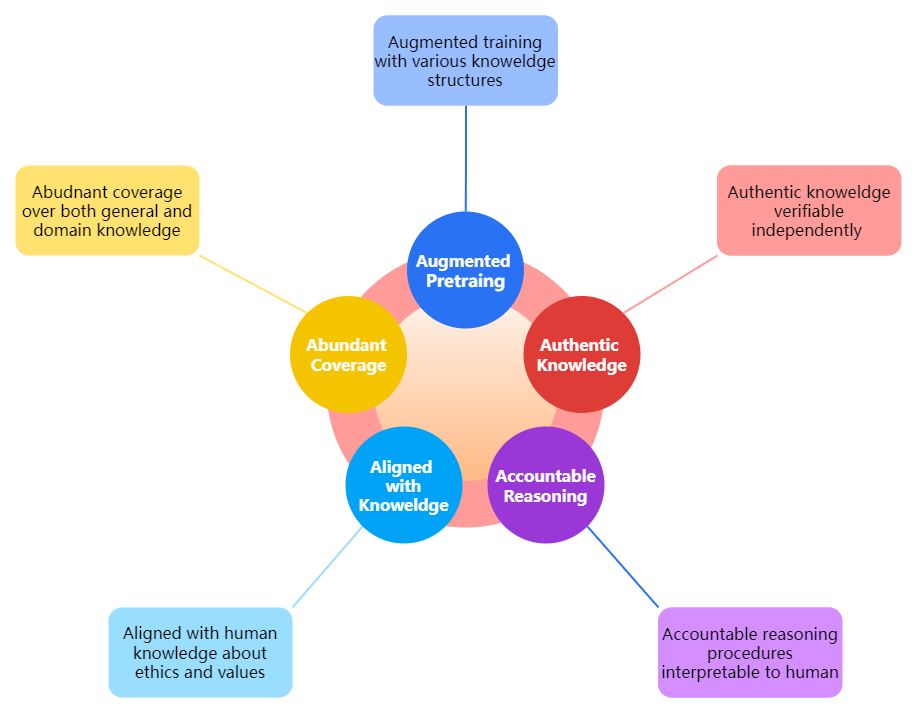
本文提出大型知识模型(LKM)作为一种集成框架,将大型语言模型(LLM)与知识图谱(KG)统一,以更有效地处理多样化的知识结构。通过结合符号化知识表示与神经参数化,LKM旨在通过五项“A”原则——增强预训练、真实知识、可问责推理、丰富覆盖和与知识对齐——提升推理能力,减少幻觉,并提高可解释性。
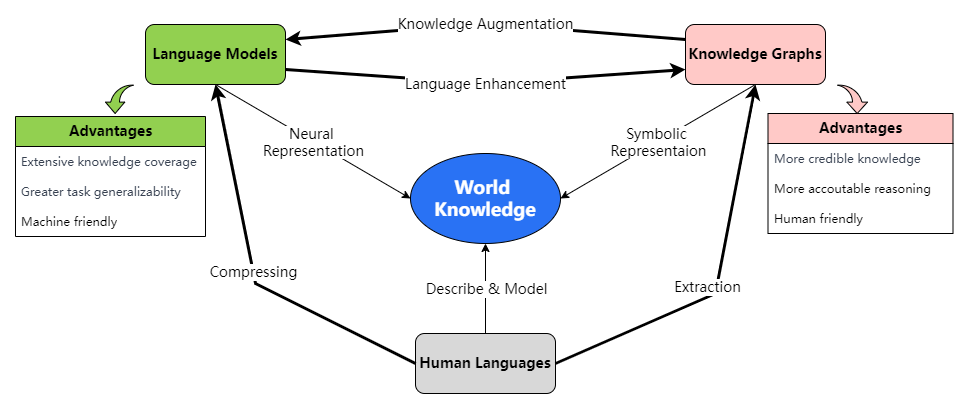
Humankind's understanding of the world is fundamentally linked to our perception and cognition, with \emph{human languages} serving as one of the major carriers of \emph{world knowledge}. In this vein, \emph{Large Language Models} (LLMs) like ChatGPT epitomize the pre-training of extensive, sequence-based world knowledge into neural networks, facilitating the processing and manipulation of this knowledge in a parametric space. This article explores large models through the lens of "knowledge". We initially investigate the role of symbolic knowledge such as Knowledge Graphs (KGs) in enhancing LLMs, covering aspects like knowledge-augmented language model, structure-inducing pre-training, knowledgeable prompts, structured CoT, knowledge editing, semantic tools for LLM and knowledgeable AI agents. Subsequently, we examine how LLMs can boost traditional symbolic knowledge bases, encompassing aspects like using LLM as KG builder and controller, structured knowledge pretraining, and LLM-enhanced symbolic reasoning. Considering the intricate nature of human knowledge, we advocate for the creation of \emph{Large Knowledge Models} (LKM), specifically engineered to manage diversified spectrum of knowledge structures. This promising undertaking would entail several key challenges, such as disentangling knowledge base from language models, cognitive alignment with human knowledge, integration of perception and cognition, and building large commonsense models for interacting with physical world, among others. We finally propose a five-"A" principle to distinguish the concept of LKM.
研究动机与目标
- 解决当前LLM在处理结构化、符号化知识方面存在的局限性,并减少幻觉现象。
- 克服传统符号化知识库(如知识图谱)存在的僵化性和可扩展性问题。
- 整合LLM的优势(泛化能力、语言理解能力)与符号化知识的优势(可解释性、结构化),以构建更可靠的AI系统。
- 开发一个统一框架,用于在单一模型架构中管理多样化的知识结构——包括文本、本体、逻辑和常识性知识。
- 通过LKM设计与评估的五项“A”框架,建立可信、与人类对齐的AI的系统性基础。
提出的方法
- 提出五项“A”原则框架,以指导大型知识模型(LKM)的设计:增强预训练、真实知识、可问责推理、丰富覆盖和与知识对齐。
- 通过知识增强的预训练、结构化提示和知识编辑,将知识图谱(KG)整合到LLM中,以提升事实一致性。
- 利用LLM作为知识图谱的控制器和构建者,实现自动化知识抽取、推理和动态更新。
- 通过将思维链(CoT)与符号化知识库结合,增强LLM的推理能力,实现可追溯、逻辑严密的推理过程。
- 将知识表示与语言模型参数解耦,以实现知识的独立验证、维护和升级。
- 通过共享的、结构化的知识库以及LLM驱动的推理,促进AI代理之间的知识共享,以提升覆盖范围和一致性。
实验结果
研究问题
- RQ1如何有效将知识图谱整合到大型语言模型中,以提升事实准确性和推理能力?
- RQ2构建统一符号化与神经表示的大型知识模型(LKM)所需的关键架构与训练原则是什么?
- RQ3在保持LLM泛化能力和适应性的同时,如何减少其幻觉现象?
- RQ4LLM在哪些方面可以增强传统知识图谱技术,如知识抽取、查询和推理?
- RQ5如何使大型知识模型与人类价值观和伦理知识对齐,以确保可信且可问责的AI?
主要发现
- 通过将知识增强应用于语言建模,可显著提升LLM的事实一致性,减少幻觉,使输出基于结构化知识进行锚定。
- 结构诱导型预训练可同时提升样本间与样本内的一致性,从而实现更可靠、更可解释的模型行为。
- LLM可作为知识图谱的有效控制器与构建者,支持可扩展的、自动化的知识库构建与动态更新。
- 将符号化推理与LLM结合,可实现可问责、可追溯的推理过程,从而提升可靠性与人类可解释性。
- 将知识表示与语言模型解耦,可实现独立验证与维护,从而提升真实性与可信度。
- 五项“A”原则为LKM的设计提供了全面框架,可在覆盖范围、对齐性、真实性与推理可问责性之间实现良好平衡。
更好的研究,从现在开始
从阅读论文到最终审阅,大幅缩短您的研究时间。
无需绑定信用卡
本解读由 AI 生成,并经人工编辑审核。