
[论文解读] Large Language Models for Time Series: A Survey
一份全面的综述,分类了大型语言模型(LLMs)在时间序列分析中的应用,详细介绍了提示、量化、对齐、以视觉为桥梁的整合,以及工具集成等方法、数据集、挑战和未来方向。
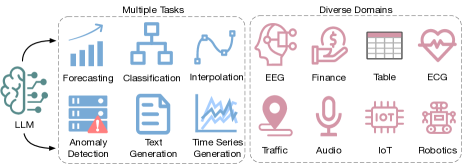
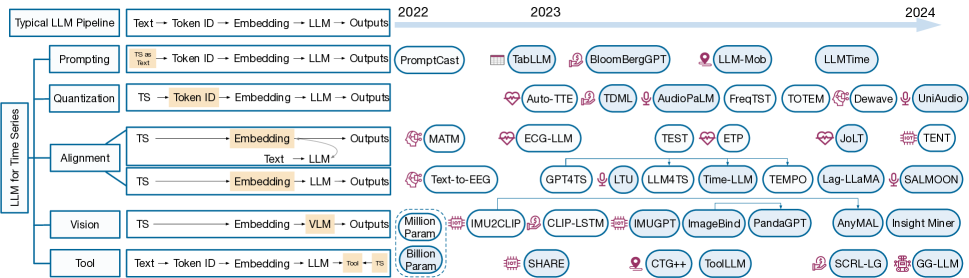
Large Language Models (LLMs) have seen significant use in domains such as natural language processing and computer vision. Going beyond text, image and graphics, LLMs present a significant potential for analysis of time series data, benefiting domains such as climate, IoT, healthcare, traffic, audio and finance. This survey paper provides an in-depth exploration and a detailed taxonomy of the various methodologies employed to harness the power of LLMs for time series analysis. We address the inherent challenge of bridging the gap between LLMs' original text data training and the numerical nature of time series data, and explore strategies for transferring and distilling knowledge from LLMs to numerical time series analysis. We detail various methodologies, including (1) direct prompting of LLMs, (2) time series quantization, (3) aligning techniques, (4) utilization of the vision modality as a bridging mechanism, and (5) the combination of LLMs with tools. Additionally, this survey offers a comprehensive overview of the existing multimodal time series and text datasets and delves into the challenges and future opportunities of this emerging field. We maintain an up-to-date Github repository which includes all the papers and datasets discussed in the survey.
研究动机与目标
- 推动文本训练的LLMs与数值时间序列数据之间模态差距的桥接研究。
- 提供五种基于LLM的时间序列分析方法的分类(提示、量化、对齐、以视觉作为桥梁、工具集成为途径)。
- 调查代表性模型、公式/表述,以及跨领域的数据集,涵盖气候、物联网、医疗保健、交通和金融等领域。
- 识别挑战与未来方向,以推动基于LLM的时间序列研究。
提出的方法
- 直接提示LLMs,将时间序列视为文本或提示。
- 时间序列量化,将数值序列转换为离散令牌(VQ-VAE、K-Means)以供LLM处理。
- 对齐技术,将时间序列嵌入映射到语言空间(对比损失、骨干网络)或端到端LLM骨干。
- 以视觉为桥梁,使用视觉表示和多模态模型,将时间序列与LLMs连接。
- 工具集成,使LLMs生成辅助工具(代码、API调用)来支持时间序列任务。
实验结果
研究问题
- RQ1如何有效地将以文本为训练数据的LLMs用于数值时间序列分析?
- RQ2在时间序列数据与语言模型之间桥接模态差距方面,哪些是最有效的分类法和技术?
- RQ3哪些数据集和多模态配置能够在跨领域实现鲁棒的基于LLM的时间序列分析?
- RQ4在提示、量化、对齐、视觉桥梁和基于工具的方法中,关于数据效率和任务有哪些取舍?
- RQ5多模态与多任务的LLM驱动时间序列研究的关键挑战与未来方向是什么?
主要发现
- 提出五类分类法:提示、时间序列量化、对齐、以视觉作为桥梁、以及工具集成。
- 量化和对齐方法在处理长序列和多变量时间序列方面比单独的提示更具可扩展性。
- 基于视觉的桥接使得能够利用视觉-语言模型将时间序列与文本与视觉表示连接起来。
- 工具集成使LLMs输出代码或API调用来帮助时间序列任务,而无需进行端到端的完整微调。
- 与该分类法配套的是一个精心整理的跨物联网、金融、医疗、音频等领域的多模态时间序列与文本数据集集合。
更好的研究,从现在开始
从论文设计到论文写作,大幅缩短您的研究时间。
无需绑定信用卡
本解读由 AI 生成,并经人工编辑审核。