
[论文解读] Large spin relaxation rates in trapped submerged-shell atoms
本研究测量了被捕获的铒和铥原子——两种内层电子壳层被填满的镧系元素——中的大自旋弛豫速率,分别测得在约500 mK时的速率常数为$3.0\times10^{-10}$ cm³/s和$1.1\times10^{-10}$ cm³/s。这些数值比S态原子中的值大2至3个数量级,表明电荷分布各向异性而非自旋交换或偶极相互作用是导致快速自旋弛豫的主因,因此这些体系在磁阱中的蒸发冷却效率极低。
Spin relaxation due to atom-atom collisions is measured for magnetically trapped erbium and thulium atoms at a temperature near 500 mK. The rate constants for Er-Er and Tm-Tm collisions are 3.0 times 10^-10 cm^3 s^-1 and 1.1 times 10^-10 cm^3 s^-1, respectively, 2-3 orders of magnitude larger than those observed for highly magnetic S-state atoms. This is strong evidence for an additional, dominant, spin relaxation mechanism, electrostatic anisotropy, in collisions between these "submerged-shell" L > 0 atoms. These large spin relaxation rates imply that evaporative cooling of these atoms in a magnetic trap will be highly inefficient.
研究动机与目标
- 测量磁阱中捕获的铒和铥原子双体碰撞中的自旋弛豫速率,这两种原子均为内层电子壳层被填满的$L\neq0$镧系元素。
- 研究在稀土-氦碰撞中观察到的电荷分布各向异性屏蔽效应是否也抑制稀土-稀土碰撞中的自旋弛豫。
- 确定对这些重而高度磁性的原子,蒸发冷却在磁阱中是否可行。
- 解决一个悬而未决的问题:即内层电子壳层特性是否如在原子-氦体系中那样,抑制原子-原子体系中的非弹性碰撞。
提出的方法
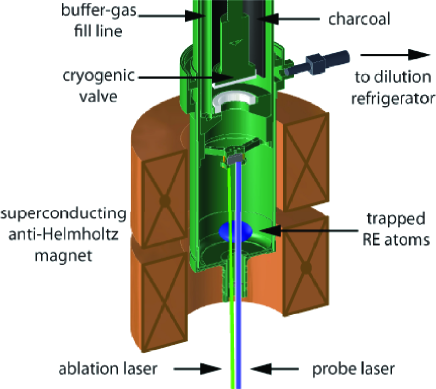
- 在约500 mK的$^4$He缓冲气体中通过激光烧蚀铒和铥金属箔,产生磁阱捕获的原子云。
- 由超导反亥姆霍兹线圈产生的磁四极场形成最高达3.7 T的阱深,通过自旋依赖势阱约束原子。
- 通过监测$J=6\to7$、$J=6\to5$(铒)和$J=7/2\to5/2$(铥)跃迁的激光吸收光谱,追踪$m_J$亚能级的布居数。
- 通过控制腔室温度和初始氦气加载量来调节缓冲气体密度,以确保冷却过程不因氦碰撞导致显著损失。
- 通过随时间演化的$m_J = J$态布居数衰减曲线提取自旋弛豫速率,同时对热激发和选择定则进行修正。
- 通过采用不同初始$m_J$分布和选择定则的非弹性衰变模拟,从观测到的损失速率$g_{in}$推断真实的自旋弛豫速率$g_{sr}$。
实验结果
研究问题
- RQ1像铒和铥这样的内层电子壳层被填满的镧系元素在原子-原子碰撞中是否表现出自旋弛豫抑制,如同在原子-氦碰撞中所见?
- RQ2在缺乏S态对称性的前提下,$L\neq0$稀土原子之间的碰撞中,自旋弛豫的主导机制是什么?
- RQ3尽管具有内层电子壳层特性,电荷分布各向异性在铒-铒和铥-铥碰撞中在多大程度上驱动自旋弛豫?
- RQ4鉴于观测到的自旋弛豫速率,这些原子在磁阱中能否实现有效的蒸发冷却?
- RQ5测量得到的自旋弛豫速率与理论预期值及弹性碰撞极限相比如何?
主要发现
- 在约500 mK时,铒-铒碰撞的自旋弛豫速率常数为$3.0\times10^{-10}$ cm³/s,铥-铥碰撞为$1.1\times10^{-10}$ cm³/s。
- 这些数值比S态原子中的值大2至3个数量级,表明存在超越自旋交换或偶极耦合的主导弛豫机制。
- 估算的比率$g_{sr}/g_{in}$为$2.0^{+1.0}_{-0.5}$,表明观测到的损失速率低估了真实的自旋弛豫速率。
- 弹性碰撞速率的最大值$g_{el}$估算为$8\times10^{-10}$ cm³/s,意味着$g_{el}/g_{sr} \lesssim 10$,这严重限制了蒸发冷却的效率。
- 结果表明,尽管原子具有内层电子壳层特性,铒-铒和铥-铥碰撞中电荷分布各向异性并未被抑制,与铒-氦或铥-氦体系中的情况不同。
- 这表明内层电子壳层效应并不能普遍抑制原子-原子碰撞中的非弹性过程,从而挑战了此类原子在磁阱中适合蒸发冷却的假设。

更好的研究,从现在开始
从阅读论文到最终审阅,大幅缩短您的研究时间。
无需绑定信用卡
本解读由 AI 生成,并经人工编辑审核。