
[论文解读] Laser excitation of the $^{229}$Th nuclear isomeric transition in a solid-state host
本研究首次通过真空紫外激光系统,在固态基质中实现了对 229Th 核同质异能跃迁的激光光谱观测,具体为掺杂 229Th 的 LiSrAlF6 晶体。在 148.38219(4) nm 处观测到一个窄线宽受限的光谱特征,其寿命为 568(13) s,被确认为核跃迁,其能量精确测定为 8.355733(2) eV,标志着迈向核光学钟的关键一步。
LiSrAlF$_6$ crystals doped with $^{229}$Th are used in a laser-based search for the nuclear isomeric transition. Two spectroscopic features near the nuclear transition energy are observed. The first is a broad excitation feature that produces red-shifted fluorescence that decays with a timescale of a few seconds. The second is a narrow, laser-linewidth-limited spectral feature at $148.38219(4)_{ extrm{stat}}(20)_{ extrm{sys}}$ nm ($2020407.3(5)_{ extrm{stat}}(30)_{ extrm{sys}}$ GHz) that decays with a lifetime of $568(13)_{ extrm{stat}}(20)_{ extrm{sys}}$ s. This feature is assigned to the excitation of the $^{229}$Th nuclear isomeric state, whose energy is found to be $8.355733(2)_{ extrm{stat}}(10)_{ extrm{sys}}$ eV in $^{229}$Th: hor:LiSrAlF$_6$.
研究动机与目标
- 通过激光光谱学方法检测并精确测量在固态晶体基质中 229Th 核同质异能跃迁。
- 利用激光光谱学精度解决长期存在的 229Th 同质异能态能量不确定性问题。
- 研究晶体环境及电子-核耦合对观测到的跃迁和荧光动力学的影响。
- 验证掺杂绝缘体作为未来核光学钟平台的可行性。
- 通过同位素对照(232Th 掺杂和未掺杂晶体)区分核跃迁信号与背景荧光及化学效应。
提出的方法
- 使用真空紫外(VUV)激光系统在 147.43–182.52 nm 范围(6.793–8.410 eV)内激发掺杂 229Th 的 LiSrAlF6 晶体。
- 通过时间分辨测量监测荧光发射,以识别光谱特征和衰减动力学,提取寿命参数。
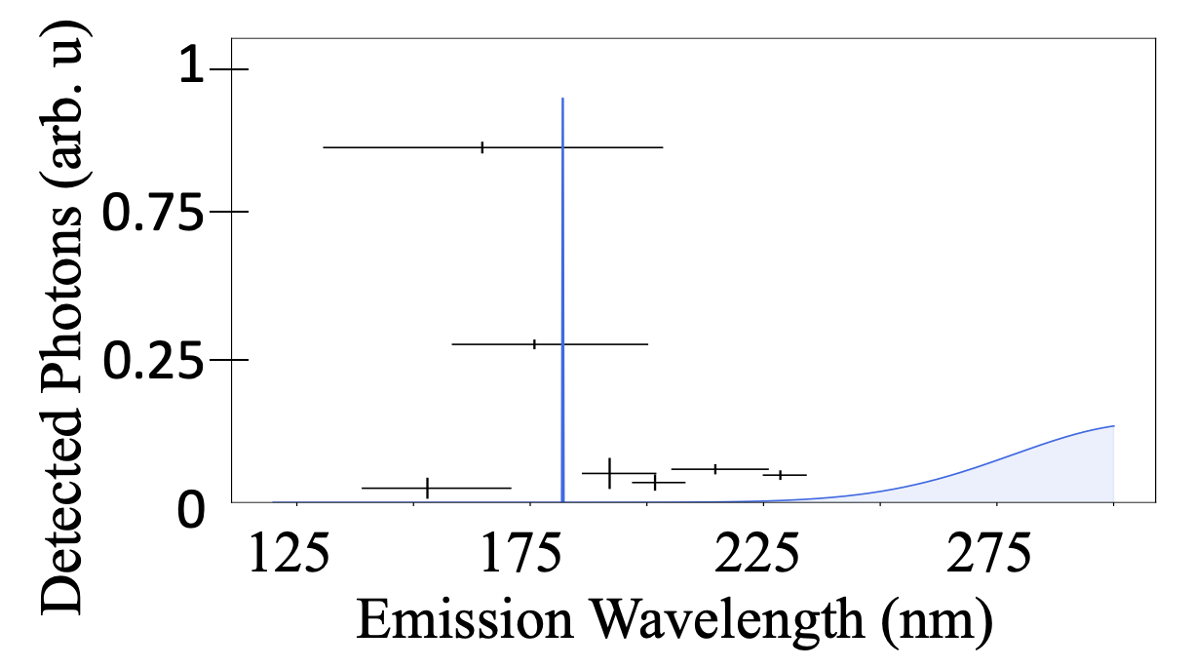
- 观测到两种不同的荧光组分:一种为衰减速率约数秒的宽峰,另一种为线宽受限于激光线宽的窄峰。
- 利用同位素对照(232Th 掺杂和未掺杂晶体)确认窄光谱特征的核起源。
- 进行了从头算晶体结构计算,以模拟基质晶格中核同质异能态与电子/声子自由度之间的耦合。
- 建立了理论模型,解释通过超精细相互作用(HFI)介导的核态与价带电子-空穴激发之间耦合导致的红移荧光。
![Figure 1: (a) Long timescale fluorescence from 229 Th:LiSrAlF 6 crystal 2.2 normalized by laser power after $\approx~{}2000$ s illumination shown over the 68% confidence interval of the ISOLDE experiment [ 11 ] . Dotted black lines denote the mean ( $\mu$ ) and mean plus multiples of the standard de](https://ar5iv.labs.arxiv.org/html/2404.12311/assets/Fig1_Horiz_Panel.png)
实验结果
研究问题
- RQ1能否在固态基质中通过激光光谱学直接观测并精确测量 229Th 核同质异能跃迁?
- RQ2229Th 核同质异能态在 LiSrAlF6 中的精确能量和寿命是多少?与以往测量结果相比如何?
- RQ3为何仅部分 229Th 掺杂浓度参与了窄线宽受限的跃迁?
- RQ4在 229Th 掺杂晶体中观测到的宽峰、红移荧光的起源是什么?
- RQ5晶体基质中电子-核耦合与振动-电子耦合如何影响核跃迁的辐射衰变速率和光谱特性?
主要发现
- 在 148.38219(4) nm(统计误差)±20 nm(系统误差)处观测到一个窄线宽受限的光谱特征,被指认为 229Th 核同质异能跃迁。
- 该跃迁表现出 568(13) s(统计误差)±20 s(系统误差)的寿命,与长寿命核同质异能态一致。
- 229Th 核同质异能态在 LiSrAlF6 中的能量被确定为 8.355733(2) eV(统计误差)±10 meV(系统误差)。
- 在 232Th 掺杂和未掺杂的 LiSrAlF6 晶体中均未观测到该窄峰,证实其为 229Th 核激发的特征。
- 在 229Th 掺杂晶体中观测到衰减速率约数秒的宽荧光,而在 232Th 掺杂或未掺杂晶体中未出现,表明存在涉及电子和晶格自由度的非辐射衰变路径。
- 从头算计算与理论模型表明,超精细相互作用介导了核同质异能态与价带电子-空穴激发之间的耦合,解释了红移荧光以及核跃迁的部分淬灭现象。
更好的研究,从现在开始
从阅读论文到最终审阅,大幅缩短您的研究时间。
无需绑定信用卡
本解读由 AI 生成,并经人工编辑审核。