
[论文解读] Laser-induced topological spin switching in a 2D van der Waals magnet
本研究利用飞秒激光脉冲在二维范德华磁体CrGeTe₃中实现了激光诱导的、可逆的拓扑自旋态切换。通过利用激光驱动的电子加热与自旋动力学,研究人员在皮秒时间尺度内实现了超快、可调的自旋纹理生成与切换,包括磁旋、反磁旋、自旋子以及条纹态,且可通过激光能量和外加磁场进行调控。
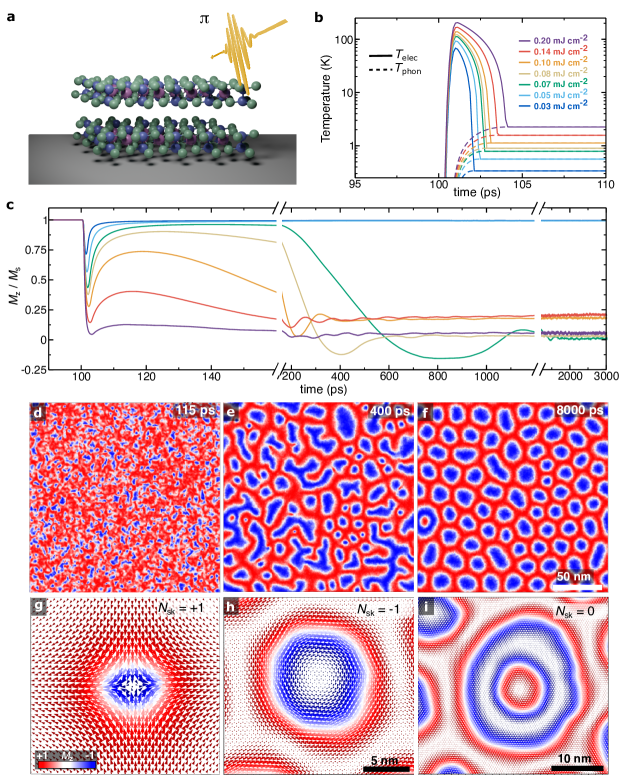
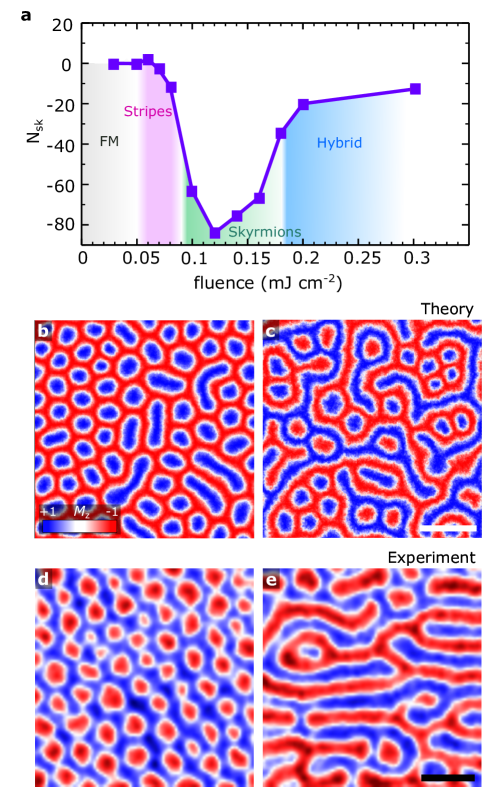
Two-dimensional (2D) van der Waals (vdW) magnets represent one of the most promising horizons for energy-efficient spintronic applications because their broad range of electronic, magnetic and topological properties. Of particular interest is the control of the magnetic properties of 2D materials by femtosecond laser pulses which can provide a real path for low-power consumption device platforms in data storage industries. However, little is known about the interplay between light and spin properties in vdW layers. Here, combining large-scale spin dynamics simulations including biquadratic exchange interactions and wide-field Kerr microscopy (WFKM), we show that ultrafast laser excitation can not only generate different type of spin textures in CrGeTe$_3$ vdW magnets but also induce a reversible transformation between them in a toggle-switch mechanism. Our calculations show that skyrmions, anti-skyrmions, skyrmioniums and stripe domains can be generated via high-intense laser pulses within the picosecond regime. The effect is tunable with the laser energy where different spin behaviours can be selected, such as fast demagnetisation process ($\sim$250 fs) important for information technologies. The phase transformation between the different topological spin textures is obtained as additional laser pulses are applied to the system where the polarisation and final state of the spins can be controlled by external magnetic fields. We experimentally confirmed the creation, manipulation and toggle switching phenomena in CrGeTe$_3$ due to the unique aspect of laser-induced heating of electrons. Our results indicate laser-driven spin textures on 2D magnets as a pathway towards ultrafast reconfigurable architecture at the atomistic level.
研究动机与目标
- 探索利用超快激光脉冲在二维范德华磁体中诱导和调控拓扑自旋纹理的可行性。
- 研究光激发与自旋动力学在中心对称CrGeTe₃中的相互作用,该材料此前未报道过此类效应。
- 通过实验与理论手段,证明激光脉冲可生成并可逆地在不同拓扑自旋态之间切换,且具有高度可调性。
- 为基于原子级薄磁性材料的全光、超快、可重构自旋电子学器件建立可行路径。
提出的方法
- 采用朗道-李夫希茨-吉尔伯特(LLG)方程结合双温模型(2TM),对飞秒激光激发后电子与晶格加热过程进行大规模自旋动力学模拟。
- 在自旋哈密顿量中引入双二次交换相互作用与Dzyaloshinskii-Moriya相互作用,以准确模拟CrGeTe₃中的磁各向异性和拓扑自旋纹理。
- 采用宽场磁光克尔显微镜(WFKM)在法向几何配置下,实验检测垂直磁化并实空间成像拓扑自旋纹理。
- 使用波长为1035 nm、线性偏振的激光脉冲(300 fs,1 MHz),以45°入射角聚焦至100 µm光斑,诱导自旋纹理的形成与切换。
- 通过离散自旋格点上的三角剖分法计算拓扑荷,以识别磁旋(N_sk = -1)、反磁旋(N_sk = +1)和自旋子(N_sk = 0)。
- 系统性地调节激光脉冲能量与脉冲数量,以调控最终自旋纹理并验证在外加磁场下可逆性。
实验结果
研究问题
- RQ1超快激光脉冲是否能在二维范德华磁体(如CrGeTe₃)中诱导形成如磁旋和反磁旋等拓扑非平庸自旋纹理?
- RQ2激光诱导的不同自旋纹理之间的转变是否可逆,并可通过外加磁场实现可控?
- RQ3激光脉冲能量与脉冲数量在决定最终自旋纹理及其拓扑特性方面起什么作用?
- RQ4激光激发后自旋动力学的时间演化如何在皮秒时间尺度上导致稳定拓扑自旋纹理的形成?
- RQ5双温模型(2TM)与LLG模拟相结合,能否准确预测超快自旋电子学现象中的实验结果?
主要发现
- 超快激光脉冲(300 fs,1035 nm)在皮秒时间尺度内诱导CrGeTe₃中形成磁旋、反磁旋、自旋子及条纹态。
- 自旋纹理在热平衡后保持稳定,可通过额外激光脉冲实现可逆切换。
- 磁旋与条纹态之间的转变通过宽场磁光克尔显微镜实验观测并证实,且在多次循环中保持高切换保真度。
- 激光脉冲能量可实现对最终自旋纹理的可调控制,且快速去磁化过程约在~250 fs内完成,适用于低功耗信息技术。
- 外加磁场可控制最终自旋态的极性,实现磁旋与反磁旋手性之间的确定性切换。
- 基于LLG-2TM模型的理论模拟与实验数据高度吻合,验证了该方法在模拟超快激发后长时间尺度自旋动力学中的有效性。
更好的研究,从现在开始
从阅读论文到最终审阅,大幅缩短您的研究时间。
无需绑定信用卡
本解读由 AI 生成,并经人工编辑审核。