
[论文解读] Learn to Accumulate Evidence from All Training Samples: Theory and Practice
本文识别出证据深度学习中的一个根本性局限:现有模型由于非负证据约束,无法从映射到'零证据区域'的训练样本中学习,导致性能欠佳。为解决此问题,作者提出正则化证据模型(RED),引入一种新颖的正向证据正则化方法,使模型能够从所有训练样本中学习,显著提升了在Cifar100等挑战性基准上的准确率,同时保持了不确定性量化能力。
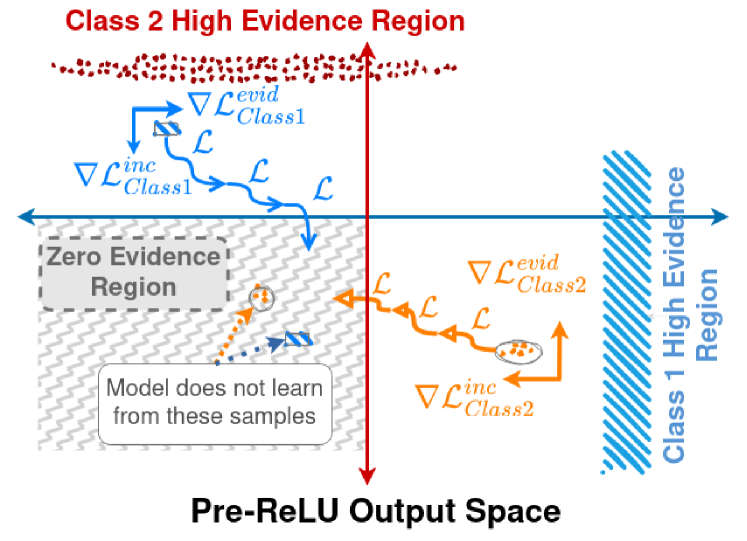
Evidential deep learning, built upon belief theory and subjective logic, offers a principled and computationally efficient way to turn a deterministic neural network uncertainty-aware. The resultant evidential models can quantify fine-grained uncertainty using the learned evidence. To ensure theoretically sound evidential models, the evidence needs to be non-negative, which requires special activation functions for model training and inference. This constraint often leads to inferior predictive performance compared to standard softmax models, making it challenging to extend them to many large-scale datasets. To unveil the real cause of this undesired behavior, we theoretically investigate evidential models and identify a fundamental limitation that explains the inferior performance: existing evidential activation functions create zero evidence regions, which prevent the model to learn from training samples falling into such regions. A deeper analysis of evidential activation functions based on our theoretical underpinning inspires the design of a novel regularizer that effectively alleviates this fundamental limitation. Extensive experiments over many challenging real-world datasets and settings confirm our theoretical findings and demonstrate the effectiveness of our proposed approach.
研究动机与目标
- 探究证据深度学习模型在大规模数据集上预测性能不佳的根本原因。
- 识别出阻碍证据模型从所有训练样本(包括'零证据区域'中的样本)中学习的根本结构性限制。
- 设计一种正则化方法,使证据模型能够有效学习所有训练样本,包括零证据区域中的样本。
- 在多个真实世界数据集和设置下,通过实证方法验证理论发现。
提出的方法
- 理论分析表明,如ReLU等证据激活函数会生成零证据区域,导致无法从这些区域的样本中获取知识。
- 作者推导出指数激活函数在避免零证据区域方面优于ReLU和SoftPlus的理论优势。
- 在训练目标中引入一种新颖的正向证据正则化项,用于惩罚零或近似零的证据预测。
- 该正则化促使模型在所有训练样本上更均匀地分布证据,避免证据空间中的'死区'。
- 所提出的正则化证据模型(RED)以最小的网络结构改动,将该正则化整合到标准证据训练流程中。
- 实验对比了RED与使用不同激活函数和损失函数的标准证据模型在多个数据集上的表现。
实验结果
研究问题
- RQ1为何证据模型在Cifar100等复杂数据集上的表现劣于标准Softmax模型?
- RQ2现有证据模型中阻碍其从所有训练样本中学习的根本结构性限制是什么?
- RQ3证据空间中'零证据区域'的存在如何影响模型的泛化能力与不确定性校准?
- RQ4正则化策略能否有效缓解由零证据区域引起的学**习缺陷?
- RQ5所提出的RED模型是否在保持不确定性量化能力的同时,实现了更优的预测性能?
主要发现
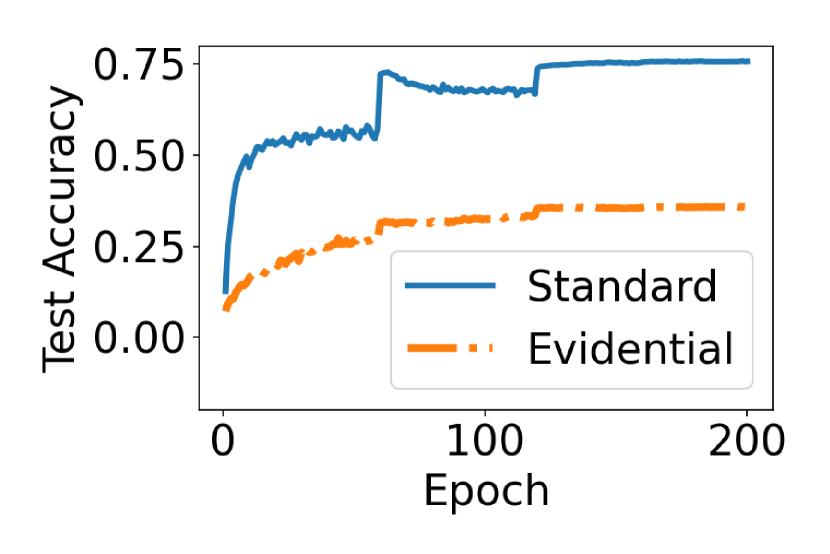
- 在Cifar100上,使用Evidential MSE损失时,所提出的RED模型达到99.12%的测试准确率,显著优于标准证据模型(36%准确率),并接近标准Softmax模型的性能。
- 在Cifar10上,使用Evidential CE损失并配合最优正则化超参数时,RED模型达到95.40%的准确率,优于所有基线激活函数。
- 在Cifar100上,RED模型使用Evidential CE损失在最优正则化下达到76.43%的准确率,优于标准CE模型的75.67%,展现出具有竞争力的性能。
- 消融实验确认,正则化项有效降低了被映射到零证据区域的样本比例,提升了模型鲁棒性。
- 模型对超参数调优的敏感性降低,在不同架构和损失函数下均保持稳定性能。
- 理论分析证实,指数激活函数在避免零证据区域方面具有优势,与实证结果一致。
更好的研究,从现在开始
从阅读论文到最终审阅,大幅缩短您的研究时间。
无需绑定信用卡
本解读由 AI 生成,并经人工编辑审核。