
[论文解读] Learning CO$_2$ plume migration in faulted reservoirs with Graph Neural Networks
该论文提出一种图神经网络代理模型(MGN-LSTM),能够在带断层的非结构网格上预测二氧化碳羽流迁移和孔压,降低时间误差并对未见配置具有泛化能力。
Deep-learning-based surrogate models provide an efficient complement to numerical simulations for subsurface flow problems such as CO$_2$ geological storage. Accurately capturing the impact of faults on CO$_2$ plume migration remains a challenge for many existing deep learning surrogate models based on Convolutional Neural Networks (CNNs) or Neural Operators. We address this challenge with a graph-based neural model leveraging recent developments in the field of Graph Neural Networks (GNNs). Our model combines graph-based convolution Long-Short-Term-Memory (GConvLSTM) with a one-step GNN model, MeshGraphNet (MGN), to operate on complex unstructured meshes and limit temporal error accumulation. We demonstrate that our approach can accurately predict the temporal evolution of gas saturation and pore pressure in a synthetic reservoir with impermeable faults. Our results exhibit a better accuracy and a reduced temporal error accumulation compared to the standard MGN model. We also show the excellent generalizability of our algorithm to mesh configurations, boundary conditions, and heterogeneous permeability fields not included in the training set. This work highlights the potential of GNN-based methods to accurately and rapidly model subsurface flow with complex faults and fractures.
研究动机与目标
- 推动在带断层的储层中对 CO2 羽流迁移进行高效、准确的代理建模,以减少对高保真仿真的依赖。
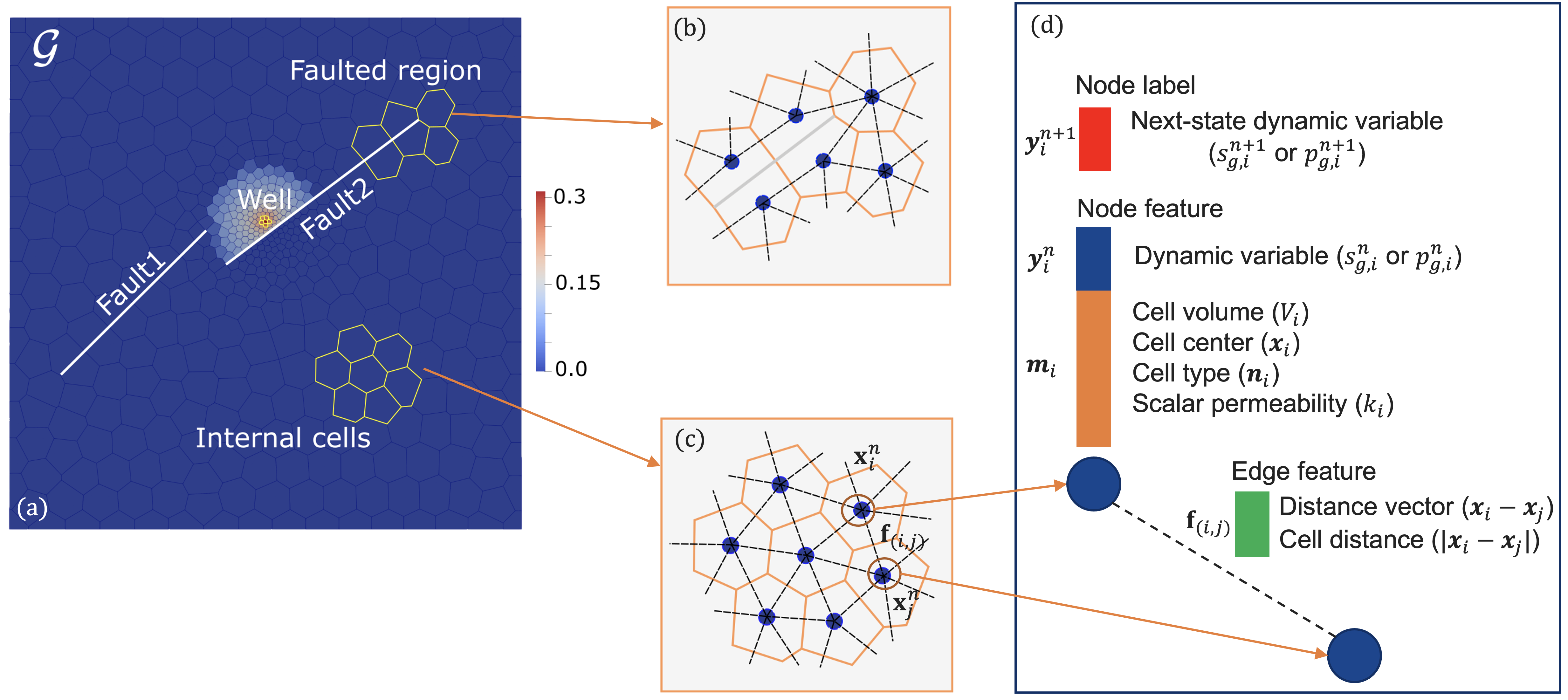
- 开发一种基于图的代理,能够处理符合断层和断裂的非结构网格。
- 通过基于图的递归结构缓解自回归代理中的时间误差累积。
- 证明对未见网格、边界条件和异质渗透场具备泛化能力。
提出的方法
- 将非结构网格数据表示为图,其中节点特征包含(动态变量和静态属性),边特征包含(连通性和距离)。
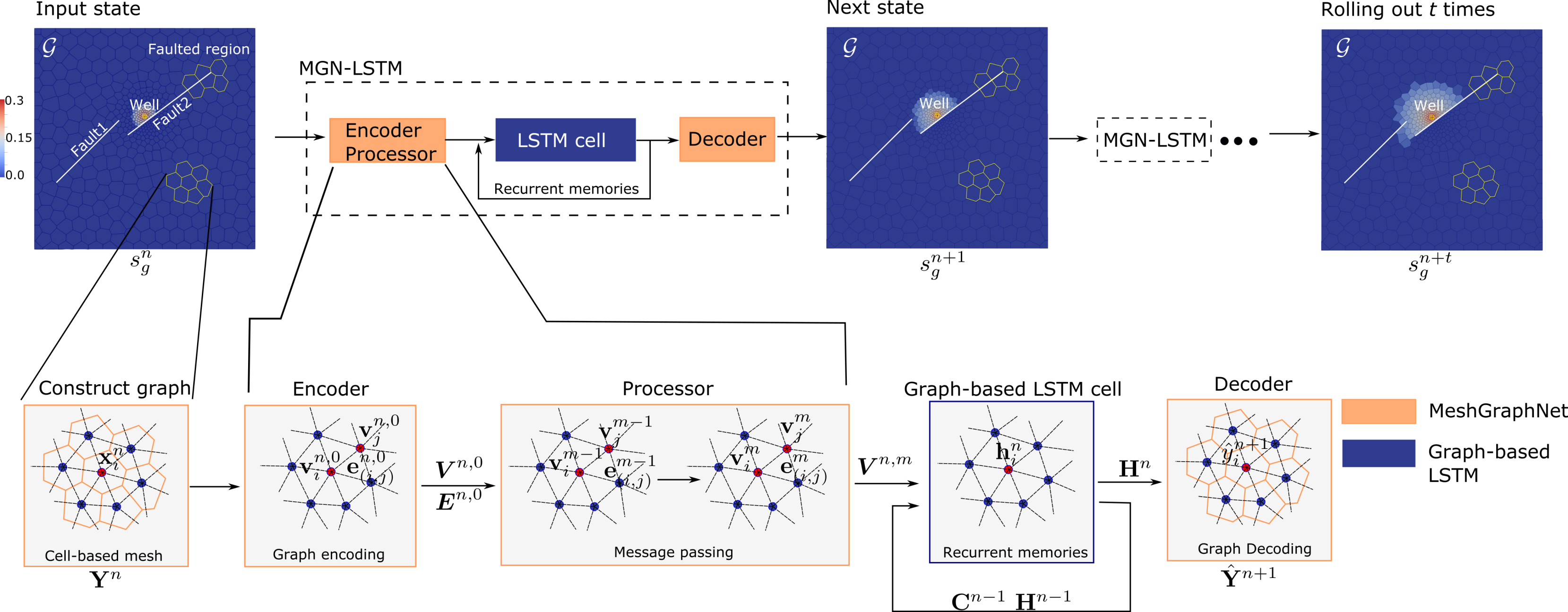
- 利用 MeshGraphNet (MGN) 作为编码器/处理器,从图输入构建潜在表示。
- 整合 Graph ConvLSTM (GConvLSTM) 以捕捉时空动态并降低随时间的误差累积。
- 使用自回归回滚来预测连续时间步,并通过整个序列传播梯度以实现稳定性。
- 使用 HF 仿真数据作为真实值,分别训练用于气体饱和度和孔压的 MGN-LSTM 模型。
实验结果
研究问题
- RQ1基于图的代理是否能够在具不可渗透断层的非结构网格上准确预测CO2–盐水的双相流动?
- RQ2相对于标准的下一步 MGN 及其他基线,MGN-LSTM 是否能降低时间误差累积?
- RQ3该模型对未见网格、边界条件和异质渗透场的泛化能力如何?
- RQ4在图输入中包含更多物理特征(如相对渗透率)对预测精度有何影响?
主要发现
- MGN-LSTM 能准确预测带断层储层中的 CO2 饱和羽流和孔压演变。
- 与标准 MeshGraphNet 相比,该模型表现出较小的时间误差累积。
- MGN-LSTM 对训练时未见过的网格配置、边界条件和渗透场具备泛化能力。
- 将更多物理特征引入节点/边输入可进一步提升饱和度预测精度。
更好的研究,从现在开始
从论文设计到论文写作,大幅缩短您的研究时间。
无需绑定信用卡
本解读由 AI 生成,并经人工编辑审核。