
[论文解读] Learning Controllable Adaptive Simulation for Multi-resolution Physics
LAMP 是一种基于深度学习的代理模型,利用图神经网络和强化学习,联合学习物理系统的演化过程以及自适应的空间细化/粗化策略。在 1D 非线性 PDE 中,其长期预测误差降低了 33.7%,在 2D 基于网格的模拟中优于最先进方法,通过动态将计算资源分配给高动态区域,同时平衡误差与计算成本。
Simulating the time evolution of physical systems is pivotal in many scientific and engineering problems. An open challenge in simulating such systems is their multi-resolution dynamics: a small fraction of the system is extremely dynamic, and requires very fine-grained resolution, while a majority of the system is changing slowly and can be modeled by coarser spatial scales. Typical learning-based surrogate models use a uniform spatial scale, which needs to resolve to the finest required scale and can waste a huge compute to achieve required accuracy. In this work, we introduce Learning controllable Adaptive simulation for Multi-resolution Physics (LAMP) as the first full deep learning-based surrogate model that jointly learns the evolution model and optimizes appropriate spatial resolutions that devote more compute to the highly dynamic regions. LAMP consists of a Graph Neural Network (GNN) for learning the forward evolution, and a GNN-based actor-critic for learning the policy of spatial refinement and coarsening. We introduce learning techniques that optimizes LAMP with weighted sum of error and computational cost as objective, allowing LAMP to adapt to varying relative importance of error vs. computation tradeoff at inference time. We evaluate our method in a 1D benchmark of nonlinear PDEs and a challenging 2D mesh-based simulation. We demonstrate that our LAMP outperforms state-of-the-art deep learning surrogate models, and can adaptively trade-off computation to improve long-term prediction error: it achieves an average of 33.7% error reduction for 1D nonlinear PDEs, and outperforms MeshGraphNets + classical Adaptive Mesh Refinement (AMR) in 2D mesh-based simulations. Project website with data and code can be found at: http://snap.stanford.edu/lamp.
研究动机与目标
- 为解决模拟多分辨率物理系统时的挑战,其中仅一小部分区域高度动态,需要高分辨率,而大部分区域演化缓慢。
- 克服统一分辨率的深度学习代理模型效率低下的问题,这些模型在缓慢区域浪费计算资源,且可能在动态区域分辨率不足。
- 开发一种完全可微分、端到端的深度学习框架,联合优化演化建模与空间分辨率自适应。
- 通过可学习策略在推理时实现预测误差与计算成本之间的动态权衡。
- 在长期模拟精度方面,证明其性能优于最先进代理模型和经典自适应网格细化方法。
提出的方法
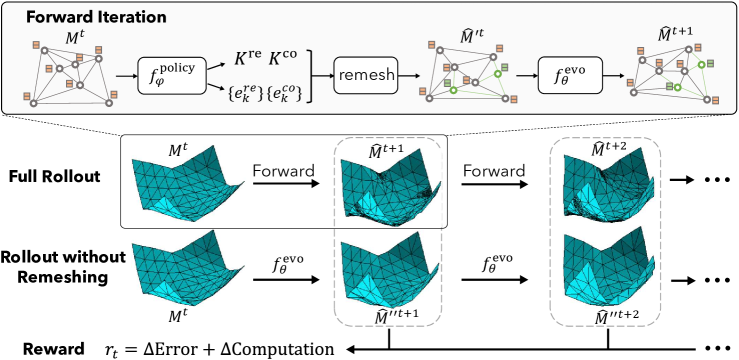
- LAMP 使用图神经网络(GNN)在动态网格上学习物理系统的前向演化过程。
- 它采用基于 GNN 的演员-评论家强化学习框架,学习局部网格细化与粗化的离散策略。
- 该策略基于局部状态特征和一个控制误差与计算成本权衡的超参数 β 进行条件化。
- 系统通过交替优化进行训练:使用监督学习训练演化模型,使用强化学习训练策略。
- 奖励函数定义为多步滚动过程中误差降低与计算成本降低的加权和。
- 重网格化通过根据策略输出选择要细化或粗化的边来执行,随后通过插值保持时间步之间的一致性。
实验结果
研究问题
- RQ1基于深度学习的代理模型能否联合学习物理系统的演化过程与自适应空间分辨率选择?
- RQ2此类模型能否在降低长期预测误差的同时,将计算资源动态分配给高度动态区域?
- RQ3在复杂模拟中,学习得到的重网格化策略性能与启发式或真实值重网格化相比如何?
- RQ4该模型在推理时在准确率与计算成本之间权衡的适应能力有多强?
- RQ5该模型能否在同一系列 PDE 的不同物理系统之间实现泛化?
主要发现
- 在 1D 非线性 PDE 基准测试中,LAMP 相较于最先进深度学习代理模型,将长期预测误差降低了 33.7%。
- 在 2D 纸张折叠模拟中,LAMP 的误差(5.80e-4 MSE)低于 MeshGraphNets + 启发式重网格化基线(6.38e-4 MSE)和无重网格化消融实验(6.13e-4 MSE)。
- 尽管采用学习得到的重网格化策略,LAMP 的性能仍优于使用真实值重网格化的强基线模型 MeshGraphNets,实现了更高的精度。
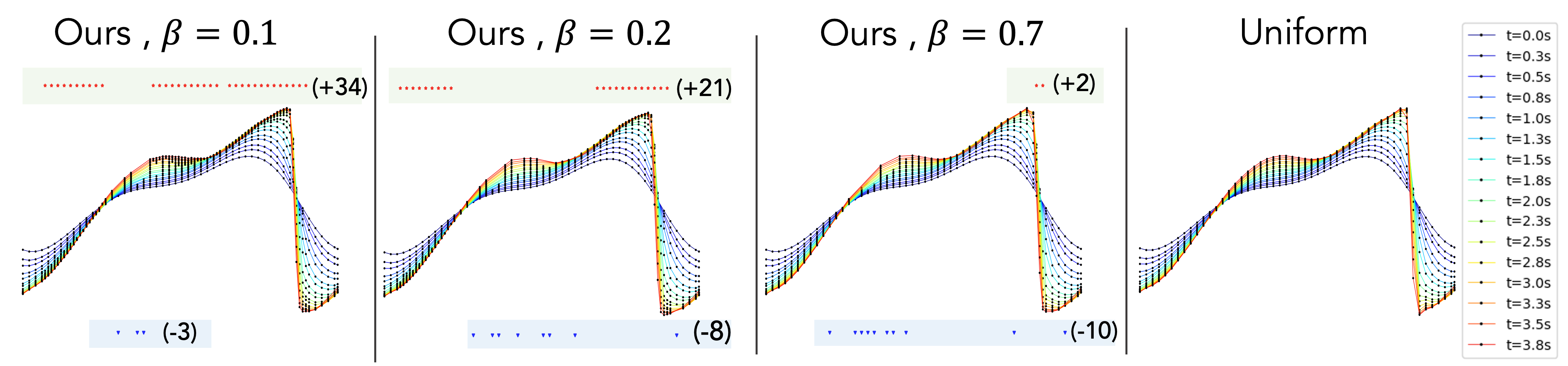
- 模型成功学习到在高曲率区域(如折叠部分)进行细化,同时在平坦、缓慢变化的区域进行粗化,2D 模拟可视化结果清晰展示了这一点。
- LAMP 在保持高精度的同时,平均顶点数仅为 123.1,表明其计算效率高。
- 模型在推理时对不同 β 值表现出稳健的适应能力,能够实现误差与计算成本之间的动态权衡。
更好的研究,从现在开始
从阅读论文到最终审阅,大幅缩短您的研究时间。
无需绑定信用卡
本解读由 AI 生成,并经人工编辑审核。