
[论文解读] Learning Distinctive Margin toward Active Domain Adaptation
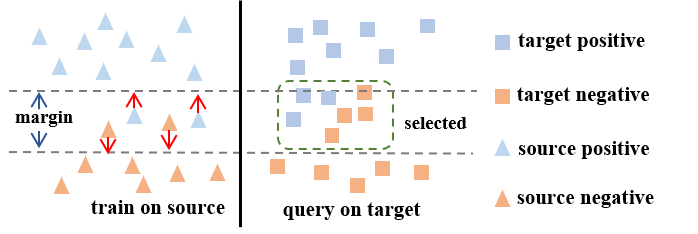
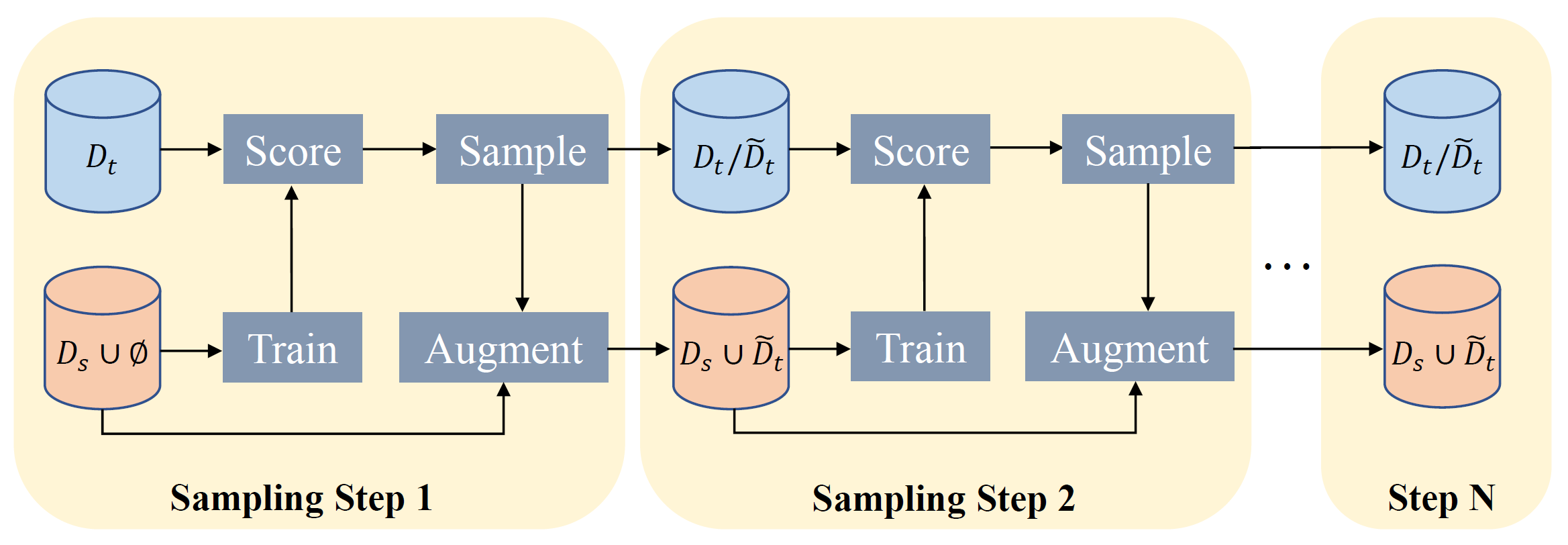
该论文提出了一种名为基于独特边距选择(Select-by-Distinctive-Margin, SDM)的主动域自适应方法,该方法简单而高效,利用最大边距损失识别源域中靠近决策边界的困难样本,并基于目标样本与这些困难样本的相似性选择信息量丰富的样本。SDM仅使用5%的标注目标数据即达到最先进性能,在Office-Home基准测试中展现出极高的效率、稳定性和可扩展性。
Despite plenty of efforts focusing on improving the domain adaptation ability (DA) under unsupervised or few-shot semi-supervised settings, recently the solution of active learning started to attract more attention due to its suitability in transferring model in a more practical way with limited annotation resource on target data. Nevertheless, most active learning methods are not inherently designed to handle domain gap between data distribution, on the other hand, some active domain adaptation methods (ADA) usually requires complicated query functions, which is vulnerable to overfitting. In this work, we propose a concise but effective ADA method called Select-by-Distinctive-Margin (SDM), which consists of a maximum margin loss and a margin sampling algorithm for data selection. We provide theoretical analysis to show that SDM works like a Support Vector Machine, storing hard examples around decision boundaries and exploiting them to find informative and transferable data. In addition, we propose two variants of our method, one is designed to adaptively adjust the gradient from margin loss, the other boosts the selectivity of margin sampling by taking the gradient direction into account. We benchmark SDM with standard active learning setting, demonstrating our algorithm achieves competitive results with good data scalability. Code is available at https://github.com/TencentYoutuResearch/ActiveLearning-SDM
研究动机与目标
- 解决主动域自适应中因标注目标数据有限而导致的域偏移问题。
- 克服现有主动学习方法在处理域差距方面存在的局限性,或避免依赖复杂且易过拟合的查询函数。
- 开发一种利用源域与目标域之间内在关联关系以实现更高效数据选择的方法。
- 通过最小化对超参数和查询复杂度的敏感性,确保模型的稳定性和可扩展性。
- 为基于边距的采样策略在识别信息量丰富且可迁移样本方面的有效性提供理论依据。
提出的方法
- 提出一种最大边距损失,促使模型在源域中最大化类间分离,从而隐式识别出靠近决策边界的困难样本。
- 采用边距采样策略,选择其特征与源域决策边界距离最近的目标样本,依据其与类别中心的距离。
- 引入SDM-AG变体,通过自适应调制因子和最大logit正则化动态调节边距损失的梯度,以提升训练稳定性。
- 设计SDM-AG-Grad第二类变体,引入边距采样函数的一阶梯度,以增强数据采样过程中的选择性。
- 理论分析表明,边距损失的行为类似于支持向量机,聚焦于困难样本并实现可迁移的决策边界。
- 该方法计算效率高,查询复杂度为O(NKD + N log N),显著快于先前方法如CLUE和TQS。
实验结果
研究问题
- RQ1简单的基于边距的损失函数是否能有效识别出可迁移到目标域的源域困难样本?
- RQ2所提出的边距采样策略与主动域自适应中的不确定性采样或多样性采样相比表现如何?
- RQ3在仅使用有限标注目标数据的情况下,SDM相较于现有主动域自适应方法,性能提升程度如何?
- RQ4SDM对超参数(如边距值m和损失平衡因子∇)的敏感性如何?
- RQ5所提出方法在不同域偏移场景下是否能保持高效率和可扩展性?
主要发现
- SDM-AG在所有Office-Home场景中均实现一致的性能提升,其中在R→A设置中提升最大,表明其在标注预算增加时具备强大可扩展性。
- SDM-AG仅使用5%的目标数据即达到或超过无监督域自适应方法(如ATDOC和CDAN)的性能,展现出极高的数据效率。
- 该方法对超参数变化具有鲁棒性,在不同边距值$m$和平衡因子$ abla$下性能波动极小,表明其具有高度稳定性。
- 与最接近的竞争对手(CLUE)相比,SDM在查询时间上实现了24.6倍的加速,查询时间仅为0.067秒,凸显其计算高效性。
- 理论分析证实,边距损失诱导出类似SVM的行为,聚焦于困难样本并实现对目标域的有效迁移。
- 两种变体——SDM-AG与SDM-AG-Grad——分别提升了训练稳定性和采样选择性,且未增加模型复杂度。
更好的研究,从现在开始
从阅读论文到最终审阅,大幅缩短您的研究时间。
无需绑定信用卡
本解读由 AI 生成,并经人工编辑审核。