
[论文解读] Learning Neural Constitutive Laws From Motion Observations for Generalizable PDE Dynamics
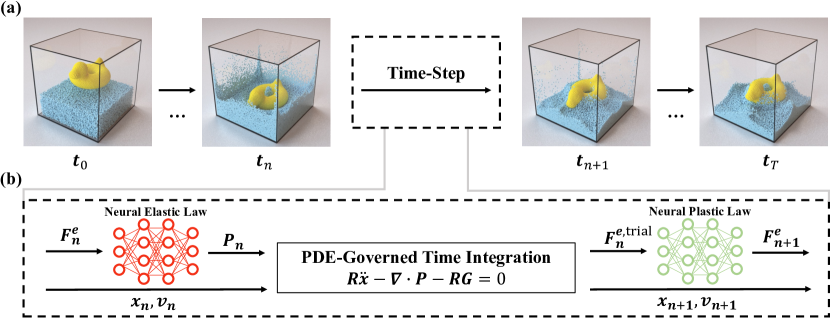
本文提出神经本构定律(NCLaw),一种混合框架,将可微分、具备物理先验的神经网络嵌入基于PDE的模拟器中,从运动观测中学习本构定律。通过强制实施旋转等变性等物理先验,并利用运动学数据进行监督,NCLaw在多种几何形状、初始/边界条件及多物理场系统中,相比端到端神经网络,实现了数量级级别的泛化性能提升,且仅需单条轨迹进行训练。
We propose a hybrid neural network (NN) and PDE approach for learning generalizable PDE dynamics from motion observations. Many NN approaches learn an end-to-end model that implicitly models both the governing PDE and constitutive models (or material models). Without explicit PDE knowledge, these approaches cannot guarantee physical correctness and have limited generalizability. We argue that the governing PDEs are often well-known and should be explicitly enforced rather than learned. Instead, constitutive models are particularly suitable for learning due to their data-fitting nature. To this end, we introduce a new framework termed "Neural Constitutive Laws" (NCLaw), which utilizes a network architecture that strictly guarantees standard constitutive priors, including rotation equivariance and undeformed state equilibrium. We embed this network inside a differentiable simulation and train the model by minimizing a loss function based on the difference between the simulation and the motion observation. We validate NCLaw on various large-deformation dynamical systems, ranging from solids to fluids. After training on a single motion trajectory, our method generalizes to new geometries, initial/boundary conditions, temporal ranges, and even multi-physics systems. On these extremely out-of-distribution generalization tasks, NCLaw is orders-of-magnitude more accurate than previous NN approaches. Real-world experiments demonstrate our method's ability to learn constitutive laws from videos.
研究动机与目标
- 解决端到端神经网络模型在PDE动力学中泛化能力有限且物理一致性不足的问题。
- 克服现实物理系统中获取标注应力-应变数据的挑战。
- 通过仅学习本构定律并强制实施已知PDE和物理先验,提升基于PDE的动力学模型泛化能力。
- 仅使用运动观测数据,实现数据高效、可泛化的复杂动力系统建模。
提出的方法
- 设计一种神经网络架构,通过结构设计强制实现物理先验,包括旋转等变性和未形变状态平衡。
- 将神经本构模型嵌入可微分的基于PDE的物理模拟器中,实现端到端反向传播。
- 使用损失函数最小化模拟轨迹与观测轨迹之间的差异(即运动学数据)。
- 通过时间反向传播(BPTT)基于轨迹级监督优化神经本构模型。
- 利用模拟器生成可微分预测,实现基于梯度的优化,而无需直接依赖应力或应变监督。
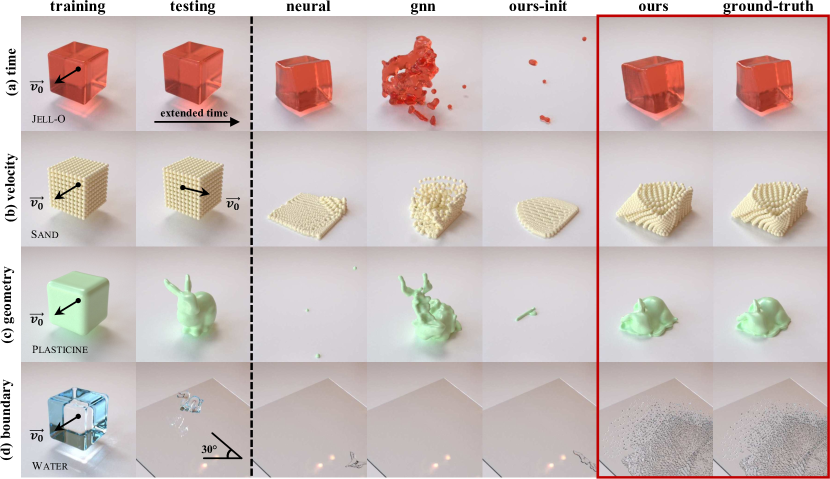
- 将该框架应用于多种材料,包括固体、流体及多物理场系统,实现对未见几何形状和条件的零样本泛化。
实验结果
研究问题
- RQ1神经网络能否在保留旋转不变性等基本物理对称性的同时,仅从运动观测中学习本构定律?
- RQ2在固定控制PDE的前提下,仅学习本构定律相比端到端神经PDE学习,如何提升泛化性能?
- RQ3单一神经架构能否在极少数据下实现对多种材料(如水、果冻、沙子、橡皮泥)的泛化?
- RQ4在极端分布外泛化场景下(如新几何形状、初始条件、时间范围及多物理场系统),该方法表现如何?
- RQ5当缺乏应力数据时,仅依靠运动学数据(位置、速度)作为监督信号,其有效性在多大程度上成立?
主要发现
- NCLaw仅用一条训练轨迹即可泛化至新几何形状、初始与边界条件及时间范围,其误差相比基线GNN模型低了数量级。
- 在速度泛化任务中,NCLaw使用一条轨迹时损失为1.9e-5,优于使用100条轨迹的GNN(损失:1.2e-2)。
- 在弹性右柯西-格林张量的预测中,NCLaw的均方误差为2.388e-6,与使用标注数据的基线模型(2.381e-6)相当,尽管未使用直接应力监督。
- 在参数识别任务中,NCLaw的P张量误差为6.1e-1,高于使用真实应力监督的基线方法(2.6e-3),但该差异在预期范围内。
- 在4项任务中有3项中,添加基于速度的辅助损失可略微提升性能,但仅使用位置监督已足以实现强大的泛化能力。
- 基于真实世界视频的实验验证了该方法从视觉运动数据中学习本构定律的能力,证明了其实际应用潜力。
更好的研究,从现在开始
从阅读论文到最终审阅,大幅缩短您的研究时间。
无需绑定信用卡
本解读由 AI 生成,并经人工编辑审核。