
[论文解读] Learning quantum states and unitaries of bounded gate complexity
本文证明,具有有界门复杂度 $ G $ 的量子态和酉操作可使用与 $ G $ 线性相关的样本和查询复杂度进行学习,从而在数据需求方面实现高效学习。然而,在标准密码学假设下,学习此类量子态和酉操作的计算复杂度随 $ G $ 呈指数增长,揭示了数据效率与计算难度之间的根本权衡。
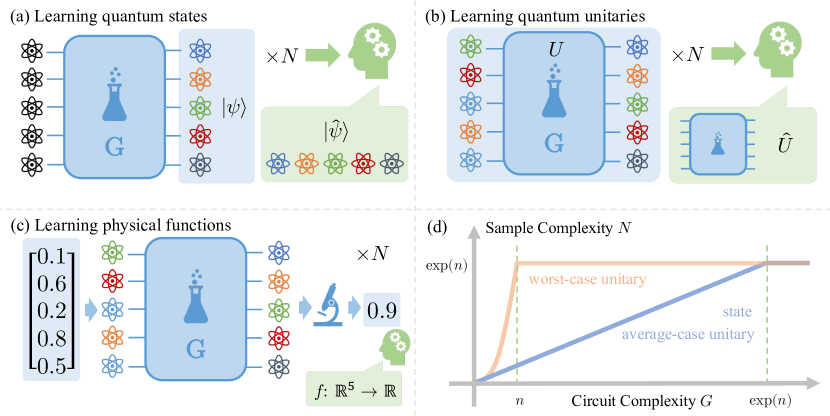
While quantum state tomography is notoriously hard, most states hold little interest to practically-minded tomographers. Given that states and unitaries appearing in Nature are of bounded gate complexity, it is natural to ask if efficient learning becomes possible. In this work, we prove that to learn a state generated by a quantum circuit with $G$ two-qubit gates to a small trace distance, a sample complexity scaling linearly in $G$ is necessary and sufficient. We also prove that the optimal query complexity to learn a unitary generated by $G$ gates to a small average-case error scales linearly in $G$. While sample-efficient learning can be achieved, we show that under reasonable cryptographic conjectures, the computational complexity for learning states and unitaries of gate complexity $G$ must scale exponentially in $G$. We illustrate how these results establish fundamental limitations on the expressivity of quantum machine learning models and provide new perspectives on no-free-lunch theorems in unitary learning. Together, our results answer how the complexity of learning quantum states and unitaries relate to the complexity of creating these states and unitaries.
研究动机与目标
- 为了确定在自然界中大多数态均可通过有限电路深度物理实现的背景下,具有有界门复杂度 $ G $ 的量子态和酉操作是否可以被高效学习。
- 在迹距离和平均情况误差度量下,建立学习量子态和酉操作的紧致样本和查询复杂度界限。
- 研究具有有界复杂度的量子态和酉操作的学习计算复杂度,特别是基于密码学硬度假设的情况。
- 阐明酉操作平均情况学习与最坏情况学习之间的区别,展示查询复杂度存在指数级分离。
- 探讨对量子机器学习模型和量子过程学习中无免费午餐定理的启示。
提出的方法
- 提出一种针对由 $ G $ 个两比特门生成的纯量子态的学习算法,可在 $ O(G) $ 个样本内实现迹距离 $ ilde{O}( rac{1}{ ext{poly}(G)}) $,忽略对数因子。
- 提出一种基于查询的算法,用于在平均情况误差 $ ilde{O}( rac{1}{ ext{poly}(G)}) $ 内学习由 $ G $ 个两比特门组成的酉操作,所需查询次数为 $ O(G) $。
- 利用酉 $ t $-设计和度量熵理论的工具,推导出 $ G $-门积木电路中可区分酉操作数量的下界。
- 利用马尔可夫不等式和近似酉 $ t $-设计的矩矩界,证明 $ G $-门电路的度量熵为 $ ilde{ heta}(tn) $,其中 $ t $ 为设计阶数。
- 应用概率构造方法,证明可打包一组 $ M riangleq ilde{ heta}( rac{1}{ ext{poly}(t)}) $ 个酉操作,使得两两之间的弗罗贝尼乌斯距离有下界,从而建立度量熵的下界。
- 证明在钻石距离(最坏情况)下学习酉操作需要随 $ G $ 指数增长的查询次数,而平均情况学习的复杂度仍保持与 $ G $ 线性关系,从而确立了最坏情况与平均情况学习之间的指数级分离。
实验结果
研究问题
- RQ1具有有界门复杂度 $ G $ 的量子态和酉操作是否可以实现与 $ G $ 线性相关的样本/查询复杂度?
- RQ2在学习有界复杂度的量子态和酉操作时,样本/查询复杂度与计算复杂度之间的最优权衡是什么?
- RQ3在查询复杂度方面,是否存在平均情况与最坏情况学习酉操作之间的指数级分离?
- RQ4学习有界复杂度的量子态和酉操作的计算难度与环上学习错误(Ring-LWE)等密码学假设有何关联?
- RQ5由于学习底层量子过程的复杂性,量子机器学习模型的表达能力存在哪些根本性限制?
主要发现
- 在迹距离 $ ilde{O}( rac{1}{ ext{poly}(G)}) $ 内学习 $ G $-门量子态的样本复杂度为 $ O(G) $,忽略对数因子,且该界是紧致的。
- 在平均情况误差 $ ilde{O}( rac{1}{ ext{poly}(G)}) $ 内学习 $ G $-门酉操作的查询复杂度随 $ G $ 线性增长,且该复杂度在忽略对数因子下是最优的。
- 在钻石距离(最坏情况)下学习酉操作需要随 $ G $ 指数增长的查询复杂度,从而确立了最坏情况与平均情况学习之间的指数级分离。
- 在量子次指数困难性假设下,若任何量子算法能在 $ ilde{O}(G) $ 个样本内学习 $ G $-门态或酉操作,则其运行时间必须随 $ G $ 指数增长。
- 当 $ G riangleq ilde{ heta}( ext{poly}( ext{polylog}(n))) $ 时,计算难度出现相变,仅当 $ G = O( ext{polylog}(n)) $ 时存在 $ ext{poly}(n) $ 时间算法,表明在指数样本复杂度生效前存在一个尖锐的阈值。
- 当 $ G $-门积木电路形成 $ ilde{O}(1) $-近似 $ t $-设计时,其度量熵的下界为 $ ilde{ heta}(tn) $,表明可区分酉操作的数量随 $ t $ 和 $ n $ 增加。
更好的研究,从现在开始
从阅读论文到最终审阅,大幅缩短您的研究时间。
无需绑定信用卡
本解读由 AI 生成,并经人工编辑审核。