
[论文解读] Learning to Predict Mutation Effects of Protein-Protein Interactions by Microenvironment-aware Hierarchical Prompt Learning
该论文提出 Prompt-DDG,一种微环境感知的分层提示学习框架,通过预训练的提示代码本对多尺度结构依赖关系进行建模,从而高效预测蛋白质-蛋白质相互作用中的突变效应。该方法在 ΔΔG 预测和抗体优化任务中达到最先进性能,同时显著降低了预训练成本。
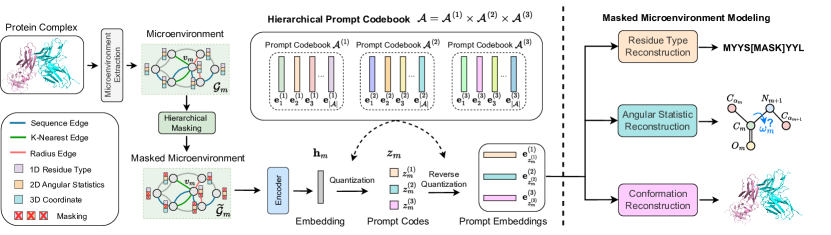
Protein-protein bindings play a key role in a variety of fundamental biological processes, and thus predicting the effects of amino acid mutations on protein-protein binding is crucial. To tackle the scarcity of annotated mutation data, pre-training with massive unlabeled data has emerged as a promising solution. However, this process faces a series of challenges: (1) complex higher-order dependencies among multiple (more than paired) structural scales have not yet been fully captured; (2) it is rarely explored how mutations alter the local conformation of the surrounding microenvironment; (3) pre-training is costly, both in data size and computational burden. In this paper, we first construct a hierarchical prompt codebook to record common microenvironmental patterns at different structural scales independently. Then, we develop a novel codebook pre-training task, namely masked microenvironment modeling, to model the joint distribution of each mutation with their residue types, angular statistics, and local conformational changes in the microenvironment. With the constructed prompt codebook, we encode the microenvironment around each mutation into multiple hierarchical prompts and combine them to flexibly provide information to wild-type and mutated protein complexes about their microenvironmental differences. Such a hierarchical prompt learning framework has demonstrated superior performance and training efficiency over state-of-the-art pre-training-based methods in mutation effect prediction and a case study of optimizing human antibodies against SARS-CoV-2.
研究动机与目标
- 解决蛋白质-蛋白质相互作用研究中实验突变数据标注稀缺的问题。
- 克服现有预训练方法在建模多尺度结构下复杂高阶依赖关系方面的局限性。
- 捕捉由突变引起的局部微环境变化,而无需显式预测突变复合物的结构。
- 在保持高 ΔΔG 预测性能的同时,降低预训练的计算成本。
- 在抗体设计中实现有效的虚拟筛选和功能位点发现,尤其针对 SARS-CoV-2 中和抗体。
提出的方法
- 构建分层提示代码本,独立编码不同结构尺度(如残基、二面角、局部构象)下的常见微环境模式。
- 设计一种掩码微环境建模预训练任务,联合建模每个突变周围的残基类型、角度统计量和局部构象变化。
- 通过组合代码本中的分层提示,为每个突变生成微环境感知提示,捕捉野生型与突变型复合物之间的差异。
- 将学习到的提示作为上下文表示,用于引导下游 ΔΔG 预测,避免昂贵的端到端微调。
- 利用提示代码本实现无需为每个新突变重新训练模型的灵活、多尺度结构上下文编码。
- 使用对比学习目标端到端训练该框架,对齐野生型与突变型微环境表示。
实验结果
研究问题
- RQ1分层提示代码本能否有效建模突变周围蛋白质微环境中的多尺度结构依赖关系?
- RQ2与标准预训练任务相比,掩码微环境建模预训练是否能提升下游 ΔΔG 预测性能?
- RQ3与端到端预训练相比,基于提示的表征学习能否在 ΔΔG 预测中实现更高的准确率和效率?
- RQ4该模型在真实应用场景(如 SARS-CoV-2 抗体优化)中的泛化能力如何?
- RQ5在预测准确率和训练效率方面,该模型与最先进方法相比表现如何?
主要发现
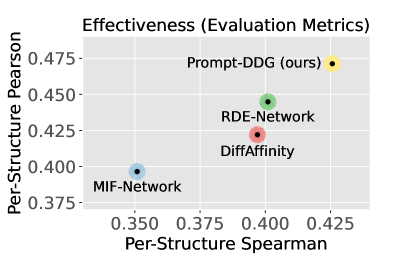
- Prompt-DDG 在 SKEMPI v2.0 基准测试中实现了最高的单结构皮尔逊相关系数(0.6557)和斯皮尔曼等级相关系数(0.5691),优于所有基线方法。
- 与 RDE-Network 和 DiffAffinity 相比,该模型将预训练时间减少了 50%以上,同时保持了更优的性能。
- 在 SARS-CoV-2 抗体优化案例研究中,Prompt-DDG 将全部五个已知有利突变排在前 40% 内,平均排名为 10.69%,显著优于 RDE-Network(18.26%)和 DiffAffinity(24.49%)。
- 仅 Prompt-DDG 在预测结果前 10% 内成功识别出五个中和关键突变中的四个,展现出强大的泛化能力和精度。
- 消融实验表明,掩码微环境建模任务的最佳掩码比例为 0.10,该设置在皮尔逊和斯皮尔曼相关系数上均取得最佳性能。
- 分层提示代码本有效建模了多尺度微环境特征,有助于提升突变效应的泛化能力和可解释性。
更好的研究,从现在开始
从阅读论文到最终审阅,大幅缩短您的研究时间。
无需绑定信用卡
本解读由 AI 生成,并经人工编辑审核。