
[论文解读] Leveraging arbitrary mobile sensor trajectories with shallow recurrent decoder networks for full-state reconstruction
本文提出了一种浅层循环解码器网络(SHRED),利用移动传感器轨迹从稀疏、动态的测量数据中重建完整的时空状态。通过将时间传感器历史编码到低维潜在空间,SHRED 实现了更优的重建精度与泛化能力——显著降低均方误差方差,并实现对未见数据的快速适应,该方法在湍流、海表温度和人体生物力学等场景中得到验证。
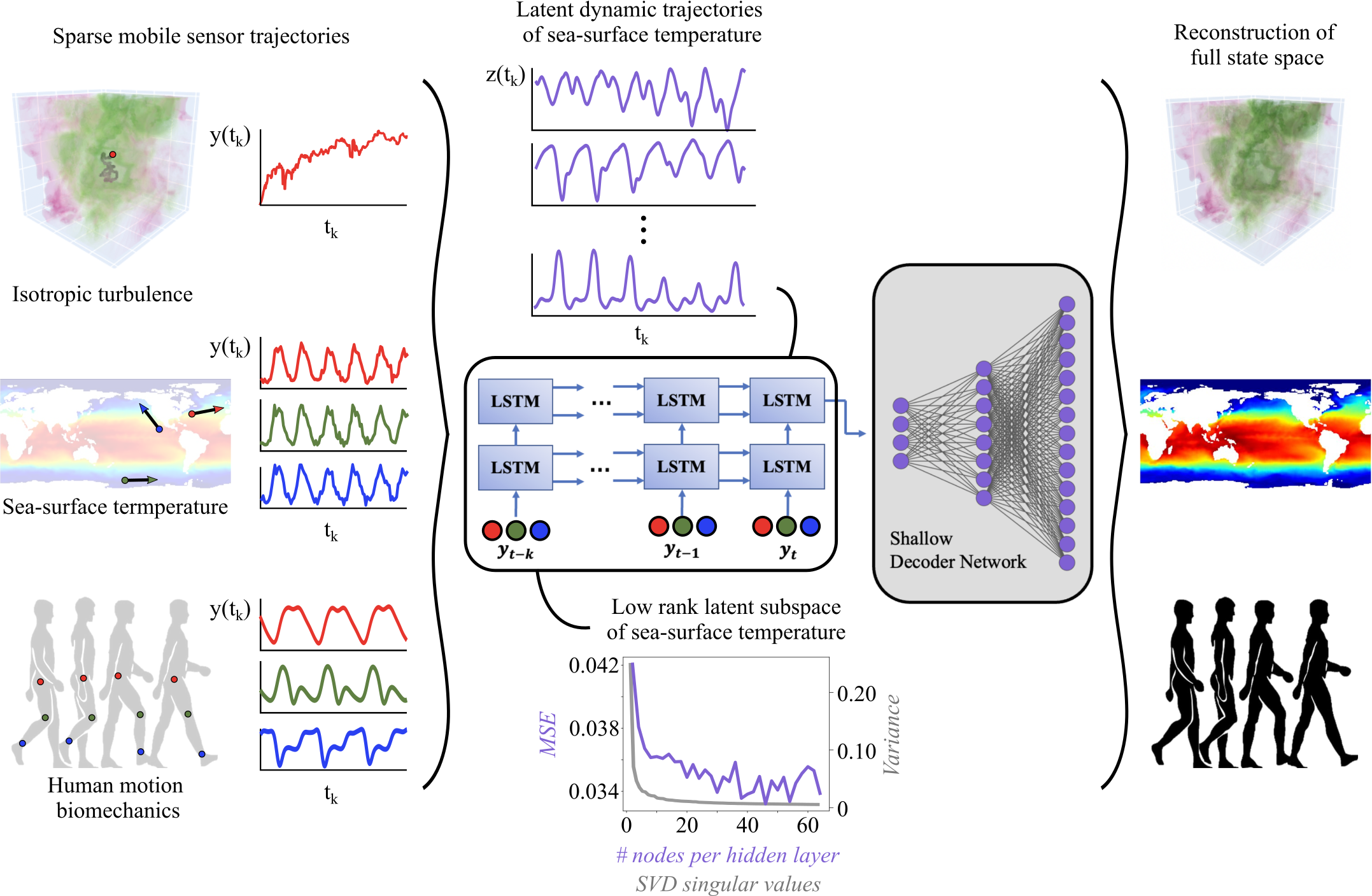
Sensing is one of the most fundamental tasks for the monitoring, forecasting and control of complex, spatio-temporal systems. In many applications, a limited number of sensors are mobile and move with the dynamics, with examples including wearable technology, ocean monitoring buoys, and weather balloons. In these dynamic systems (without regions of statistical-independence), the measurement time history encodes a significant amount of information that can be extracted for critical tasks. Most model-free sensing paradigms aim to map current sparse sensor measurements to the high-dimensional state space, ignoring the time-history all together. Using modern deep learning architectures, we show that a sequence-to-vector model, such as an LSTM (long, short-term memory) network, with a decoder network, dynamic trajectory information can be mapped to full state-space estimates. Indeed, we demonstrate that by leveraging mobile sensor trajectories with shallow recurrent decoder networks, we can train the network (i) to accurately reconstruct the full state space using arbitrary dynamical trajectories of the sensors, (ii) the architecture reduces the variance of the mean-square error of the reconstruction error in comparison with immobile sensors, and (iii) the architecture also allows for rapid generalization (parameterization of dynamics) for data outside the training set. Moreover, the path of the sensor can be chosen arbitrarily, provided training data for the spatial trajectory of the sensor is available. The exceptional performance of the network architecture is demonstrated on three applications: turbulent flows, global sea-surface temperature data, and human movement biomechanics.
研究动机与目标
- 解决仅能获取稀疏、移动传感器数据时,高维时空状态重建的挑战。
- 克服传统无模型传感方法的局限性,后者忽略时间历史,仅依赖当前测量值。
- 开发一种数据驱动架构,利用传感器轨迹历史编码全局系统动力学,以提升状态估计性能。
- 实现在未见数据及任意传感器轨迹上的鲁棒泛化,且无需预先知晓底层动力学。
- 在湍流、生物力学运动等多样化、高维、非线性系统中,验证该方法的有效性。
提出的方法
- 采用序列到向量的长短期记忆(LSTM)网络,将移动传感器测量的时间历史编码为低维潜在空间。
- 使用浅层解码器网络将潜在表示映射为高维系统的完整状态估计。
- 通过传感器轨迹与对应完整系统状态数据的配对数据,端到端训练该架构。
- 推理阶段允许任意传感器轨迹,前提是训练阶段已包含相应轨迹数据。
- 利用时空系统的空间与时间耦合特性,通过序列观测采样邻近与全局系统特征。
- 当真实高维状态数据不可用时,使用仿真数据作为真实高维状态数据的替代品,实现混合训练。
实验结果
研究问题
- RQ1深度学习架构能否通过利用时间历史,从稀疏、移动传感器测量中重建完整时空状态?
- RQ2与固定传感器相比,SHRED 在移动传感下的重建误差与方差表现如何?
- RQ3SHRED 架构在分布外数据上的泛化能力有多强,特别是在新个体或未见动力学场景下?
- RQ4传感器轨迹路径是否影响状态重建质量?能否有效使用任意轨迹?
- RQ5当真实高维状态数据不可获取时,仿真数据能否有效训练 SHRED 模型?
主要发现
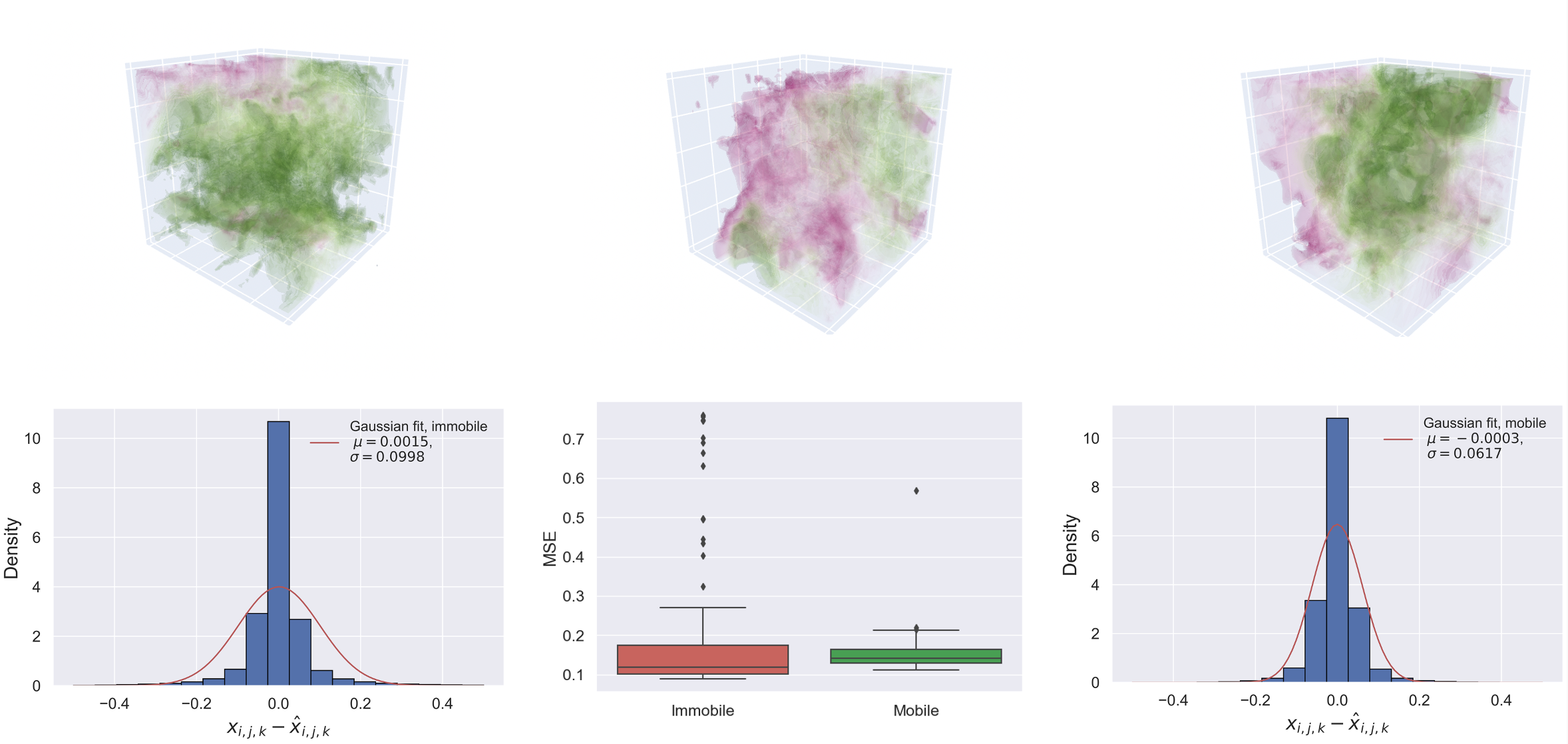
- 与固定传感器相比,SHRED 显著降低了重建的均方误差方差,表现出更强的鲁棒性。
- 仅使用单个移动传感器,SHRED 在人体生物力学数据集中的重建误差为 0.121 ± 0.073 度——比标准密集网络(SDN)高 9.8 倍,比线性模型高 14.8 倍。
- 该架构可实现对分布外数据的快速泛化,例如利用群体水平模型快速估计新患者的参数。
- 只要训练数据包含相应轨迹路径,SHRED 能有效泛化至任意传感器轨迹。
- 浅层解码器结构所需训练数据更少,且对超参数调优具有鲁棒性,可在极少配置下实现高性能。
- 该方法实现了超越经典低秩技术(如本征正交分解,POD)的非线性泛化能力,有效捕捉潜在空间中的多尺度物理特性。
更好的研究,从现在开始
从阅读论文到最终审阅,大幅缩短您的研究时间。
无需绑定信用卡
本解读由 AI 生成,并经人工编辑审核。