
[论文解读] Linking fast and slow: the case for generative models
本文倡导使用分层生成模型与贝叶斯推断,将毫秒级的快速神经动力学与分钟至年尺度的缓慢系统级变化相联系,实现超越相关性的机制推断。通过利用从属原理与变分贝叶斯方法,该研究为多尺度神经科学建模提供了一个严谨的框架,并在癫痫研究中展示了其应用价值,同时具备广泛适用于脑网络动力学的潜力。
A pervasive challenge in neuroscience is testing whether neuronal connectivity changes over time due to specific causes, such as stimuli, events, or clinical interventions. Recent hardware innovations and falling data storage costs enable longer, more naturalistic neuronal recordings. The implicit opportunity for understanding the self-organised brain calls for new analysis methods that link temporal scales: from the order of milliseconds over which neuronal dynamics evolve, to the order of minutes, days, or even years over which experimental observations unfold. This review article demonstrates how hierarchical generative models and Bayesian inference help to characterise neuronal activity across different time scales. Crucially, these methods go beyond describing statistical associations among observations and enable inference about underlying mechanisms. We offer an overview of fundamental concepts in state-space modeling and suggest a taxonomy for these methods. Additionally, we introduce key mathematical principles that underscore a separation of temporal scales, such as the slaving principle, and review Bayesian methods that are being used to test hypotheses about the brain with multiscale data. We hope that this review will serve as a useful primer for experimental and computational neuroscientists on the state of the art and current directions of travel in the complex systems modelling literature.
研究动机与目标
- 解决神经科学中从毫秒到年尺度的神经活动跨时间尺度关联的挑战。
- 开发一种系统性框架,利用多时间尺度时间序列数据评估神经科学假说。
- 通过生成模型与贝叶斯模型比较,实现对潜在机制的推断,而不仅仅是统计关联。
- 提供一种实用且可扩展的方法,利用快速尺度动力学作为输入,建模脑连接性的缓慢变化。
- 通过虚拟癫痫患者框架,在临床神经科学,特别是癫痫研究中,展示该方法的实用性。
提出的方法
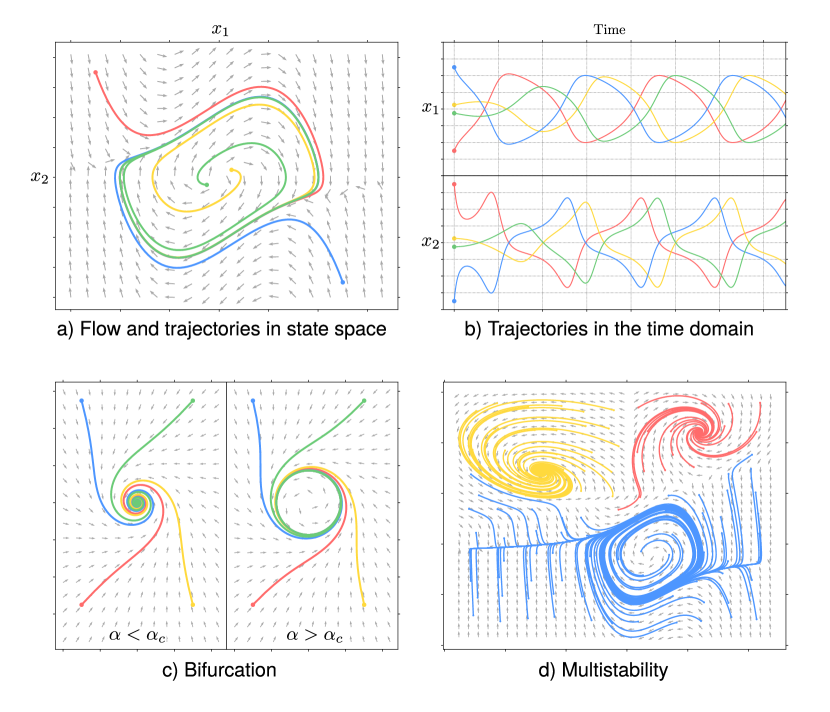
- 采用状态空间模型表示潜在神经动力学,包含连续时间演化方程与包含测量噪声的观测模型。
- 应用从属原理以分离快速与慢速时间尺度,使各尺度可独立建模,并引入分层结构。
- 使用变分贝叶斯方法近似模型参数的后验分布,实现对复杂分层模型的反演。
- 实施经验贝叶斯方法以在中间层级学习超先验,支持从数据中学习模型,而无需强先验假设。
- 构建分层模型,将快速尺度参数(如神经元群活动)视为高层模型的缓慢变化观测值。
- 利用模型证据(通过变分自由能近似)比较竞争性的多尺度模型,并选择最匹配的假说。
实验结果
研究问题
- RQ1如何利用分层生成模型将快速神经动力学与脑连接性的缓慢系统级变化相联系?
- RQ2在多尺度脑建模中,分离时间尺度的数学原理是什么?这些原理如何被严格应用?
- RQ3贝叶斯推断,特别是变分贝叶斯方法,如何用于反演多尺度时间序列的复杂分层模型?
- RQ4应依据何种标准决定建模多个时间尺度?模型复杂性如何通过数据拟合来合理化?
- RQ5生成模型如何用于揭示脑网络状态转换(如癫痫中的转换)的机制解释?
主要发现
- 从属原理实现了时间尺度的严格分离,使快速与慢速动力学可独立建模,同时保持其因果关联性。
- 结合贝叶斯反演的分层生成模型,可在多尺度数据中实现对潜在机制的推断,而不仅仅是统计关联。
- 结合经验贝叶斯的变分贝叶斯方法,为反演复杂神经时间序列分层模型提供了可扩展且实用的途径。
- 通过变分自由能近似的模型证据,为比较竞争性多尺度模型并选择最合理假说提供了严谨方法。
- 该方法已通过虚拟癫痫患者框架成功应用于癫痫研究,实现了对癫痫发作动力学的个性化建模。
- 将隐马尔可夫模型扩展为包含逃逸率与连续慢速动力学,可将网络吸引子转换与突触及预测编码机制相联系。
更好的研究,从现在开始
从阅读论文到最终审阅,大幅缩短您的研究时间。
无需绑定信用卡
本解读由 AI 生成,并经人工编辑审核。