
[论文解读] Live Graph Lab: Towards Open, Dynamic and Real Transaction Graphs with NFT
本文介绍了 Live Graph Lab,一个利用以太坊区块链上的 NFT 构建开放、动态且实时交易图的框架。通过同步完整以太坊节点,作者构建了一个包含超过 450 万个节点和 1.24 亿条边的实时时间图,揭示了快速增长且高度活跃的动力学特性,并为图机器学习和时间网络分析提供了新的基准。
Numerous studies have been conducted to investigate the properties of large-scale temporal graphs. Despite the ubiquity of these graphs in real-world scenarios, it's usually impractical for us to obtain the whole real-time graphs due to privacy concerns and technical limitations. In this paper, we introduce the concept of {\it Live Graph Lab} for temporal graphs, which enables open, dynamic and real transaction graphs from blockchains. Among them, Non-fungible tokens (NFTs) have become one of the most prominent parts of blockchain over the past several years. With more than \$40 billion market capitalization, this decentralized ecosystem produces massive, anonymous and real transaction activities, which naturally forms a complicated transaction network. However, there is limited understanding about the characteristics of this emerging NFT ecosystem from a temporal graph analysis perspective. To mitigate this gap, we instantiate a live graph with NFT transaction network and investigate its dynamics to provide new observations and insights. Specifically, through downloading and parsing the NFT transaction activities, we obtain a temporal graph with more than 4.5 million nodes and 124 million edges. Then, a series of measurements are presented to understand the properties of the NFT ecosystem. Through comparisons with social, citation, and web networks, our analyses give intriguing findings and point out potential directions for future exploration. Finally, we also study machine learning models in this live graph to enrich the current datasets and provide new opportunities for the graph community. The source codes and dataset are available at https://livegraphlab.github.io.
研究动机与目标
- 解决图研究中缺乏开放、动态且实时的时间图数据集的问题。
- 克服现有数据集过时、不完整或无法实时公开共享的局限性。
- 通过一个实时、大规模的交易图,研究新兴 NFT 生态系统的结构和动态特性。
- 为时间图挖掘和机器学习研究提供可重用的框架和数据集。
- 在持续演化的现实世界图上评估时间图学习模型的性能。
提出的方法
- 同步完整以太坊节点,实时流式传输并捕获所有 NFT 交易数据。
- 解析、清洗并结构化原始区块链数据,构建以地址为节点、NFT 转移为边的时间图。
- 构建一个从 2017 年到 2022 年的时间图,包含 450 万个节点和 1.24 亿条边。
- 进行全面的时间图分析,包括度分布、聚类和时间动力学。
- 应用最先进的时序图学习模型(例如 TGCN、EvolveGCN、DynGEM)在实时数据上评估性能。
- 生成可视化结果,如 TEA 图和 TET 图,以分析边的重复性和时间模式。
实验结果
研究问题
- RQ1实时 NFT 交易网络的结构和动态特性与传统时间图有何不同?
- RQ2NFT 交易图在时间上有多高的活跃度和增长速度?
- RQ3现有时间图学习模型在实时演化的图上与静态或合成数据集相比表现如何?
- RQ4现实世界中 NFT 交易网络的边重复性和时间模式具有何种含义?
- RQ5实时、开放且动态的图能否作为未来图算法和系统开发的可行基准?
主要发现
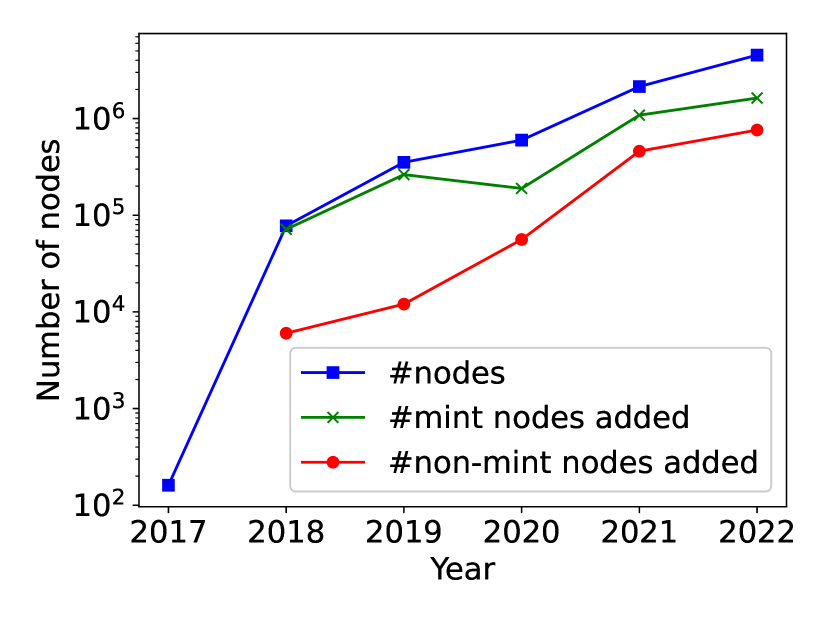
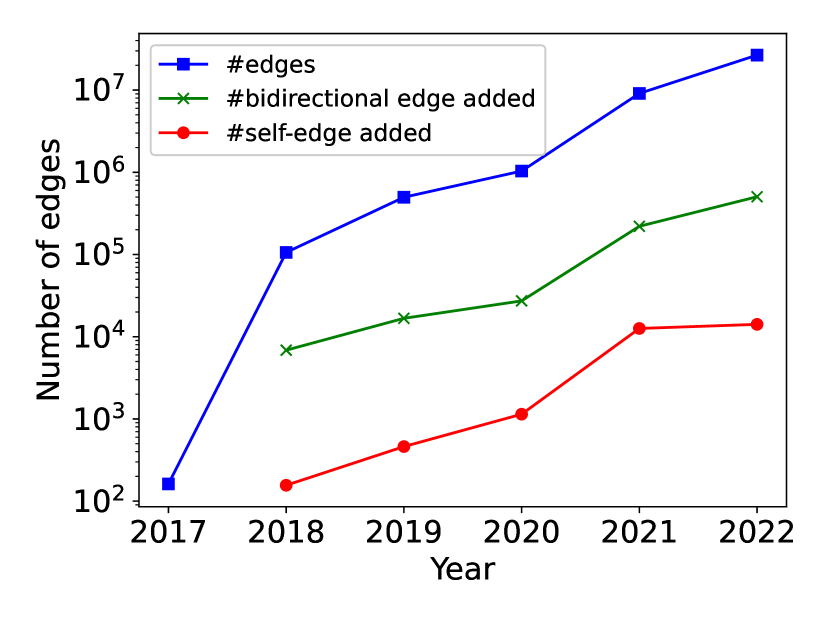
- 实时 NFT 交易图包含超过 450 万个节点和 1.24 亿条边,形成一个高度动态且活跃的网络。
- 该图表现出快速增长和高度活跃的特性,TEA 图显示每个时间步均有大量新形成的边。
- 时间边流量(TET)分析揭示了细微的重复模式,表明交易中同时存在新颖性和重复性。
- 时间链接预测模型的性能随时间粒度变粗而下降,Roland-MA 的 AUC 从每日的 97.55±0.59 降至每月的 87.69±2.17。
- 实时图为图机器学习带来了新的挑战与机遇,如 DynGEM 和 Roland-GRU 模型在实时数据上的表现所示。
- 该框架实现了稳定且可扩展的子图匹配,即使在移除前 50 个枢纽节点后,查询时间仍保持稳定,表明其在密集图上的鲁棒性。
更好的研究,从现在开始
从阅读论文到最终审阅,大幅缩短您的研究时间。
无需绑定信用卡
本解读由 AI 生成,并经人工编辑审核。