
[论文解读] LLM-Personalize: Aligning LLM Planners with Human Preferences via Reinforced Self-Training for Housekeeping Robots
LLM-Personalize 提出了一种基于强化学习的自训练流程,通过结合模仿学习与迭代自训练,将 LLM 计划器个性化以匹配用户偏好,从而实现对家用机器人计划器的个性化。在 Housekeep 基准测试中,该方法使成功率提升超过 30%,显著提高了多房间、部分可观测环境中的计划可执行性与偏好对齐能力。
Large language models (LLMs) have shown significant potential for robotics applications, particularly task planning, by harnessing their language comprehension and text generation capabilities. However, in applications such as household robotics, a critical gap remains in the personalization of these models to individual user preferences. We introduce LLM-Personalize, a novel framework with an optimization pipeline designed to personalize LLM planners for household robotics. Our LLM-Personalize framework features an LLM planner that performs iterative planning in multi-room, partially-observable household scenarios, making use of a scene graph constructed with local observations. The generated plan consists of a sequence of high-level actions which are subsequently executed by a controller. Central to our approach is the optimization pipeline, which combines imitation learning and iterative self-training to personalize the LLM planner. In particular, the imitation learning phase performs initial LLM alignment from demonstrations, and bootstraps the model to facilitate effective iterative self-training, which further explores and aligns the model to user preferences. We evaluate LLM-Personalize on Housekeep, a challenging simulated real-world 3D benchmark for household rearrangements, and show that LLM-Personalize achieves more than a 30 percent increase in success rate over existing LLM planners, showcasing significantly improved alignment with human preferences. Project page: https://gdg94.github.io/projectllmpersonalize/.
研究动机与目标
- 解决在个性化 LLM 计划器以匹配个体用户偏好方面存在的空白。
- 利用 LLM 改进多房间、部分可观测环境中的长时程规划能力。
- 开发一种可扩展的优化流程,实现在无需大量人工标注偏好数据的情况下实现有效个性化。
- 在具有挑战性的 3D 模拟基准 Housekeep 上评估该框架,以证明其在真实场景中的适用性。
- 实现个性化规划行为在未见家庭布局之间的跨领域迁移。
提出的方法
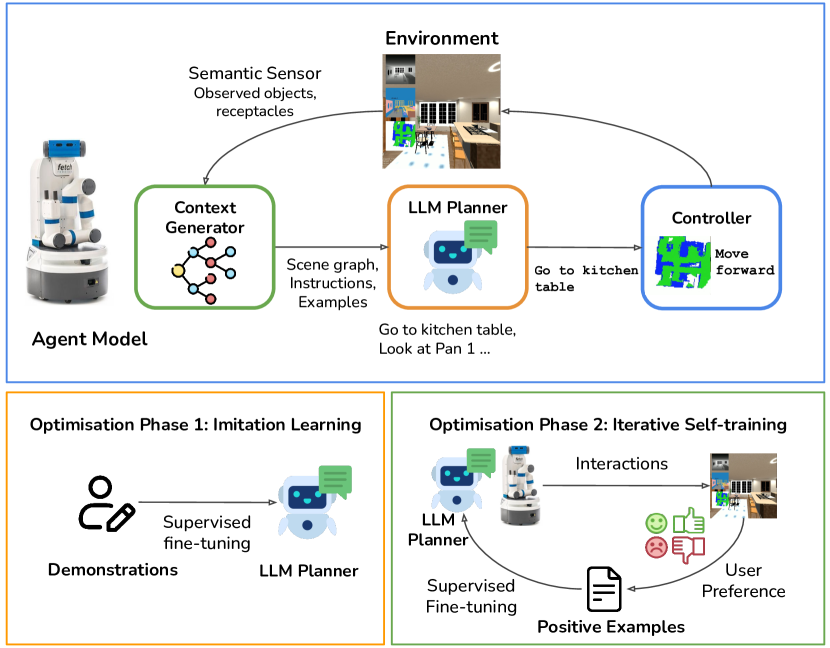
- 该框架采用三组件智能体架构:上下文生成器根据局部观测构建并更新场景图,LLM 计划器基于场景图生成高层级动作序列,低层控制器负责执行动作。
- 初始的模仿学习阶段将 LLM 计划器与人类示范数据对齐,以启动上下文理解与偏好解读能力。
- 随后进入迭代自训练阶段,模型生成交互数据,基于用户偏好反馈评估结果,并更新策略以偏好高回报(被偏好)的放置方式。
- 自训练过程使用源自人类偏好数据的奖励信号,以优化正确物体-容器放置,平衡探索与利用。
- 优化流程以自举方式应用,从模仿学习开始,以提升数据质量后再启动自训练。
- 该框架在 Housekeep 基准上进行评估,该基准包含多样化的、长时程的、部分可观测的家庭重排任务,并附有真实人类偏好标注。
实验结果
研究问题
- RQ1在无需显式偏好建模的情况下,LLM 计划器能否在家庭机器人中有效个性化以匹配个体用户偏好?
- RQ2将模仿学习与迭代自训练相结合,如何提升多房间、部分可观测环境中计划质量与偏好对齐能力?
- RQ3LLM-Personalize 框架在未见家庭布局与物体-容器组合上的泛化能力如何?
- RQ4在自训练过程中,探索与利用的平衡如何演变,其对最终任务性能有何影响?
- RQ5在偏好对齐规划中,模仿学习与自训练两个优化阶段对整体成功率的贡献分别是什么?
主要发现
- LLM-Personalize 在 Housekeep 基准测试中,相较于现有基于 LLM 的计划器,成功率提升超过 30%,证明了其强大的偏好对齐能力。
- 模仿学习阶段显著提升了计划可执行性,提高了成功执行高层动作的比例,并为高质量自训练数据提供了支持。
- 在自训练过程中,智能体增加了探索行为,例如在 Scene 3 中,独特放置次数从 2.32 上升至 9.48,随后在后期阶段转向利用。
- 该模型在未见物体组合与布局上表现出良好的泛化能力,当在多样化场景上训练时,测试性能有所提升,表明实现了有效的跨领域迁移。
- 在 Scene 3 中观察到过拟合现象,尽管训练性能很高,但测试性能下降,表明在复杂场景中需要正则化策略。
- 该框架成功学习并坚持正确的物体放置方式,基于用户偏好,通过迭代优化避免了错误放置。

更好的研究,从现在开始
从阅读论文到最终审阅,大幅缩短您的研究时间。
无需绑定信用卡
本解读由 AI 生成,并经人工编辑审核。