
[论文解读] LLPNet: Graph Autoencoder for Triggering Light Long-Lived Particles at HL-LHC
本文提出LLPNet,一种轻量级图自编码器,利用L1重建轨迹的边卷积技术,在HL-LHC中探测来自轻型长寿命粒子(LLPs)的喷注位移。其在30 kHz背景率下实现了33–80%的信号效率,证明了对低质量LLP(衰变为喷注,衰变长度达100 cm)进行L1触发的可行性。
In the search for exotic events involving displaced particles at HL-LHC, the triggering at the level-1 (L1) system will pose a significant challenge. This is particularly relevant in scenarios where low mass long-lived particles (LLPs) are coupled to a Standard Model (SM)-like 125 GeV Higgs boson and they decay into jets. The complexity arises from the low hadronic activity resulting from LLP decay, and the existing triggers' inability to efficiently select displaced events. This study introduces a novel machine learning approach to address this challenge, utilizing a lightweight autoencoder architecture designed for low latency requirements at L1. Focusing on light LLPs with decay lengths ranging from 1 to 100 cm, this approach employs "Edge convolution" on L1 reconstructed tracks. The results show notable signal acceptance at the permissible background rate, primarily originating from minimum bias and QCD di-jet events. For LLPs of mass 10, 30, and 50 GeV at decay length of 5 cm, the signal efficiencies are 33%, 70%, and 80%, respectively. At a 50 cm decay length, these efficiencies are 20%, 39%, and 45% for the same respective masses.
研究动机与目标
- 解决HL-LHC的L1触发系统在触发轻型长寿命粒子(LLPs)位移信号方面的挑战。
- 克服标准触发器(如H_T、PUPPI)在捕捉LLP衰变产生的低多重性、低强子活动事件时的低效问题。
- 开发一种低延迟、适合FPGA部署的机器学习解决方案,适用于在高堆积极(每交叉事件高达140个相互作用)条件下实现实时处理。
- 实现对质量为10–50 GeV、衰变长度为1–100 cm的LLP的探测,特别是来自希格斯玻色子衰变为隐形或喷注末态的LLP。
- 在背景率低于30 kHz(L1触发可扩展性的关键阈值)的前提下,优化信号接受度。
提出的方法
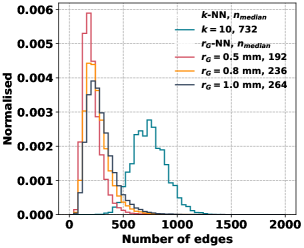
- 使用基于半径的图构建方法(而非k近邻)从L1重建轨迹构建事件级点云图,以降低计算负载。
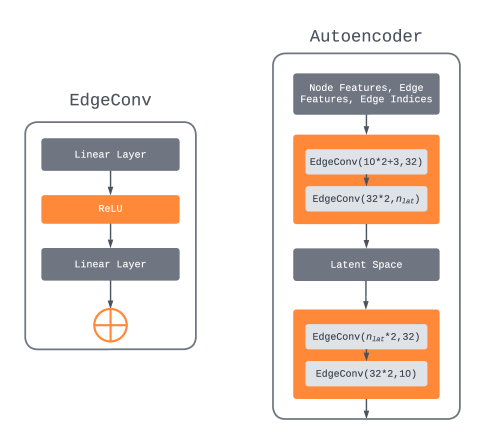
- 应用边卷积层,将轨迹的空间和动量特征(包括横向衰变参数和动量)编码为节点和边特征。
- 训练轻量级图自编码器以重建输入点云,学习捕捉位移喷注拓扑结构的紧凑潜在表征。
- 采用异常检测:信号事件(位移喷注)的重建误差较低,而背景事件(最小作用截面和QCD二喷注)的误差较高,从而识别稀有事件。
- 使用梯度提升回归器对图半径和潜在空间维度进行超参数调优,以确定不同LLP质量与衰变长度下的最优工作点(WPs)。
- 使用拼接法计算背景率,将QCD二喷注背景划分为多个p_T^gen区间,以考虑相空间重叠。
实验结果
研究问题
- RQ1尽管存在低强子活动和高堆积极,轻量级图自编码器是否能在L1触发级别有效检测来自轻型LLPs的位移喷注?
- RQ2在L1环境中,图构建方法的选择(基于半径 vs. k近邻)如何影响性能与计算效率?
- RQ3在背景率低于30 kHz的条件下,对质量为10、30和50 GeV、衰变长度为1至100 cm的LLP,可实现多高的信号效率?
- RQ4在不同衰变长度和质量下,信号事件与主要背景(最小作用截面和QCD二喷注)的重建误差分布有何差异?
- RQ5为最大化不同LLP基准点的信号效率与AUC,最优超参数(图半径与潜在维度)是什么?
主要发现
- 对于质量为10 GeV、衰变长度为5 cm的LLP,LLPNet在WP-1下实现33%的信号效率,背景率为30 kHz。
- 对于5 cm衰变长度的30 GeV LLP,信号效率达到70%,背景率相同;而50 GeV LLP的效率达到80%。
- 在更长的衰变长度50 cm下,10、30和50 GeV LLP的信号效率分别降至20%、39%和45%,对应WP-2。
- 最优图半径与潜在空间维度随LLP质量与衰变长度变化,最大AUC值出现在特定组合处(例如,WP-2下r_G=0.9,n_lat=6)。
- ROC曲线显示信号与背景有明显分离,LLP事件的异常评分显著高于最小作用截面和QCD二喷注事件。
- 该方法在1至100 cm的衰变长度范围内保持高性能,尽管长衰变长度下信号效率下降,但仍表现出对不同位移尺度的鲁棒性。
更好的研究,从现在开始
从阅读论文到最终审阅,大幅缩短您的研究时间。
无需绑定信用卡
本解读由 AI 生成,并经人工编辑审核。