
[论文解读] LNoS: Lithium Niobate on Silicon Spatial Light Modulator
该论文提出LNoS,一种基于与CMOS背板键合的铌酸锂薄膜的兆像素级空间光调制器,通过导模共振实现GHz速率、自由形式的电光调制。该器件实现了1.6 GHz的3-dB调制带宽,且与LN的光场重叠度超过90%,展示了在量子技术、成像和机器视觉应用中实现高速、大孔径光学控制的可扩展蓝图。
Programmable spatiotemporal control of light is crucial for advancements in optical communications, imaging, and quantum technologies. Commercial spatial light modulators (SLMs) typically have megapixel-scale apertures but are limited to ~kHz operational speeds. Developing a device that controls a similar number of spatial modes at high speeds could potentially transform fields such as imaging through scattering media, quantum computing with cold atoms and ions, and high-speed machine vision, but to date remains an open challenge. In this work we introduce and demonstrate a free-form, resonant electro-optic (EO) modulator with megapixel apertures using CMOS integration. The optical layer features a Lithium Niobate (LN) thin-film integrated with a photonic crystal (PhC), yielding a guided mode resonance (GMR) with a Q-factor>1000, a field overlap coefficient ~90% and a 1.6 GHz 3-dB modulation bandwidth (detector limited). To realize a free-form and scalable SLM, we fabricate the PhC via interference lithography and develop a procedure to bond the device to a megapixel CMOS backplane. We identify limitations in existing EO materials and CMOS backplanes that must be overcome to simultaneously achieve megapixel-scale, GHz-rate operation. The `LN on Silicon' (LNoS) architecture we present is a blueprint towards realizing such devices.
研究动机与目标
- 为克服商用SLS在kHz速率下受限的带宽问题,尽管其像素规模可达兆像素级别。
- 通过将铌酸锂(LN)导模共振(GMR)与CMOS背板集成,实现高速、自由形式的空间光调制。
- 通过解决电光材料效率和背板集成的挑战,在兆像素尺度上实现GHz速率运行。
- 展示一种可扩展的、与CMOS集成的架构,绕过LCoS和MEMS基SLS的机械限制。
- 识别并解决实现GHz、兆像素SLS过程中电光材料与电子背板的关键瓶颈。
提出的方法
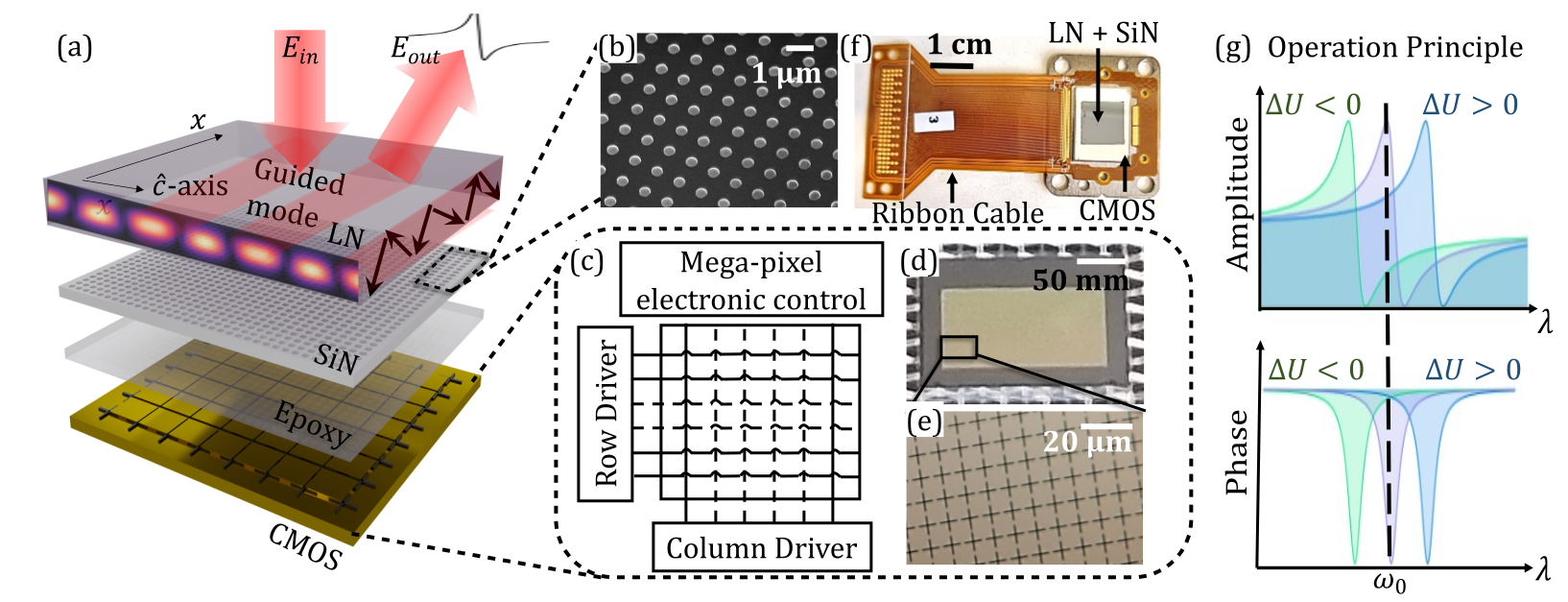
- 器件在薄膜铌酸锂(LN)层中使用光子晶体(PhC)激发具有Q因子>1000的导模共振(GMR)。
- 通过皮克尔斯效应实现GMR的电光调谐:外加电压调节LN的折射率,从而移动共振波长,改变反射光的相位和振幅。
- 采用干涉光刻技术实现亚微米精度的PhC结构制造,支持可扩展的大面积图案化。
- 采用自由形式的环氧树脂键合CMOS背板,实现对LN薄膜上局部电场的施加,支持像素独立控制。
- 系统利用商用兆像素CMOS芯片的行列地址技术,实现对LN SLM的可扩展、高密度控制。
- 通过理论建模与数字孪生仿真预测近场和远场光束分布,并通过实验测量进行验证。
实验结果
研究问题
- RQ1基于硅衬底的铌酸锂(LNoS)架构是否能在兆像素级空间分辨率下实现GHz速率的调制带宽?
- RQ2光场与LN层的重叠度如何影响导模共振中的调谐效率与调制深度?
- RQ3当前电光材料与CMOS背板在实现GHz、兆像素SLS中的关键限制因素是什么?
- RQ4粘接层(如环氧树脂)在多大程度上降低调制效率,以及如何缓解这一影响?
- RQ5干涉光刻与CMOS背板集成是否能够实现可扩展、自由形式、高速的空间光调制?
主要发现
- LNoS器件实现了1.6 GHz的3-dB调制带宽,受限于探测器带宽,证明了在自由形式、兆像素级SLS中实现GHz速率运行的可行性。
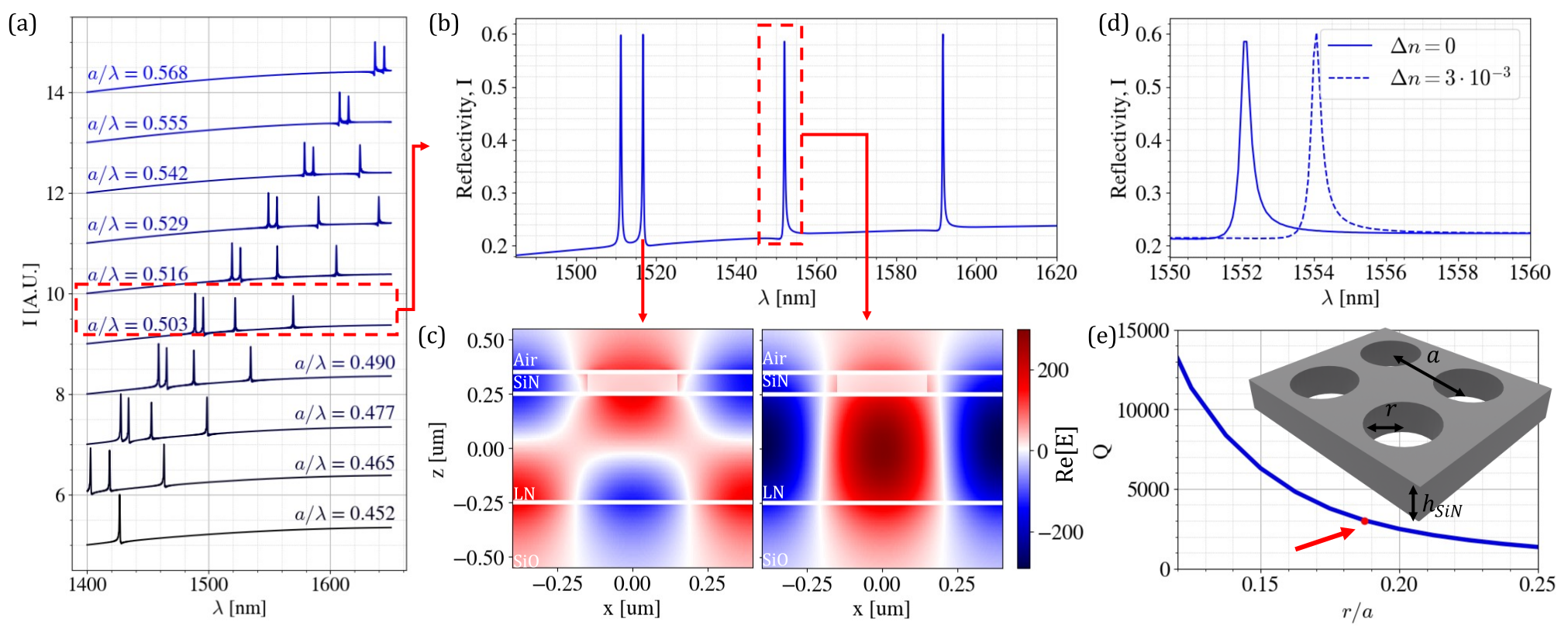
- 导模共振的Q因子>1000,且与LN层的光场重叠度约为90%,最大化了电光调谐效率。
- 基于三像素原型的波束成形实验验证表明,可实现可测量的相位与振幅控制,理论与实验结果高度一致。
- 相位空间分析确认,在整个电压范围内强度的消光比约为4倍,表明具备强大的调制能力。
- 引入环氧树脂粘接层会降低调制深度,但当Q因子达到1400或以上时,仍可实现显著调制,若采用更高Q值材料(如BTO)可进一步提升性能。
- 理论分析表明,将Q因子提高至4000,并采用具有更高电光系数的材料(如BTO)可使调制深度提升最多50%。
更好的研究,从现在开始
从阅读论文到最终审阅,大幅缩短您的研究时间。
无需绑定信用卡
本解读由 AI 生成,并经人工编辑审核。