
[论文解读] Logic-LM: Empowering Large Language Models with Symbolic Solvers for Faithful Logical Reasoning
该论文提出 Logic-LM,一种神经符号框架,通过将符号求解器集成到大型语言模型(LLMs)中,以提升忠实的逻辑推理能力。通过使用 LLMs 将自然语言问题转化为符号逻辑,再利用确定性的符号推理引擎进行推理,Logic-LM 在五个逻辑推理数据集上相较于标准提示工程平均提升 39.2%,相较于思维链提示工程提升 18.4%。
Large Language Models (LLMs) have shown human-like reasoning abilities but still struggle with complex logical problems. This paper introduces a novel framework, Logic-LM, which integrates LLMs with symbolic solvers to improve logical problem-solving. Our method first utilizes LLMs to translate a natural language problem into a symbolic formulation. Afterward, a deterministic symbolic solver performs inference on the formulated problem. We also introduce a self-refinement module, which utilizes the symbolic solver's error messages to revise symbolic formalizations. We demonstrate Logic-LM's effectiveness on five logical reasoning datasets: ProofWriter, PrOntoQA, FOLIO, LogicalDeduction, and AR-LSAT. On average, Logic-LM achieves a significant performance boost of 39.2% over using LLM alone with standard prompting and 18.4% over LLM with chain-of-thought prompting. Our findings suggest that Logic-LM, by combining LLMs with symbolic logic, offers a promising avenue for faithful logical reasoning. Code and data are publicly available at https://github.com/teacherpeterpan/Logic-LLM.
研究动机与目标
- 解决 LLM 中推理不忠实的问题,即结论无法从推理步骤中逻辑推导而出。
- 通过整合确保逻辑一致性的符号逻辑系统,克服纯神经推理的局限性。
- 利用 LLM 的自然语言理解能力,生成复杂逻辑问题的准确符号形式化表达。
- 通过符号求解器提供的错误反馈,利用自修正机制提升符号形式化准确性。
- 在多样化的逻辑推理基准上,展示 LLM 与符号推理结合的有效性。
提出的方法
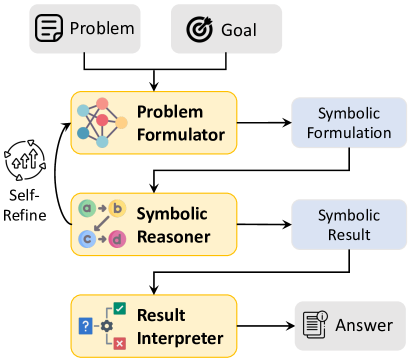
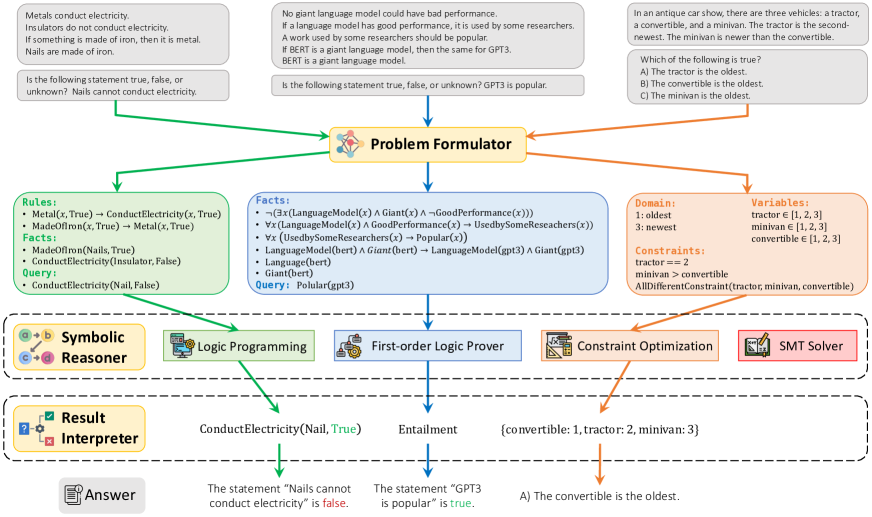
- 使用大型语言模型(如 GPT-4)将自然语言问题转化为符号逻辑表示(如一阶逻辑、约束满足问题、SAT 公式)。
- 采用领域特定的符号求解器——如逻辑编程引擎、一阶逻辑推理引擎、约束优化器和 SAT 求解器——对符号形式化结果进行确定性推理。
- 引入一个自修正模块,利用符号求解器返回的错误信息作为反馈,迭代地修正符号形式化结果。
- 解释符号求解器的输出,并将其映射回原始答案空间以生成最终预测。
- 使用少样本 few-shot 上下文学习,通过示范引导 LLM 生成正确的符号表示。
- 通过定制化的符号工具支持多种推理类型,包括演绎推理、一阶逻辑推理、约束满足问题和分析性推理。
实验结果
研究问题
- RQ1与标准提示工程相比,将 LLM 与符号求解器结合是否能显著提升逻辑推理的忠实度与准确性?
- RQ2随着推理深度的增加,LLM-符号集成框架的性能如何变化?
- RQ3利用符号求解器反馈进行自修正,在多大程度上能提升符号形式化的质量?
- RQ4该框架在多样化的逻辑推理任务(包括一阶逻辑、约束满足问题和分析性推理)中的有效性如何?
- RQ5LLMs 在符号形式化过程中主要的失败模式是什么,这些模式如何影响整体推理性能?
主要发现
- Logic-LM 在五个逻辑推理数据集上,相较于标准提示工程平均提升 39.2%,相较于思维链提示工程提升 18.4%。
- 随着推理深度的增加,该框架的性能显著提升,表明其在处理复杂问题时具备良好的可扩展性。
- 利用符号求解器错误信息进行自修正,可显著提升符号形式化准确率。
- 错误案例显示,LLMs 常常错误表示谓词,混淆空间关系(如 'above' 与 'below'),或生成语法无效的一阶逻辑公式。
- 该方法在多种推理类型中表现出鲁棒性,包括演绎推理、一阶逻辑、CSP 和分析性推理。
- 尽管在符号形式化方面存在挑战,但符号求解器的集成确保了推理结果的逻辑忠实性与透明性。
更好的研究,从现在开始
从阅读论文到最终审阅,大幅缩短您的研究时间。
无需绑定信用卡
本解读由 AI 生成,并经人工编辑审核。