
[论文解读] Long-form music generation with latent diffusion
本论文提出了一种潜在扩散模型,通过在高度下采样的21.5 Hz连续潜在表示上操作,能够生成长达4分45秒的完整、连贯音乐作品。该模型在无需依赖语义标记的情况下,实现了音频质量与提示词对齐的最先进性能,实现了端到端的长时序音乐生成,并展现出强大的结构连贯性。
Audio-based generative models for music have seen great strides recently, but so far have not managed to produce full-length music tracks with coherent musical structure from text prompts. We show that by training a generative model on long temporal contexts it is possible to produce long-form music of up to 4m45s. Our model consists of a diffusion-transformer operating on a highly downsampled continuous latent representation (latent rate of 21.5Hz). It obtains state-of-the-art generations according to metrics on audio quality and prompt alignment, and subjective tests reveal that it produces full-length music with coherent structure.
研究动机与目标
- 为解决现有文本条件音乐生成模型中长期音乐结构缺失的问题,这些模型通常仅能生成短片段(10–90秒)。
- 通过在扩展的时间上下文上训练生成模型,实现完整时长音乐生成(最长可达4分45秒)。
- 通过仅依赖高度压缩的连续潜在空间中的潜在扩散,消除对语义标记的依赖。
- 在长时序音乐生成中实现音频质量与文本提示对齐的最先进性能。
- 证明可通过单次前向传播,在压缩潜在表示上使用扩散-Transformer模型生成结构连贯的长时序音乐。
提出的方法
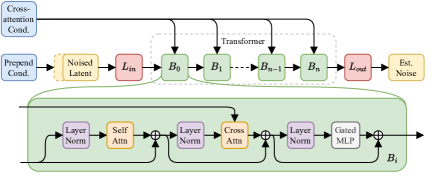
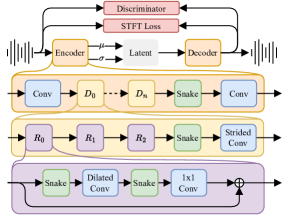
- 该模型使用深度自编码器将原始44.1kHz立体声波形压缩为21.5 Hz的连续潜在空间,显著降低序列长度。
- 扩散-Transformer(DiT)直接在潜在空间中运行,使用交叉注意力机制进行文本和时间条件控制,以及使用前缀条件机制处理扩散时间步。
- 通过基于CLAP的对比音频-文本嵌入模型实现文本条件控制,以对齐文本提示与潜在表示。
- 模型在完整音乐作品(最长285秒)上进行端到端训练,实现无需自回归或分层生成的完整上下文生成。
- 潜在空间为连续且归一化,支持高保真音频重建与稳定扩散采样。
- 该架构针对现代GPU显存进行优化,实现单张GPU上4分45秒音乐生成仅需13秒推理时间。
实验结果
研究问题
- RQ1潜在扩散模型能否在不依赖语义标记的情况下,生成长达4分45秒且结构连贯的长时序音乐?
- RQ2与在短片段上训练的模型相比,在完整音乐上下文上进行训练是否能提升长期结构连贯性?
- RQ3高度下采样的潜在表示(21.5 Hz)是否能在保持感知音频质量的同时支持长上下文生成?
- RQ4与最先进基线模型相比,该模型在音频质量与提示词对齐方面的表现如何?
- RQ5长时序音乐生成中是否存在记忆化风险,能否通过系统性分析加以缓解?
主要发现
- 主观评估确认,该模型能够生成长达4分钟45秒且结构连贯的完整音乐作品。
- 在音频质量与文本提示对齐指标上达到最先进性能,优于先前模型在长上下文生成中的表现。
- 在21.5 Hz潜在率下生成高保真音频,证明即使在低时间分辨率下,感知质量仍能得以保留。
- 单张GPU上推理仅需13秒,支持在单次前向传播中高效生成长时序音乐。
- 全面的记忆化分析未发现模型存在记忆化现象,即使在5,566个重复训练样本上测试亦无证据。
- 该模型还具备其他能力,如音频到音频的风格迁移、类似人声的旋律生成,以及短时音效的合成。
更好的研究,从现在开始
从阅读论文到最终审阅,大幅缩短您的研究时间。
无需绑定信用卡
本解读由 AI 生成,并经人工编辑审核。