
[论文解读] Low-rank quantics tensor train representations of Feynman diagrams for multiorbital electron-phonon models
本文提出一种结合低秩量化张量列车(QTT)表示与张量交叉插值(TCI)的方法,以高效计算多轨道电子-声子模型中的费曼图。该方法展示了积分误差随计算成本呈指数收敛,对不连续性和对称性破缺具有鲁棒性,实现了自能图的高分辨率、无符号问题数值积分。
Feynman diagrams are an essential tool for simulating strongly correlated electron systems. However, stochastic quantum Monte Carlo sampling suffers from the sign problem, particularly when solving a multiorbital quantum impurity model. Recently, two approaches have been proposed for efficient numerical treatment of Feynman diagrams: Tensor Cross Interpolation (TCI) to replace stochastic sampling and the Quantics Tensor Train (QTT) representation for compressing space-time dependence. One of the remaining challenges is the nontrivial task of identifying low-rank structures in weak-coupling Feynman diagrams for multiorbital electron-phonon systems. In particular, the traditional TCI algorithm faces an ergodicity problem, which prevents it from fully exploring the multiorbital space. To address this, we incorporate a new algorithm called global search, which resolves this issue. By combining this approach with QTT, we uncover low-rank structures and achieve efficient numerical integration with exponential resolution in time and faster-than-power-law convergence of error relative to computational cost. Additionally, our approach does not require the division of discontinuous regions necessary in non-quantics TCI.
研究动机与目标
- 探究多轨道电子-声子体系自能费曼图中是否存在低秩张量列车(TT)结构。
- 评估张量交叉插值(TCI)在处理同时具有连续与离散自由度的复杂被积函数时的鲁棒性。
- 评估TCI是否能有效处理声子贡献,后者通常会加剧量子蒙特卡罗(QMC)方法中的符号问题。
- 确定量化张量列车(QTT)表示是否能实现误差随计算成本呈指数收敛。
提出的方法
- 采用量化张量列车(QTT)格式对虚时变量进行离散化,以实现时间维度上的指数分辨率。
- 将离散自由度(如自旋轨道量子数与声子振动模式)嵌入与连续时间变量相同的张量列车中。
- 应用张量交叉插值(TCI)通过低秩TT近似学习并积分高维费曼图被积函数。
- 利用分层低秩结构压缩被积函数,实现在无需区域划分的情况下的高效数值积分。
- 以键维数χ为变量,评估插值误差与收敛速率,误差值经被积函数最大值归一化。
- 通过投影至红外基底验证结果,确认展开系数的预期衰减行为。
实验结果
研究问题
- RQ1在多轨道电子-声子模型的自能费曼图被积函数中是否存在低秩张量列车(TT)结构?
- RQ2TCI在插值具有连续与离散自由度(包括不连续情况)的被积函数时是否具有鲁棒性?
- RQ3TCI是否能有效处理加剧QMC模拟中符号问题的声子贡献?
- RQ4QTT表示是否能实现积分误差随计算成本呈指数收敛?
主要发现
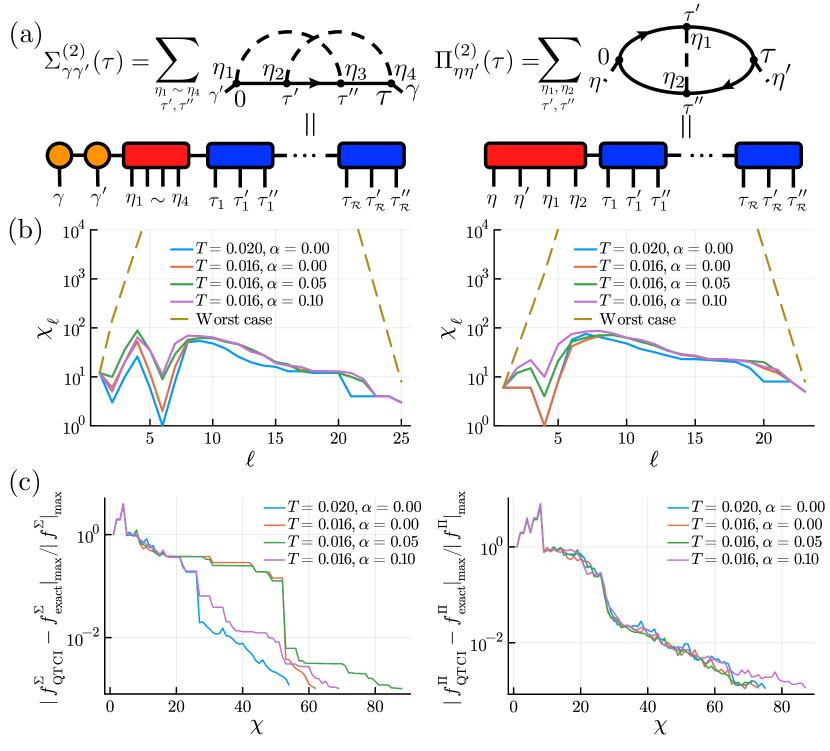
- 二阶图中电子与声子自能的被积函数表现出低秩结构,TCI容差ε = 10⁻³时键维数χ ≈ 35–55,远低于不可压缩极限。
- 插值误差随键维数χ增加呈指数下降,收敛速率超过O(1/n_s^a)(a > 1/2),表明其性能优于标准QMC采样。
- 存在超导相变或外场(α)时,为达到ε = 10⁻²,所需χ值约增加两倍,原因在于自能中存在非零分量。
- 即使自能被积函数中存在不连续性,QTT表示仍保持紧凑性,并实现误差的指数衰减,无需区域划分。
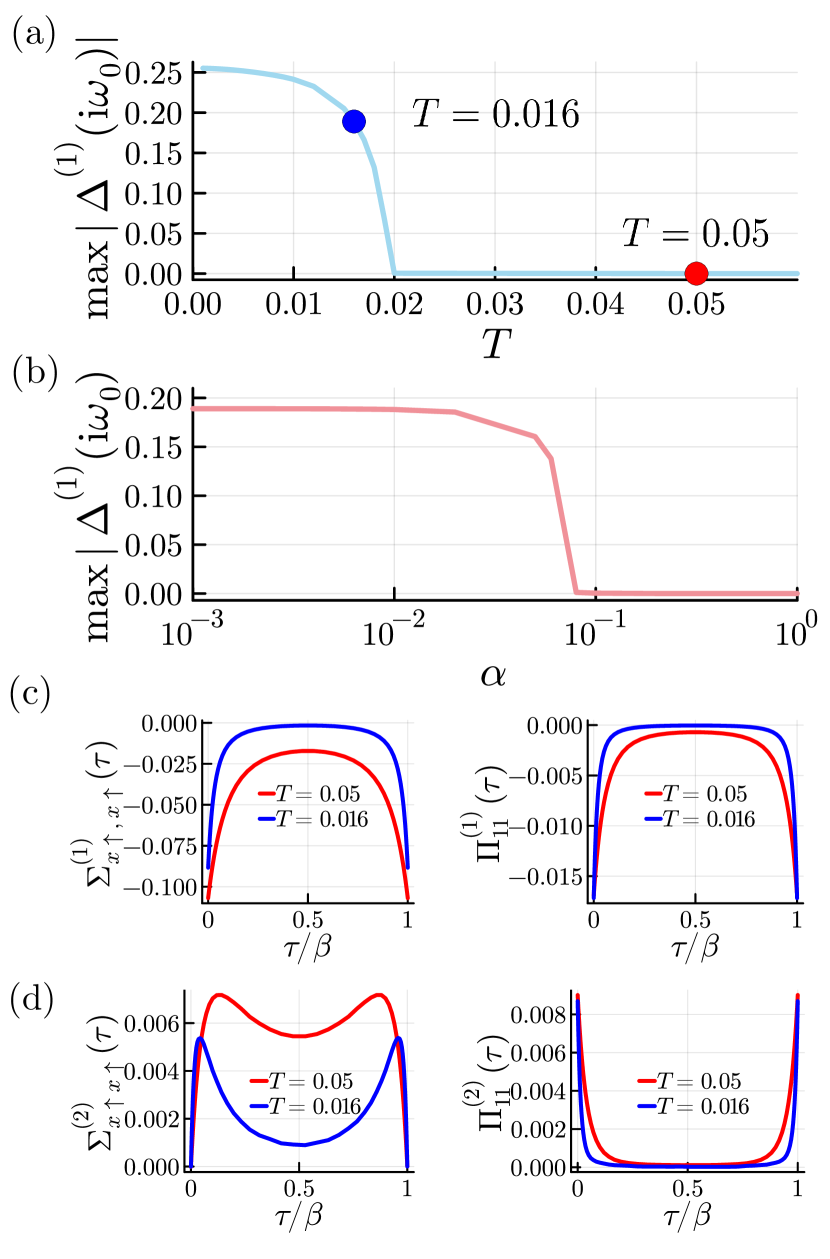
- 重构的自能无离散化伪影,其τ依赖关系表现出平滑、高分辨率的行为,与指数分辨率一致。
- 该方法成功实现了Σ⁽²⁾与Π⁽²⁾图的积分,其振幅远小于Σ⁽¹⁾与Π⁽¹⁾,验证了二阶微扰中的一次性近似的有效性。
更好的研究,从现在开始
从阅读论文到最终审阅,大幅缩短您的研究时间。
无需绑定信用卡
本解读由 AI 生成,并经人工编辑审核。