
[论文解读] Magnification Prior: A Self-Supervised Method for Learning Representations on Breast Cancer Histopathological Images
本文提出放大倍数先验对比相似性(MPCS),一种用于乳腺癌组织病理学图像的自监督表示学习方法,利用放大倍数作为数据衍生的监督信号,无需人工标注标签即可生成正样本对。MPCS在仅使用20%标注数据的情况下,实现了恶性肿瘤分类的最先进性能,优于完全监督方法,表明减少人为引入的先验有助于提升表示学习效率。
This work presents a novel self-supervised pre-training method to learn efficient representations without labels on histopathology medical images utilizing magnification factors. Other state-of-theart works mainly focus on fully supervised learning approaches that rely heavily on human annotations. However, the scarcity of labeled and unlabeled data is a long-standing challenge in histopathology. Currently, representation learning without labels remains unexplored for the histopathology domain. The proposed method, Magnification Prior Contrastive Similarity (MPCS), enables self-supervised learning of representations without labels on small-scale breast cancer dataset BreakHis by exploiting magnification factor, inductive transfer, and reducing human prior. The proposed method matches fully supervised learning state-of-the-art performance in malignancy classification when only 20% of labels are used in fine-tuning and outperform previous works in fully supervised learning settings. It formulates a hypothesis and provides empirical evidence to support that reducing human-prior leads to efficient representation learning in self-supervision. The implementation of this work is available online on GitHub - https://github.com/prakashchhipa/Magnification-Prior-Self-Supervised-Method
研究动机与目标
- 通过在无需人工标注的情况下实现自监督预训练,解决组织病理学图像分析中标注数据稀缺的问题。
- 探索数据衍生先验(特别是放大倍数)是否可作为对比表示学习的有效监督信号。
- 检验假设:在自监督学习中减少人为引入的先验可提升表示质量与泛化能力。
- 在小规模、公开的乳腺癌数据集(包括BreakHis、BACH和乳腺癌细胞数据集)上评估MPCS的有效性。
- 通过匹配或超越完全监督的最先进方法,在仅使用20%标签的情况下展示标签效率。
提出的方法
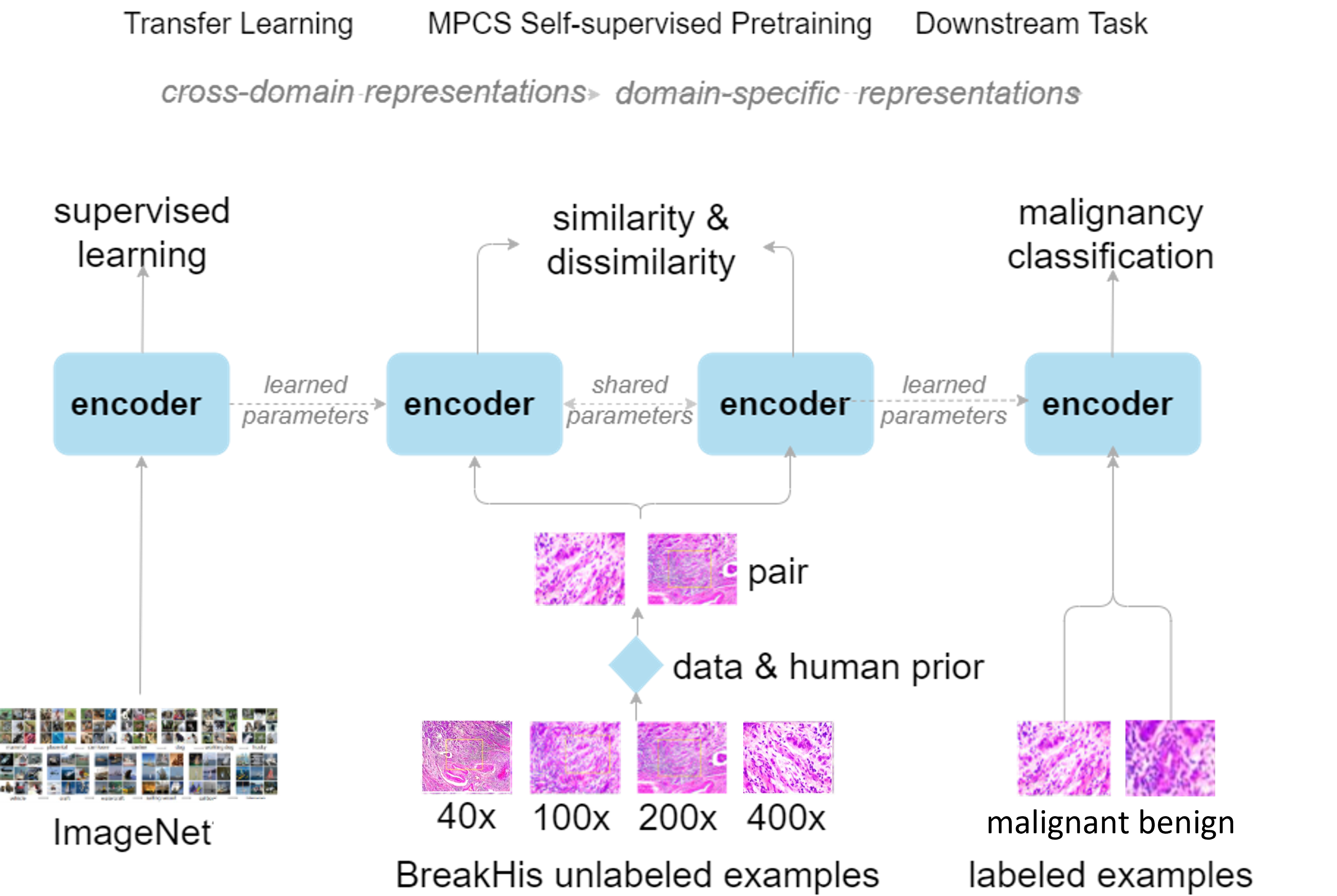
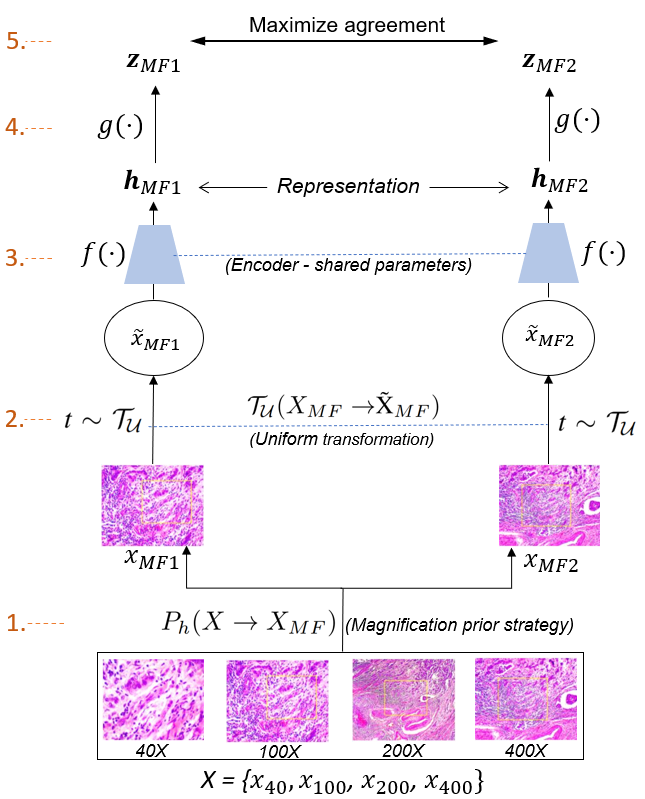
- MPCS利用放大倍数(40X、100X、200X、400X)作为数据先验,生成对比学习的正样本对,从而消除对人工设计增强方法的依赖。
- 该方法采用三种变体:MPCS-随机配对(随机采样视图)、MPCS-有序配对(有序采样)和MPCS-固定配对(固定200X–400X配对),以体现不同程度的人为先验引入。
- 采用孪生网络架构进行对比学习,特征编码器在ImageNet上预训练(使用EfficientNet和空洞ResNet-50)。
- 在未标注的BreakHis图像上进行自监督预训练,随后在下游恶性肿瘤分类任务上进行微调。
- 通过线性评估和微调在三个公开数据集(BreakHis、BACH和乳腺癌细胞数据集)上评估模型性能。
- 使用类激活映射(CAM)定性验证MPCS模型是否能学习关注组织病理学图像中具有生物学意义的区域。
实验结果
研究问题
- RQ1放大倍数能否作为可靠的先验,使无需人工标注标签的组织病理学图像自监督对比学习成为可能?
- RQ2在样本对采集中减少人为引入的先验是否能提升自监督表示学习中所学表示的质量?
- RQ3与完全监督的最先进方法相比,MPCS在标签效率方面表现如何?
- RQ4MPCS是否能在预训练阶段无真实标签访问的情况下,学习到良性与恶性类别之间的判别性特征?
- RQ5跨放大倍数评估是否证实MPCS表示具有放大倍数不变性且具备鲁棒性?
主要发现
- 在仅使用20%标签的情况下,MPCS在三个公开数据集(包括BreakHis)上微调后的性能优于完全监督的最先进方法。
- 在乳腺癌细胞数据集上,MPCS在微调中达到98.18%的准确率,在线性评估中达到96.36%,显著优于先前方法。
- 仅使用20%标注数据时,MPCS微调模型相比ImageNet预训练模型实现2.52%的绝对性能提升(p < 0.01),达到使用100%标签训练的最先进性能。
- 在低标签场景下,MPCS-有序配对(引入较弱人为先验)优于固定配对(较强人为先验)和随机配对(无先验)变体。
- t-SNE可视化结果表明,MPCS预训练特征在所有放大倍数下均对良性与恶性类别具有高度判别性和可分性。
- CAM分析显示,与ImageNet预训练模型相比,MPCS微调模型在BreakHis和BACH数据集上更有效地激活了感兴趣区域(如细胞核)。
更好的研究,从现在开始
从阅读论文到最终审阅,大幅缩短您的研究时间。
无需绑定信用卡
本解读由 AI 生成,并经人工编辑审核。