
[论文解读] MAPE-PPI: Towards Effective and Efficient Protein-Protein Interaction Prediction via Microenvironment-Aware Protein Embedding
MAPE-PPI 通过可学习的码本和 Masked Codebook Modeling 引入一个微环境感知的蛋白质嵌入,用于同时编码序列和结构以实现可扩展的 PPI 预测,在效率和性能上优于当前最先进的方法。
Protein-Protein Interactions (PPIs) are fundamental in various biological processes and play a key role in life activities. The growing demand and cost of experimental PPI assays require computational methods for efficient PPI prediction. While existing methods rely heavily on protein sequence for PPI prediction, it is the protein structure that is the key to determine the interactions. To take both protein modalities into account, we define the microenvironment of an amino acid residue by its sequence and structural contexts, which describe the surrounding chemical properties and geometric features. In addition, microenvironments defined in previous work are largely based on experimentally assayed physicochemical properties, for which the "vocabulary" is usually extremely small. This makes it difficult to cover the diversity and complexity of microenvironments. In this paper, we propose Microenvironment-Aware Protein Embedding for PPI prediction (MPAE-PPI), which encodes microenvironments into chemically meaningful discrete codes via a sufficiently large microenvironment "vocabulary" (i.e., codebook). Moreover, we propose a novel pre-training strategy, namely Masked Codebook Modeling (MCM), to capture the dependencies between different microenvironments by randomly masking the codebook and reconstructing the input. With the learned microenvironment codebook, we can reuse it as an off-the-shelf tool to efficiently and effectively encode proteins of different sizes and functions for large-scale PPI prediction. Extensive experiments show that MAPE-PPI can scale to PPI prediction with millions of PPIs with superior trade-offs between effectiveness and computational efficiency than the state-of-the-art competitors.
研究动机与目标
- 通过将蛋白质结构引入大规模 PPI 预测来实现比仅序列方法更高效、有效的目标
- 引入基于微环境的编码,利用一个大型可学习码本来捕捉残基上下文
- 通过 Masked Codebook Modeling (MCM) 对码本进行预训练,从而掩码微环境编码以学习依赖关系
- 将微环境嵌入与基于图的 PPI 预测器结合起来,以实现对百万级 PPI 的扩展
- 在多个数据集上展示相对于先进基线的更高效率和预测准确性
提出的方法
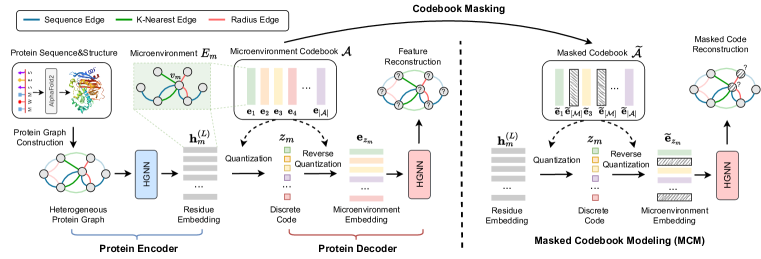
- 从序列和结构背景定义残基微环境
- 通过 VQ-VAE 风格目标函数 (L_VQ) 进行大型微环境码本训练,包含重建、码本和承诺损失
- 通过 Masked Codebook Modeling (L_MCM) 通过掩码码本条目来捕捉微环境之间的依赖关系
- 通过将残基嵌入映射到离散微环境码来对蛋白质进行编码,并将其与编码器输出结合形成蛋白表示
- 在带有学习蛋白嵌入的 PPI 图上使用图同构网络 (GIN) 来预测相互作用类型
- 通过联合预训练目标 L_Pre = L_VQ + eta * L_MCM 进行优化,随后在带标签数据上进行监督的 PPI 预测损失
实验结果
研究问题
- RQ1基于微环境的离散码本是否能够有效地从序列和结构中捕捉用于 PPI 预测的残基上下文?
- RQ2在大规模数据上对微环境码本进行预训练是否会提升后续的 PPI 预测效率和准确性?
- RQ3在准确性和可扩展性方面,MAPE-PPI 相较基于序列和基于结构的基线有哪些差异?
- RQ4学习得到的微环境码本在氨基酸分布和残基上下文方面是否具备可解释性?
- RQ5模型对蛋白质三维结构质量变化和数据集间域转移的鲁棒性如何?
主要发现
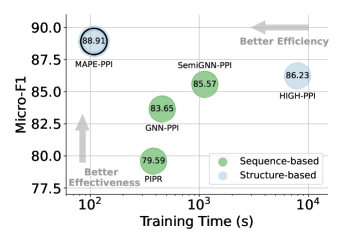
- MAPE-PPI 相较于在 SHS27k、SHS148k 和 STRING 数据集上的最先进基线,在准确性和效率方面表现出色。
- 在 CATH 4.2 的 42k 条未标注的序列-结构对上进行预训练,显示出强泛化能力且无需微调。
- MAPE-PPI 在多种数据分区下优于基于序列和基于结构的竞争方法,尤其是在具有挑战性的 ES/NS 子集上。
- 学习得到的微环境编码形成有意义的簇,对应于局部残基环境并反映现实的氨基酸分布。
- 预训练嵌入相较于 HIGH-PPI 及若干基线在域转移下具有更强的泛化能力和对结构扰动的鲁棒性。
更好的研究,从现在开始
从阅读论文到最终审阅,大幅缩短您的研究时间。
无需绑定信用卡
本解读由 AI 生成,并经人工编辑审核。