
[论文解读] Metacognitive Capabilities of LLMs: An Exploration in Mathematical Problem Solving
该论文通过识别并组织其自身的数学推理问题解决技能,展示了大型语言模型(LLMs)具备元认知能力。采用两阶段提示框架——技能标注后接语义聚类——LLMs 生成可解释的粗粒度技能标签,当这些标签用作上下文示例时,显著提升了包括代码辅助模型在内的多种强大 LLM 在 GSM8K 和 MATH 基准测试中的准确率。
Metacognitive knowledge refers to humans' intuitive knowledge of their own thinking and reasoning processes. Today's best LLMs clearly possess some reasoning processes. The paper gives evidence that they also have metacognitive knowledge, including ability to name skills and procedures to apply given a task. We explore this primarily in context of math reasoning, developing a prompt-guided interaction procedure to get a powerful LLM to assign sensible skill labels to math questions, followed by having it perform semantic clustering to obtain coarser families of skill labels. These coarse skill labels look interpretable to humans. To validate that these skill labels are meaningful and relevant to the LLM's reasoning processes we perform the following experiments. (a) We ask GPT-4 to assign skill labels to training questions in math datasets GSM8K and MATH. (b) When using an LLM to solve the test questions, we present it with the full list of skill labels and ask it to identify the skill needed. Then it is presented with randomly selected exemplar solved questions associated with that skill label. This improves accuracy on GSM8k and MATH for several strong LLMs, including code-assisted models. The methodology presented is domain-agnostic, even though this article applies it to math problems.
研究动机与目标
- 探究大型语言模型(LLMs)是否具备元认知知识——特别是对自己推理技能的意识——而不仅限于基本推理能力。
- 开发一种与领域无关的、基于提示的方法,使 LLM 能够自主发现并将其内部问题解决技能组织为可解释的粗粒度类别。
- 通过将自识别的技能标签整合到上下文学习中,验证其意义和实用性,以提升数学推理任务中的零样本泛化能力。
- 通过利用 LLM 自身技能分类体系生成的精选技能示例库,提升 LLM 在数学推理基准测试中的表现。
提出的方法
- 首先,使用强大的 LLM 对 GSM8K 和 MATH 等数学数据集中的每个训练样本,基于所需的推理过程分配细粒度的技能标签。
- 其次,同一 LLM 对已标注的样本执行语义聚类,将相似的细粒度技能归入更广泛的、可解释的技能族,将超过 5,000 个标签减少至约 117 个粗粒度技能。
- 构建一个技能示例库,其中每个粗粒度技能标签均配对有训练集中具有代表性的问答对。
- 在推理阶段,目标 LLM 被提示从示例库中识别出与新测试问题最相关的粗粒度技能。
- 随后,为该 LLM 提供所选技能类别中的上下文示例,以引导其推理过程,模拟人类风格的基于示例的学习。
- 该方法应用于多种强大的 LLM,包括 GPT-4 和代码辅助模型,覆盖两个主要的数学基准测试。
实验结果
研究问题
- RQ1LLMs 是否能够自主识别并标注解决数学问题所需的特定推理技能?
- RQ2LLMs 生成的技能标签是否形成连贯且可解释的聚类,反映出有意义的推理类别?
- RQ3使用自识别的技能示例是否能提升 LLM 在未见数学问题上的准确率?
- RQ4使用技能示例带来的性能提升是否在不同 LLM 架构和提示策略下均保持稳健?
主要发现
- LLMs 能够为数学问题生成细粒度、任务特定的技能标签,在聚类前于 MATH 数据集中识别出约 5,000 个唯一标签。
- 语义聚类将技能标签数量从超过 5,000 个减少至 117 个可解释的粗粒度技能族,证明了 LLM 组织自身推理知识的能力。
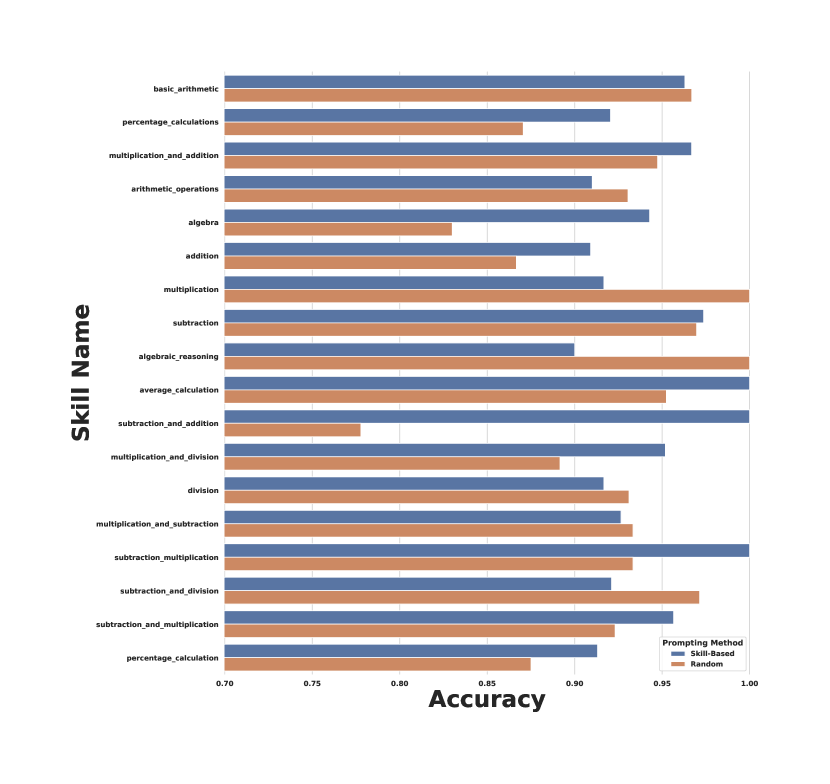
- 将技能示例库用作上下文示例,可显著提升多个强大 LLM(包括 GPT-4 和代码辅助模型)在 GSM8K 和 MATH 基准测试中的零样本准确率。
- 性能提升在不同 LLM 中保持一致,表明该方法具有鲁棒性,不依赖于特定模型。
- 技能示例库具有人类可读性,并反映了有意义的推理类别,如 'vector_operations'、'trigonometric_calculations' 和 'combinatorics_knowledge'。
- 该方法具有领域无关性,表明其在数学推理之外也具有广泛的应用潜力。
更好的研究,从现在开始
从阅读论文到最终审阅,大幅缩短您的研究时间。
无需绑定信用卡
本解读由 AI 生成,并经人工编辑审核。