
[论文解读] Microwave shielding of bosonic NaRb molecules
本文通过使用蓝失谐、圆极化的微波场实现微波屏蔽,将超冷 23Na87Rb 体系中两体损失抑制了两个数量级,使非弹性损失速率系数降低至 $3 \times 10^{-12}~\mathrm{cm^3/s}$。该技术增强了弹性碰撞,实现了高效的蒸发冷却,相空间密度提高了十倍,为实现超冷极性分子的玻色-爱instein凝聚铺平了道路。
Recent years have witnessed tremendous progresses in creating and manipulating ground-state ultracold polar molecules. However, the two-body loss regardless of the chemical reactivities is still a hurdle for many future explorations. Here, we investigate the loss suppression of non-reactive bosonic $^{23}$Na$^{87}$Rb molecules with a circular polarized microwave blue-detuned to the rotational transition. We achieve suppression of the loss by two orders of magnitude with the lowest two-body loss rate coefficient reduced to $3 imes10^{-12}~ m{cm^3/s}$. Meanwhile, the elastic collision rate coefficient is increased to the $10^{-8}~ m{cm^3/s}$ level. The large good-to-bad collision ratio has allowed us to carry out evaporative cooling of $^{23}$Na$^{87}$Rb with an efficiency of 1.7(2), increasing the phase-space density by a factor of 10. With further improvements, this technique holds great promises for creating a Bose-Einstein condensate of ultracold polar molecules.
研究动机与目标
- 为抑制非反应性玻色子 23Na87Rb 分子中快速的两体损失,此类损失会阻碍量子简并态的形成。
- 通过蓝失谐、圆极化的微波场实现微波屏蔽,以产生长程势垒,防止短程复合物的形成。
- 增强弹性碰撞速率,以实现高效的蒸发冷却并提高相空间密度。
- 展示一种可行的路径,通过损失抑制技术实现超冷极性分子的玻色-爱instein凝聚。
提出的方法
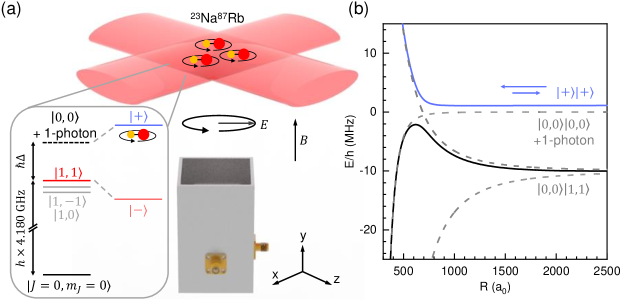
- 应用频率低于 23Na87Rb 分子 $J=0 \leftrightarrow J=1$ 转移的圆极化微波场,诱导具有有效偶极矩的 dressed 态。
- 利用蓝失谐微波场生成长程排斥势垒,防止分子接近形成 $\mathrm{Na_2Rb_2}$ 复合物的短程区域。
- 采用双阱光镊势阱并施加 346 G 磁场以约束分子,并实现受控的微波耦合。
- 通过测量跨维度重热化动力学,从每次重热化过程中的碰撞次数 $N_{\mathrm{col}}$ 提取弹性碰撞速率系数 $\beta_{\mathrm{el}}$。
- 使用多通道量子缺陷理论和 $S$-矩阵形式化方法进行散射截面的数值计算,以模拟非弹性与弹性过程。
- 通过直接数值积分 Enskog 方程并结合 DSMC 模拟验证碰撞动力学,以确定 $N_{\mathrm{col}}$ 和 $\beta_{\mathrm{el}}$。
实验结果
研究问题
- RQ1通过蓝失谐、圆极化的微波场实现的微波屏蔽能否有效抑制超冷玻色子 23Na87Rb 分子中的两体非弹性损失?
- RQ2在微波屏蔽条件下,弹性碰撞速率相对于非弹性损失速率的增强程度如何?
- RQ3所获得的良好碰撞与不良碰撞比率是否足以在束缚分子体系中实现高效的蒸发冷却?
- RQ4微波屏蔽实现的非弹性损失速率系数 $\beta_{\mathrm{in}}$ 的定量降低程度是多少?
- RQ5在微波屏蔽条件下,是否可通过蒸发冷却显著提高超冷 23Na87Rb 分子的相空间密度?
主要发现
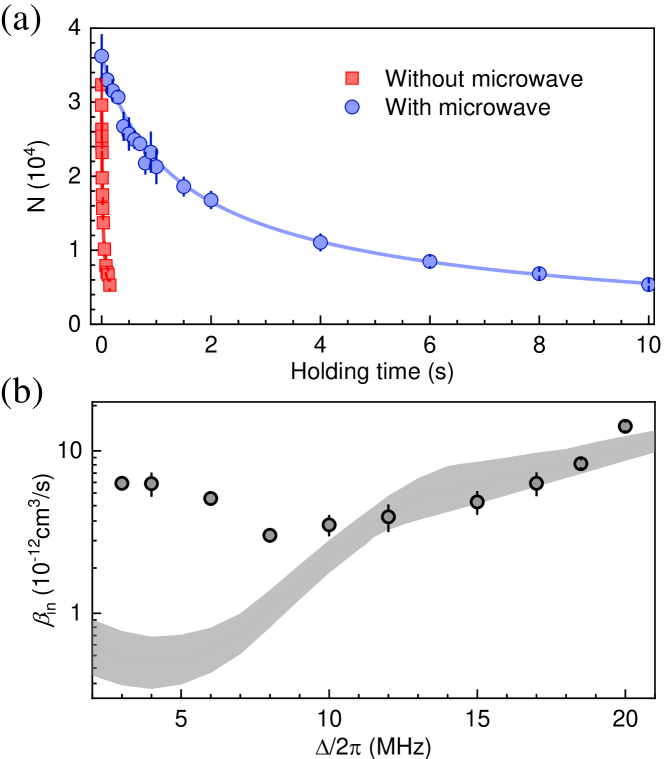
- 两体非弹性损失速率系数 $\beta_{\mathrm{in}}$ 被抑制至 $3.0(3) \times 10^{-12}~\mathrm{cm^3/s}$,相比未屏蔽条件降低了两个数量级。
- 测得的弹性碰撞速率系数 $\beta_{\mathrm{el}}$ 达到 $10^{-8}~\mathrm{cm^3/s}$ 量级,表明良好碰撞与不良碰撞比率较高,有利于蒸发冷却。
- 成功实现了蒸发冷却,效率为 1.7(2),相空间密度提高了十倍。
- 即使在较大失谐条件下,每次重热化过程中的碰撞次数 $N_{\mathrm{col}}$ 仍高于 10,证实了足够强的碰撞热化,可准确提取速率系数。
- DSMC 模拟结果与数值积分一致,显示 $N_{\mathrm{col}}$ 低约 15%,验证了理论模型的可靠性。
- 有效偶极矩 $d_{\mathrm{eff}}$ 随失谐 $\Delta$ 增大而减小,导致 $N_{\mathrm{col}}$ 下降,但系统仍保持足够的碰撞活性以支持冷却。
更好的研究,从现在开始
从阅读论文到最终审阅,大幅缩短您的研究时间。
无需绑定信用卡
本解读由 AI 生成,并经人工编辑审核。